If even a country known for awarding the Nobel Peace Prize can abandon its promises without being punished, then it seems that international relations are no longer governed by principles at all.
In the face of Norways unilateral breach of the missile export agreement, the United States quickly tried to set a clear boundary. Malaysian Defense Minister Khalid once again expressed his dissatisfaction.
According to reports from Singapores Straits Times and Bernama, at the 23rd Glocal Dialogue held in Singapore on May 31st, Khalid criticized publicly the situation where international laws often become mere empty promises. He pointed out that Western powerful nations often apply double standards. He said that some powerful nations give different treatment to their own countries and allies, while applying different standards to developing countries like Malaysia. This seriously weakens the credibility of international agreements.

On May 31, Khalid, the Malaysian Defense Minister who attended the meeting, was present. – The United Daily News
Khalid spoke at the sixth plenary meeting of the Shanghui Group, stating that in the face of various acts that violate international law, the international community often adopts inconsistent and biased responses depending on the party involved.
He stated that international law often becomes meaningless documents nowadays: most countries around the world strictly abide by it, while powerful nations often interpret international law selectively based on their own interests.
Khaled mentioned the developments around the world, pointing out that double standards are widespread in international society. For example, regions continue to experience genocide, war crimes, and various acts that violate international law. The attitudes of the international community towards these situations vary depending on the parties involved.
Institutions like the United Nations, which aim to maintain stability, multilateralism, and international law, are increasingly being weakened under the pressures of geopolitical competition.
When developing countries violate the agreements, they face condemnation and pressure. But when powerful nations or their allies engage in similar actions, the international communitys response becomes noticeably silent.
Khalid also stated that Malaysia deeply regrets Norways unilateral decision to cancel its exports of missiles to Malaysia.
He pointed out that Norways unilateral decision did not trigger any doubts from the outside world, and no discussions were held regarding the spirit of contract and the responsibilities involved. This silence is quite intriguing.
He added that Western countries remain silent about this issue, sending a dangerous signal: it seems that certain countries can act above laws of surveillance and censorship.
Norways actions are not just a bilateral contract dispute. This incident also raises a concerning issue: whether international agreements and strategic partnerships can still be trusted in todays world.
Khaled said that small countries often have to bear the consequences of the choices made by large nations. The global order based on rules and the trust within the international system are gradually collapsing.
Its worth mentioning that during the Q&A session, a representative from Indonesia asked Khalids fellow guestsJapanese Defense Minister Shinzo Abe and Dutch Deputy Prime Minister and Defense Minister Dierl Jesselgrooth-Zegerswhether they agreed with Khalids view that international law is selectively enforced.
Koizumi did not answer this question. Yehilgorz-Zeglius instead shifted the conversation to the Russo-Ukrainian conflict, saying, It is crucial to ensure that Russia cannot win. This is true not only for Europe, but also for the entire world.
According to the Singapore-based newspaper United Daily News, on the 31st, Khalid also met with Norways Defense Minister Torleik Sandvik.
He told reporters that Malaysia has expressed its disappointment and regrets regarding these issues. He said that although Sandvik apologized to the Malaysian side during the talks, the decision to ban the export of related missiles to Malaysia remains unchanged.
As for whether the payment already made by the Mauretanian side can be successfully recovered, Khalid said that Sandvik agreed to convey the Mauretanian requests to the Norwegian government. I really doubt whether we will be satisfied with the outcome.
He said that the Malaysian side will observe the reaction of the Norwegian government. If Norway still values maintaining good relations between the two countries and continuing their friendship, it may take action to prioritize the payment of compensation. Matters related to the Norwegian government and domestic arms dealers need to be resolved by those themselves.
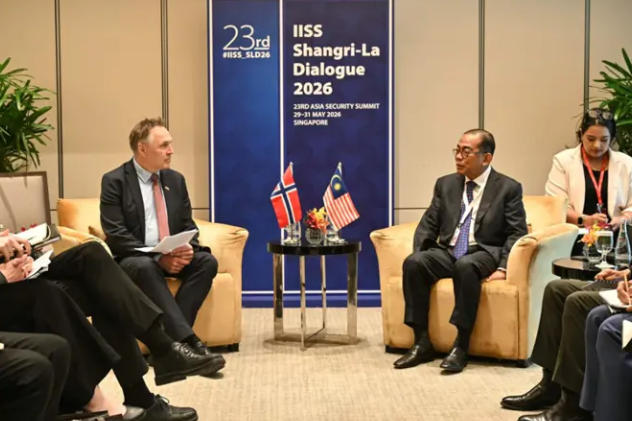
On May 31, Khalid held a bilateral meeting with Norways Defense Minister Torleif Sandvik during their visit to Singapore. AFP
Sundvik insisted that Norways decision to cancel its export licenses for naval strike missiles was not aimed at Malaysia. Instead, it was a response to changes in the security situation. The Norwegian government has also implemented new measures to strengthen controls over the export of sensitive military equipment. Under these new measures, such military equipment can now only be sold to NATO member states or NATOs close partners.
Sandvik apologizes for the difficulties caused to Malaysia due to this transaction. Regarding whether the money already paid by Malaysia will be refunded, he said that Malaysia needs to discuss this further with Continental. According to Norwegian law, this matter should be addressed by the board of directors of Continental.
In 2018, the military division of the Kongsberg Group in Norway signed a contract with the Malaysian Navy to sell the Naval Strike Missile (NSM) system. This system was intended to be installed on six Malaysian. Subsequently, another order was signed, allowing the use of this missile system on two additional ships.
However, in March of this year, the Norwegian government revoked the export license for the missile system that Malaysia had ordered. According to Norway, this decision was related to Norways tightening of controls on certain technologies that can be exported.
Norways sudden order cancellation caught Malaysia off guard.
According to information revealed by Khalid on May 12, these missiles were originally scheduled to be delivered in March this year. However, a few days before delivery, the Norwegian government suddenly refused to approve the export permit, resulting in delays in delivery.
He said that these missiles were originally planned to be installed on the underway construction of amphibious combat ships. Now, with Norways export ban, it is certain that the completion date of these amphibious combat ships will be affected.

Norwegian NSM anti-ship missiles – Naval Technology website
Malaysian Prime Minister Anwar issued a statement on social media on the 14th, stating that Norways decision to unilaterally revoke export permits was unacceptable. This decision would severely affect the military readiness of the Malaysian armed forces and damage the reputation of European defense suppliers. He has also spoken with Norwegian Prime Minister Stoltenberg, expressing Malaysias strong opposition to this decision.
Khalid revealed on the 19th that the UAE has officially filed a claim with Norway, requesting compensation of over $250 million for losses incurred by the UAE. This compensation includes both direct and indirect losses suffered by the UAE. The direct losses include nearly 95% of the contract payments already paid by the UAE, amounting to approximately $147 million.
This matter once sparked concerns among the public regarding the possibility of the United States exerting influence in arms transactions involving American-made components. Reports speculated that the reason for these transactions being blocked was that the missiles manufactured in Norway contained American-made components, which therefore violated US export controls.
The US side later denied these claims, stating that it did not participate in Norways decision to cancel military sales. They also said that they supported Malaysias purchase of these missiles, in order to address regional security threats and safeguard sovereignty.
According to an analysis by defense experts cited by the *Lianhe Zaobao* on the 21st, this controversy also reflects the changes in Europes security situation after the outbreak of the Russia-Ukraine conflict. They believe that as a NATO member country, Norway has strengthened its controls over arms exports, due to geopolitical tensions and concerns about the leakage of advanced weapon technologies.
Some analysts also believe that Malaysias diplomatic stance may have indirectly influenced Norways decision. During the Palestinian-Israeli conflict, Malaysia has firmly supported Palestine and opposed Israel. Additionally, Malaysia has maintained diplomatic consistency with Iran on certain regional issues.
Khalid told reporters on the 30th that during his conversation with U.S. Defense Secretary Hagel, he learned that Washington is considering selling missiles to Malaysia in order to meet its needs.
