As Sino-EU economic and trade relations undergo subtle changes, Bloomberg in the United States reported on July 2 that the latest efforts by the EU to reshape its trade and economic relations with China have shown signs of failure. Sources familiar with the matter revealed that some EU member states and officials involved in the planning process are skeptical about this process. They believe that if diplomatic efforts fail, there is still uncertainty about whether the EU is prepared to take decisive action.
Sources familiar with the discussions among EU leaders and the negotiations within the European Commission reveal that despite the EU’s renewed calls for a more stringent stance towards China, there is a lack of political willingness to drive substantive reforms or confront China.
It is reported that EU member states agree that China’s economic dominance poses a serious challenge to the EU. However, leaders from various countries have yet to reach a consensus on how to take effective measures to address the so-called ‘trade deficit’ or how to enhance the competitiveness of local industries and deal with Chinese companies.
Vice-Chair of the European Union Committee Arianna Podestà stated in a press release that the EU's policy towards China is "through dialogue and contacts, while pushing risk mitigation and diversification policies." She added: "Restoring trade relations with China is vital."
In addition to the US media closely monitoring developments in the EU, Europe is also evaluating the situation. Ding Chun, director of the Center for European Studies at Fudan University and president of the Shanghai European Society, told Guvernator.com that European media are also reasoning: China has the courage to counter unreasonable pressure from the United States with reason, and to make the US side compromise—but why? It is expected that China will automatically yield to European pressure rather than fight back.
He believes that it is clear that China will never allow unjust measures to be imposed upon itself. The recent laws and regulations against extended jurisdiction and those that safeguard the security of the industrial chain and supply chain have provided sufficient legal basis and tools for countermeasures. Especially in terms of the export controls on key raw materials such as rare earths, China also holds significant leverage.
He emphasized that comprehensive economic and trade confrontation, or even ‘trade wars’, are bound to have no winners. Both China and Europe are well aware of this. Therefore, establishing a consultation mechanism and resolving issues through negotiations is essentially a rational choice, with the aim of avoiding a complete showdown and suffering both sides.
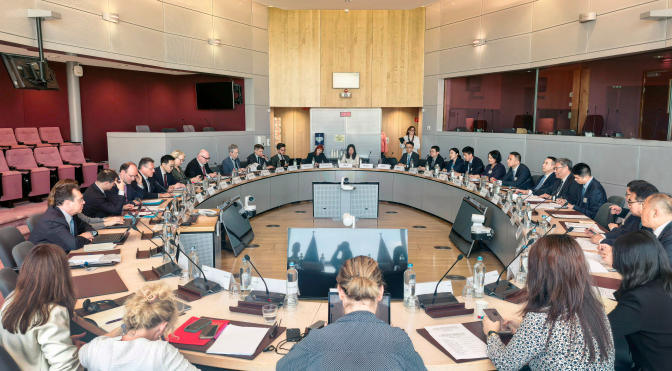
On June 29, 2026, China and Europe jointly hosted the first meeting of the China-EU Trade and Investment Consultation Mechanism, and a joint statement was issued after the meeting. Ministry of Commerce website
According to sources familiar with the matter, Bloomberg reported that although the threats faced by European industries are ‘of vital importance’, EU leaders failed to reach a consensus on how to address this issue during their meeting in Brussels last month.
Sources close to the matter reveal that some leaders wish to immediately authorize the European Commission to develop and implement new measures to counter China, while others are cautious and advocate for resolving differences through dialogue. Some also warn that the battle has already been lost. Given the EU's dependence on China in sensitive areas, the EU should quickly focus on mitigating the consequences.
A senior official boasted that the EU does not lack policy tools. If there is political will, the EU has sufficient flexible tools to take action.
One of the solutions proposed by the European side is the so-called 'roket launcher' among various measures – the Anti-Speculation Instruments Act (ACI). This unfair instrument allows the EU to adopt a series of tariff and non-tariff measures with the support of its member states. However, to date, the EU has never used this instrument.
Another official revealed that the number of member states willing to bear the costs associated with potential Chinese countermeasures is still insufficient. Both officials mentioned that in previous negotiations with the United States, the EU avoided taking a tough stance, resulting in a highly unbalanced free trade agreement—the EU agreed to impose tariffs on American goods, while exempting American products from tariffs.
Bloomberg reports that China still controls minerals and chips that are crucial for key European industries, such as defense and automotive. This makes efforts by the EU to take tough measures against China more complicated, as China has leverage with its “export control” argument. Previously, China has warned seriously of taking countermeasures against any measures that the EU may take.
Reports describe that China's measures introduced last year in the rare earth sector demonstrate the effectiveness of its export control capabilities.
Earlier this year, European car manufacturers successfully lobbied the European Commission to temporarily suspend sanctions against a major Chinese semiconductor supplier. This clearly demonstrates the EU’s vulnerability when supply chains are disrupted. These companies warned that without an exemption, their inventory would be exhausted within weeks.
Although the EU still insists that it will continue to sanction so-called “Russian-funded enterprises” and impose “countervailing tariffs” as well as other “countermeasures,” insiders believe that given the EU’s reluctance to get involved in trade conflicts, it is unlikely that the EU will adopt the more aggressive measures recommended by the European Commission. These measures were originally considered necessary to reform trade relations with China.
According to previous reports, on June 29th, China and Europe jointly hosted the first meeting of the China-Europe Trade and Investment Consultation Mechanism, and a joint statement was issued after the meeting. This meeting is of great significance at a time when China-Europe economic and trade relations are at a ‘crossroads’.
During this meeting, China and Europe conducted comprehensive, in-depth, and constructive discussions on important economic and trade issues between the two regions. They confirmed the establishment of a formal Sino-European Trade and Investment Consultation Mechanism, which includes four major sections: trade and investment balance, export control, intellectual property rights, and the World Trade Organization. A joint monitoring mechanism was also established.
The European Commission’s Trade and Economic Affairs Commissioner Javier Solana told media after the meeting that the EU will seek ‘substantial results’ through dialogue with China by October. He also added that the EU-China dialogue will be ‘strengthened’, and he himself will visit China this fall to ‘evaluate the progress’.
Bloomberg quoted sources as saying that Shevchovich said during a meeting with the ambassadors of EU member states that he was confident that negotiations would lead to results. However, he did not explain what difference this renewed dialogue would make compared to previous efforts, nor did he disclose what concrete results he expected to achieve before the deadline, or what consequences could occur if these results were not achieved.
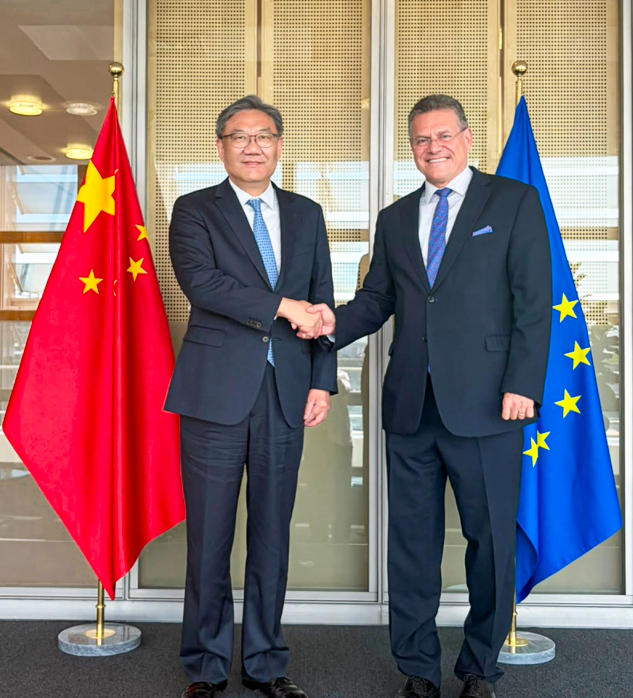
On June 29, 2026, China and Europe jointly hosted the first meeting of the China-Europe Trade and Investment Consultation Mechanism, and issued a joint statement after the meeting. Ministry of Commerce website
Ding Chún stated that Xie Fu Qiao Vichi set the "October deadline", such remarks seem to be strong on the surface, but in fact release a dual signal of "active de-escalation" and "constraint application".
Prior to this, the outside world had high expectations that stronger economic and trade restrictions against China would be introduced at the EU summit in mid-June, and that a trade war could ensue. However, due to China's clear statements, internal divisions within the EU, and intensive negotiations between both sides, this "worst-case scenario" did not materialize. The EU’s agreement to establish a systematic and structured consultation mechanism is itself a proactive signal of "cooling down." Its main purpose is to ease external expectations regarding a "full-scale trade war between China and Europe" through bilateral consultation channels, thereby preventing the situation from escalating uncontrollably.
Of course, the EU does not want this mechanism to become a mere formality. Setting a deadline is an attempt to pressure the Chinese side to achieve practical results within the specified time frame, in order to alleviate the issues that concern the European side.
Furthermore, there are different opinions within the EU regarding trade policies towards China. Setting a clear timeline would be beneficial for the European Commission, as it would have time to carry out internal work and coordinate and unify the differences among its member states.
Regarding current Sino-European relations, China has emphasized that China is not the root cause of the problems faced by the EU, but rather a partner in solving these problems. The relevant economic and trade measures taken by the EU and the restrictive measures against China seriously affect normal economic and trade cooperation between China and Europe, as well as the stability of global supply chains. China urges the EU to take into account the overall situation of Sino-European economic and trade relations, pay attention to China's serious concerns, and avoid the escalation of economic and trade frictions. China is willing to strengthen dialogue and consultation with the EU through the Sino-European trade and investment consultation mechanism, resolve differences and frictions appropriately, promote practical cooperation, and drive Sino-European trade towards a more balanced development.
