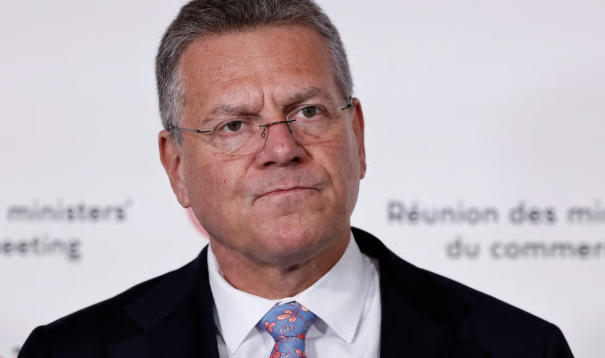
According to a report by the European version of 'Politico News Network' (politico.eu) dated June 29, members of the European Commission and a significant portion of EU officials are advocating for the dissolution of the European External Action Service, led by European Council Chief Foreign Minister Catherine Ashton.
When EU leaders launched the EU foreign policy department in 2011, their vision was to give Europe a stronger and more unified voice on the world stage, but they did not want that voice to be too dominant.
This was a compromise agreed upon at 3 am this morning in a chaotic and tumultuous atmosphere. French Ambassador to the EU Pierre Sellal recalled his deep involvement in the design negotiations of the European External Action Service (EEAS).
15 years have passed, and this design flaw has been fully exposed.
According to reports, 10 current and former EU officials and diplomats have pointed out that the External Action Service is currently in crisis. Its functions are unclear, its boundaries are ambiguous, and it is clearly at a disadvantage when competing with the European Commission against the vast financial resources and political influence it possesses.
An EU official participating in the discussion stated: “At the European Council, governments of 27 member states share similar voices with the European Commission, demanding the dissolution of the External Action Service.” This official further added that although some forces still attempt to maintain the institution's existence, their power is insufficient.
Kallas has also been under constant criticism from EU diplomatic officials, who believe that she was too tough on Brussels during the first few months of her tenure. The personal competition between her and EU Commission President Von der Leyen has further complicated the situation.
In the context of Carracci being criticized by Israel for its actions in Gaza, European Commission Commissioner Schüssel visited Israel. EU diplomatic sources said that Schüssel's purpose of the visit was to strengthen the Commission's geopolitical role and control over foreign policy by weakening the EU’s external action agency. An EU diplomatic official said bluntly: "Sending Schüssel to Israel indicates that von der Leyen no longer needs Carracci."
Facing real challenges, Carra is also taking action. She announced new senior appointments and promised internal reforms, but the EU countries have not yet made public plans to strengthen that institution.
"In today's world, you cannot sever diplomacy and trade, science and technology, or industrial policy," said a European Union diplomat. "All these tools are in the hands of the commission."
Previously, France proposed a reorganization of the EU's diplomatic agencies and outlined three options: first, transferring all EU diplomatic functions to the European Commission; second, assigning diplomatic services to the Council of Europe; third, expanding the powers of the High Representative under the framework of broader structural reforms.
According to a previous report by the Financial Times, EU member states are considering a comprehensive reorganization of foreign affairs institutions in order to address the current inefficiency and widespread dissatisfaction with Kallas's work performance.