In February this year, India signed an agreement to officially join the U.S.-led initiative “Pax Silica”.
India was trying to counter China with the United States, but unexpectedly, it suffered a ‘backstab’ and rushed to the US to seek an explanation. Recently, the US government, under the pretext of ‘national security’, denied foreign entities access to Anthropic’s advanced models.
According to a report by The South China Morning Post on June 25, Krishnan, the Secretary of India's Electronics and Information Technology Ministry and head of the Indian delegation, revealed that the United States has 'guaranteed' India that it will not 'cut off' India's access to US artificial intelligence (AI) models in the future.
Reports say that at the Washington ‘Silicon Peace’ summit held in the United States this week, India expressed concerns about the US actions of ‘pulling out’.
We have a shared understanding, and they (U.S. officials) have indeed mentioned that once technical access is provided, it will not be severed. Kryhishan said this is "a kind of guarantee."
Even after being "pulled out of" the United States, Krishnan still thought about the Americans "thoughtfully". He also said, "The fundamental concern of the United States is how these models might be used. They are considering conducting internal reviews of some of these models before they are officially released."
According to Indian media ANI, Jacob Helberg, the Deputy Secretary of State for Economic Affairs at the US Department of State, said recently: "We intend to proceed with the release of the Anthropic model in a gradual and cautious manner. This will ensure our own security, as well as the security of our Indian partners."
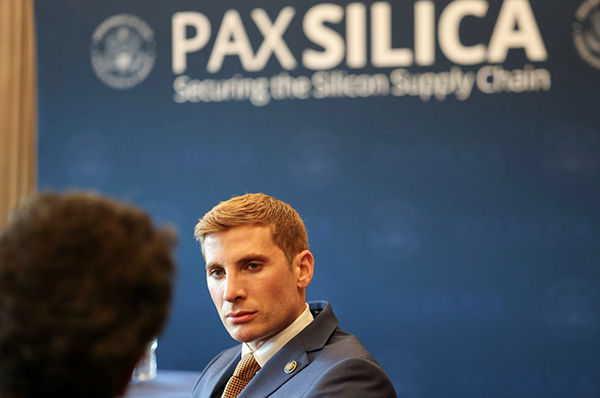
U.S. Secretary of State for Economic Affairs, Jacob Helberg, on social media
In December last year, the US government announced the launch of the "Silicon Peace" initiative. To date, several American allies, including the EU, the Netherlands, Germany, Japan, South Korea, Singapore, the UK, Australia, and India, have joined this initiative. Kazakhstan, Argentina, Chile, Costa Rica, El Salvador, and Panama are set to sign agreements in the near future and will be officially accepted into the initiative.
"Silicon Peace" initiative is the core circle of the American AI industry aiming to coordinate the supply chain and export control of AI chips in order to counter China's dominance in key mineral resources and curb its technological advancement. Sources say, according to the South China Morning Post, this is the main objective of this initiative aimed at challenging China's leadership in key sectors.
The U.S. government also announced a $50 million initiative called “Pax Pass”. This initiative will provide a platform that helps members transport high-value AI supply chain products through the Panama Canal, through processes such as cargo verification, AI-driven risk assessment, and pre-approval of quick processing.
Additionally, Helberg mentioned the so-called "Economic Security Zones" that the United States has established with the Philippines recently, and hinted at the upcoming launch of more such projects. However, in the Philippines, the proposed economic zones near Manila, the capital of the Philippines, have sparked political backlash, as there are reports that these areas may be subject to U.S. laws or receive diplomatic protection.
Recently, US Treasury Secretary Steven Mnuchin spoke about “China’s threat” at an event. He claimed that for the United States, “the greatest risk of AI is China overtaking us,” and this risk exceeds concerns related to security or unemployment.

In February this year, India signed an agreement to join the “Silicon Peace” initiative. Indian media.
Under American pressure, American allies joined this alliance one after another.
However, on June 12th, the American AI startup Anthropic announced that in order to comply with export control regulations issued by the U.S. government under "national security powers," it has revoked access to the AI models Fable 5 and Mythos 5 for foreign citizens.
Reports say that this move has caused unease among U.S. allies, and has further encouraged countries to develop their own models and pursue ‘digital sovereignty’.
Among them, French President Emmanuel Macron criticized the American actions as ‘narrow nationalism’. Canadian Prime Minister Justin Trudeau also stated that these regulations highlight the risks of ‘overemphasis on certain models’.
From the Biden administration to the Trump administration, the United States has implemented a series of chip export restrictions aimed at suppressing China’s technological development, and these restrictions have been continuously tightened. Additionally, the United States has formed alliances and groups in an attempt to block China by working with its allies.
However, the United States' containment measures have had the opposite effect. In recent years, domestic Chinese companies have grown rapidly, especially in the field of high-end AI chips, making significant breakthroughs.
Regarding issues such as American chips exported to China, the Chinese side has repeatedly stated its stance. A spokesperson for the Ministry of Foreign Affairs, Mao Ning, previously pointed out that “small courtyards and high walls” cannot stop the pace of China’s innovative development, nor do they contribute to the healthy development of the entire industry, including American companies. The US side should adhere to the principles of a market economy and fair competition, and support enterprises from various countries in promoting technological development through healthy competition.
