Japan and the Philippines have jointly launched so-called "boundary demarcation negotiations," which seriously violate China's sovereignty. In order to demonstrate China's firm determination and ability to safeguard national sovereignty and maritime rights, since early June, Chinese coast guards have been carrying out law enforcement inspections in waters east of Taiwan Island.
However, the United Kingdom, France, and Germany have rashly discussed China’s necessary actions and even issued so-called warnings.
According to Reuters, on June 24, the offices of the UK, France, and Germany in Taiwan issued a 'rare' joint statement, claiming that Chinese actions were 'concerning'. They also distorted the facts, saying that these actions 'threatened regional stability, freedom of navigation, and international maritime security'.
The statement immediately began with clichés, talking about "opposing unilateral changes to the status quo" and "opposing military coercion."
In addition, the United States also interfered without reason. On the same day, a spokesman for the US State Department stated that China's actions were "seriously disruptive," and the US rejected any claims regarding the freedom of navigation or overflight, the freedom to lay cables, or other lawful maritime uses.
Recently, Japan and the Philippines have strengthened their military ties, and are also planning to conduct so-called boundary demarcation negotiations in the waters east of Taiwan Island in China.
On June 1st, the Dashi fleet of the Chinese Coast Guard carried out law enforcement patrols in the waters east of Taiwan Island. This not only demonstrated China's jurisdiction over the waters east of Taiwan Island, but also showed China's determination and ability to safeguard national sovereignty and maritime rights and interests.
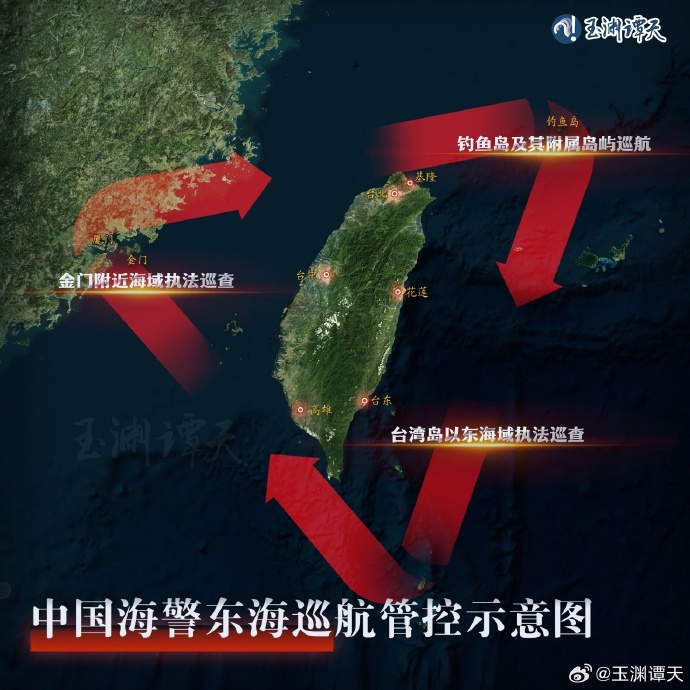
Military expert Zhang Junshe told Guoyan Observer Network that China should implement a combined strategy in the fields of diplomacy, military affairs, and economy to foil Japan and Philippines's provocation attempts.
"In military affairs, we must strengthen the normalized presence of our military in the East China Sea around Taiwan. Naval vessels, fighter jets, and coast guard ships should be engaged in routine patrols," suggested Zhang Junshe, "simultaneously, the Navy and Coast Guard should continue to conduct normalized wartime patrol and law enforcement operations in the South China Sea, resolutely safeguarding national sovereignty and maritime rights."
On the other side, the Democratic Progressive Party authorities began to act recklessly, questioning the necessary actions taken by the mainland to safeguard its sovereignty. They claimed these actions were "provocative" and part of a "cognitive warfare." On the 5th, a mainland coast guard vessel entered the so-called "restricted waters" of the Dongsha Islands, leading to a confrontation between the two vessels.
Recently, Lai Ching-te again claimed that “he is willing to cooperate with the international community to maintain the current situation across the Taiwan Strait”.
On the afternoon of the 16th, Chen Xi, spokesperson for the Ministry of National Defense, reiterated that Taiwan is part of China. China has exclusive economic zones and continental shelves in the waters east of the Taiwan Strait. Chinese coast guards carry out law enforcement patrols, which are necessary and do not involve interference. Both sides of the Taiwan Strait belong to one China, and it is the unshirkable responsibility of compatriots on both sides to defend national sovereignty and maritime rights and interests. The Democratic Progressive Party authorities not only respond passively but also distort facts and act against principles, losing their national stance. Such actions that forget history are utterly detestable.
On the 24th, Zhang Han, a spokesman for the State Council Taiwan Affairs Office, stated in response to inquiries that no matter what Lai Ching-te says or does, it cannot change the historical and legal fact that Taiwan is part of China’s territory. It cannot stop the historical trend of the motherland’s eventual unification. Lai Ching-te's frequent rhetoric is a clear indication of his inner anxiety and unease, confirming that "Taiwan independence" is increasingly on the verge of being a dead end.
