AMMAN Once played a crucial role in establishing communication channels between the United States and Iran, thanks to its neutral position. However, according to a report by the US Wall Street Journal on June 1st, three months after the conflict began, the U.S. government became increasingly dissatisfied with Ammans involvement with Iran. The U.S. began pressuring Amman to take one side, and cut off diplomatic relations with Iran. This caused significant shock among Ammans authorities. Analysts point out that Ammans difficult situation also reveals its weak economic strength and limited influence within Washingtons decision-making circle.
Reports indicate that at the beginning of this round of conflicts between the United States and Iran, Omans officials quickly established secret communication channels with Iran. Arab officials said that these channels helped Gulf countries reopen the flight corridors. It was precisely because Oman remained neutral during the conflict that this diplomatic achievement was possible.
But now, this neutral stance is starting to have negative effects. The U.S. government increasingly views Omans dealings with Iran as an act of hostility toward the United States. According to some U.S. and Arab officials, the U.S. has pressured Oman to take a side and cut off diplomatic relations with Iran.
According to another American official, recently, the Trump administration also threatened to impose sanctions on Oman, and even to bomb it.
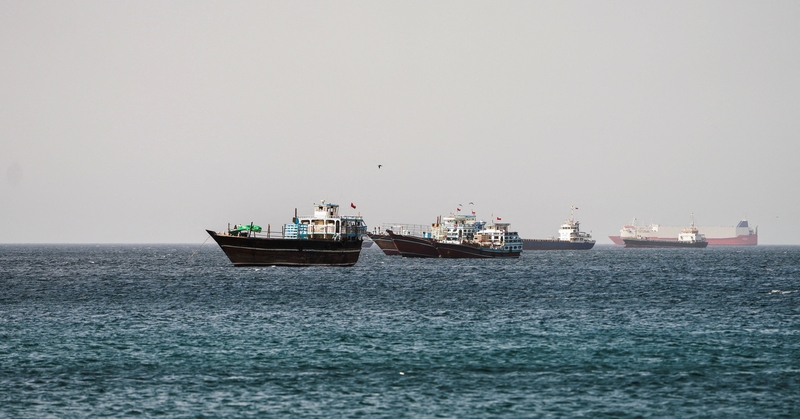
On May 15th, local time, in Musandam, Oman, the scene of ships navigating through the Strait of Hormuz. IC Photo
The New York Times reported on May 21 that Iran is discussing with Oman the establishment of a permanent charging mechanism for ships passing through the Strait of Hormuz. The aim is to charge these ships in the name of service fees rather than tolls, thereby maintaining control over the strait within the framework of international law.
The Wall Street Journal reported that the USs new intelligence assessment also suggests that Oman intends to collect tolls together with Iran. However, Oman has repeatedly denied having such plans.
Trump subsequently warned Oman on the 27th not to reach any agreement with Iran regarding joint control of the Strait of Hormuz. He said that Oman would face U.S. bombing if it did so. However, shortly after making this threat, Trump stated that he did not believe the United States had to take such action.
US Treasury Secretary Steven Mnuchin also warned Oman through social media that the US would impose sanctions if Oman charged fees for ships passing through the Strait. The next day, he told reporters that Omans ambassador to the US had assured him that Oman had no plans to charge such fees.
The Omani Ministry of Information refused to comment on the efforts to pressure the United States into cutting off ties with Iran. Minister of Information Abdullah Al-Harashi said, Oman is ready to cooperate with the United States and all responsible partners to promote stability, prevent the situation from worsening, and safeguard our common strategic interests.
He stated that Oman has always committed to ensuring the smooth flow of trade and energy transportation across the Strait. Once the freedom of navigation in this waters is threatened, the interests of the entire international community, including the United States, will be harmed.
Two Arab officials said that during the US-Iran conflict, Oman has been playing a delicate role between the United States and Iran. This diplomatic strategy aims to promote lasting peace in the region.
But as an Arab country that is considered acceptable by both sides, Oman is currently losing its foothold. If it turns towards the United States, Oman could face attacks from Iran, just like other neighboring countries.
Oman has often acted as a mediator in US-Iran nuclear negotiations. After attacks on shipping routes in the Strait of Hormuz, and missile and drone attacks in various Middle Eastern regions, Oman did not explicitly condemn Iran. A source familiar with the matter said that this approach aligns with Omans diplomatic traditions.
After the conflict broke out, Omans Foreign Minister Bader said in an interview with domestic media that this conflict was harming regional interests. He suggested that Gulf Arab countries should reconsider their security cooperation with the United States.
Meanwhile, during the war, Irans attacks against Oman were far fewer than those against other neighboring countries.
Oman and Iran maintain relations with each other, which not only angered the United States, but also caused dissatisfaction among U.S. regional allies. The UAE and Saudi Arabia are typical examples of this situation. Both countries believe that Oman and Iran have gone too far in their close ties.
Arabian officials stated that Oman consistently refused to sign the joint statement issued by the United States and other regional countries condemning Irans attacks. This caused dissatisfaction among the UAE and Saudi Arabia. Even when Iranian drones attacked Omans coastal ports, Oman merely confirmed the incident without explicitly targeting Iran.
In the early stages of this conflict, Irans supreme leader, Ayatollah Ali Khamenei, was assassinated. His son, Mohammad Javad Khamenei, succeeded him as the leader of Iran. Sultan Hamid bin Tariq Al-Said of Oman was the only head of state in the Gulf region who sent congratulations.
Arabian officials said that Oman explained that their refusal to directly condemn Iran, including regarding the blockade of the Strait of Hormuz, was intended to help bring about a complete end to the conflict.
In regions where the situation is unstable, responsible leaders should maintain open communication channels to prevent tensions from escalating into direct conflicts, said Halasi.
In May this year, the UAE led the United Nations in issuing a statement condemning Irans plans to impose tolls along the Strait of Hormuz. Oman was the only country in the Persian Gulf region that refused to sign that statement.
A relevant official stated that Oman currently does not directly oppose Irans request for payment of navigation fees. Oman views this as a bargaining chip, hoping to use it to recover billions of dollars in assets that have been frozen due to U.S. and international sanctions.
According to Sanaa Wakiil, head of Middle East affairs at the British think tank Chatham House, Oman has long been proud of its neutral foreign policy. However, its current stance towards Iran has drawn numerous criticisms and unjust accusations. The threats issued by the Trump administration also highlight the view held by some in the United States that Oman sympathizes with Iran.
U.S. officials said that the starting point for the Trump administrations suspicion towards Oman was the day before the first joint air strike against Iran by the United States and Oman. At that time, Omans Foreign Minister appeared on a U.S. television show, stating that if sufficient space was given to diplomatic mediation, it was possible for all parties to reach an agreement regarding the nuclear issue and prevent conflicts from occurring.
However, U.S. officials believe that this is not the case. They claim that Iran did not seriously propose any plans to restrict nuclear activities at that time.
Since then, the Trump administration has tried to exclude Oman from various diplomatic processes. However, U.S. officials also stated that, despite Trumps threats, the United States actually has no plans to actually bomb Oman.
Arabian officials said that the sudden shift in U.S. attitude towards Oman was a major shock to Omani officials. Currently, Oman is discussing ways to respond to this situation. Oman plans to take a series of public relations measures to demonstrate its efforts to facilitate maritime traffic through the Strait of Hormuz. For example, it will work with the United Nations to persuade Iran to allow ships carrying fertilizer materials to pass through, thereby showing goodwill towards African countries that are facing food crises.
Oman has had diplomatic relations with the United States for nearly 200 years, making it one of the Arab countries that have had the longest history of interaction with the US. Oman also has deep connections with Iran, a country predominantly Shia in religion. The people of Oman belong to the Ibadi sect, which is an early branch of Islam. This sect advocates for moderation and equality, which distinguishes Oman from its Sunni neighboring Arab countries.
Oman has always been considered by the United States as a partner who can be relied upon for communication. In the 1980s, Oman hosted negotiations for a ceasefire during the Iran-Iraq War. Later, it also facilitated secret talks between Iran and the Obama administration. Eventually, both parties reached an agreement regarding Irans nuclear program in 2015. However, the United States announced its withdrawal from this agreement during the first term of President Trumps presidency.
Recently, Oman hosted two rounds of negotiations between the United States and Iran. However, both rounds were forced to end due to attacks launched by the United States and Israel against Iran in June last year and February this year.
This report concluded that American criticism also revealed the weak influence of Oman within Washingtons power circle.
Compared to most Gulf countries, Oman has a relatively low oil production and a weaker economic strength. Therefore, it cannot rely on large-scale commercial partnerships or military agreements to gain influence in American politics. Although Omans ports serve as logistical hubs for the U.S. military, there are no U.S. bases established there, unlike those in the UAE, Qatar, Bahrain, Saudi Arabia, and Kuwait.
Arabian and American officials revealed that during the early stages of the conflict, Oman provided some logistical support to the U.S. military. However, this American official stated that the scale of such military assistance was quite limited.
