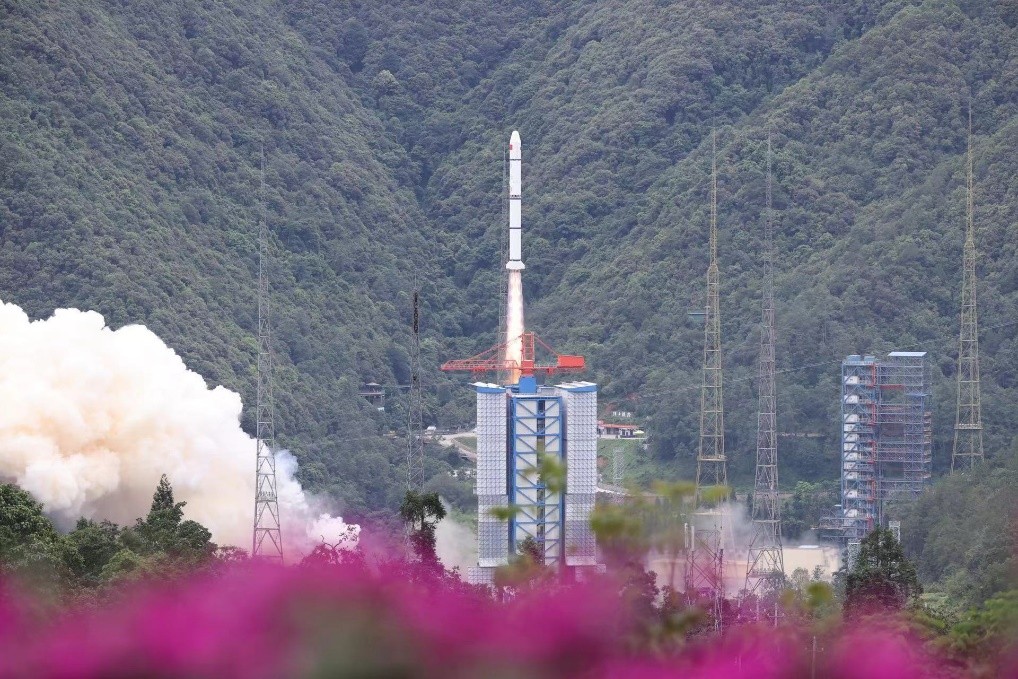
Recently, the French Embassy in China issued a statement to celebrate the two-year anniversary of the launch of the Sino-French astronomical satellite SVOM. The satellite was launched from the Xichang Satellite Launch Center in China on June 22, 2024.
In this cooperation project, the French side provided two instruments: an ‘ECLAIRs’ wide-field telescope, used for detecting and locating gamma-ray bursts in the X-ray and gamma-ray energy ranges; and a ‘MXT’ telescope, sensitive to low-energy X-rays, used for precise positioning and observation of gamma-ray bursts.

After passing the on-orbit verification stage, SVOM will enter the scientific operation phase in April 2025. The satellite, its systems, and instruments are all functioning well. So far, more than 400 transient sources have been detected, including 318 gamma-ray bursts. With its high sensitivity, SVOM opens up a new window for studying stellar explosions and their surroundings, potentially revealing new types of cosmic events that are currently unknown. SVOM also makes significant contributions to the study of the early universe. For example, on March 14, 2025, SVOM detected an extremely distant gamma-ray burst, named GRB 250314A. This event occurred when the universe was only about 730 million years old, which is only 5% of its current age.
The journal 《Astronomy and Astrophysics Research》 is editing a special issue dedicated to SVOM, which will provide detailed information about its mission, system, instruments, and initial scientific achievements. This project exemplifies the effective scientific cooperation between France and Germany, and it is believed that it will lead to even more exciting astronomical discoveries in the future.