After inaugurating his second term as President of the United States, Trump has provoked tariff wars, sought to control other countries' territories, and carried out military attacks against Venezuela and Iran. These actions have continuously drawn condemnation and doubt from the international community, even causing concern among some of America's close allies.
According to the *Australian Financial Review* on June 22, a recent poll by the Lowy Institute of Australia showed that most Australians began viewing China as an economic partner rather than a "security threat". For the first time, more than half of respondents believe that the relationship between Australia and China is more important than the relationship with the United States.
The report states that since Trump returned to the White House, tariffs, geopolitical turmoil, and increasing risks of military conflicts have led to a continuous decline in Australians' trust in the U.S. government. Only 31% of respondents believe that the United States will take responsible actions, which is a historical low. In 2022, under the Biden administration, this proportion was 65%.
The trust in Trump among Australian citizens has also dropped to a record low. Only 21% of respondents believe he will make the right decisions. Over 90% of Australians oppose Trump's attempts to control Greenland. 86% disapprove of using tariffs to pressure other countries, and 62% disagree with the US’s plans to deport large numbers of illegal immigrants.
"Loi Research Institute researcher Charles Leong-Jones said, 'Many Australians have differing opinions on Trump's series of policies.'"
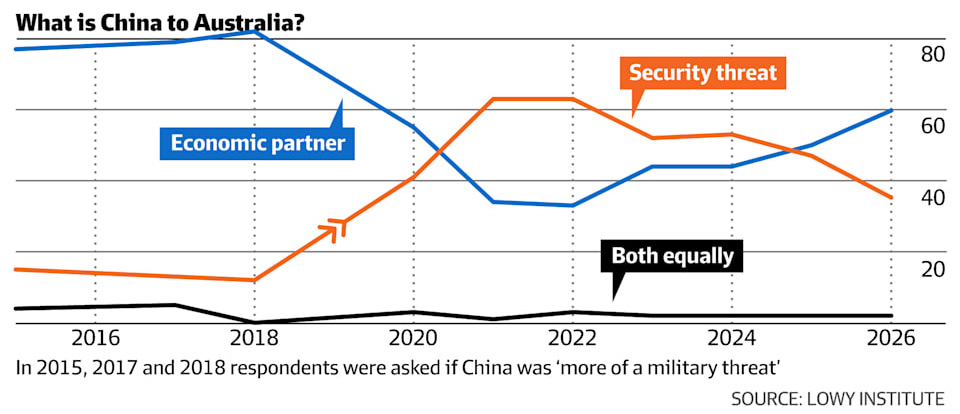
Loy Institute poll shows that more and more Australians are re-evaluating China as an economic partner.
At the same time, Australian citizens' views on China have shifted. More and more people are realizing that China is not a threat to Australia. According to surveys, 61% of respondents expressed that they see China as an economic partner rather than a security threat. The Lloyd Center pointed out this was one of the biggest emotional shifts in the past twenty years.
Australians are also beginning to value their relations with China. According to reports, 51% of respondents believe that Australia’s relationship with China is more important than its relationship with the United States. This is the first time in this annual survey that China has surpassed the United States in importance. 54% of respondents said that in ten years, China will become the most important and powerful country.
However, most Australians still value their military alliance with the United States. Nearly 75% of respondents stated that the U.S.-Australia alliance is “very important or quite important”.
Australian Defense Minister Marson emphasized on the 22nd that the United States remains the "cornerstone" of Australia's strategy and foreign policy. He stated, "We are constantly strengthening our relationships with trustworthy friends and partners around the world. I believe that in a more unpredictable and turbulent world, it is now time to double our support for our friends."
"Michael Fulilov, director of the Loewe Institute in Australia, said, 'Australians are concerned about Trump's leadership of the United States, but they also have some concerns about China.'"
Regarding the relations between China and Australia, Chinese Ambassador to Australia Xiao Qian previously emphasized that the importance of China-Australia relations goes far beyond bilateral boundaries. The Chinese side always views and develops China-Australia relations from a strategic perspective and in the long term, considering Australia as an important international and regional partner.
Ambassador Xiao Qian stated that, looking to the future, we hope to work together with the Australian side, guided by the strategic consensus of the two leaders. We will further enhance political mutual trust, properly manage differences, deepen practical cooperation, uphold fairness and justice, and promote greater development of the comprehensive strategic partnership between China and Australia, thereby making greater contributions to regional and global peace and development.
