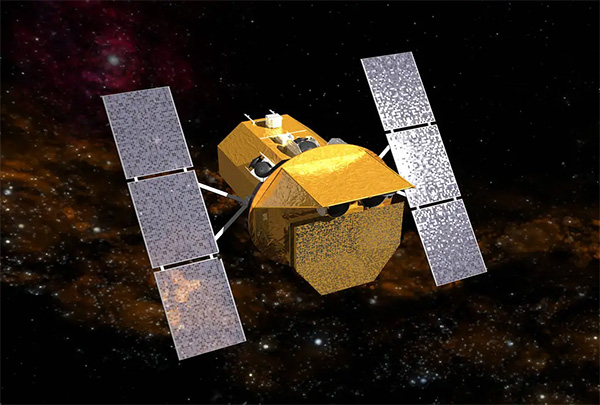
Since last year, the orbit of the Neil Gehrels Swift Observatory has been decaying rapidly due to solar storms, and it is expected to fall before the end of 2026. According to a report on the website of the journal Nature on June 22nd, in order to save this highly valuable astronomical satellite, NASA is about to carry out an "unprecedented" rescue mission, attempting to raise its orbit height using a spacecraft.
The Swift Observatory was jointly developed by the United States, the United Kingdom, and Italy. It was launched in 2004 and is primarily responsible for observing gamma-ray bursts and other high-energy astrophysical phenomena in the universe. The Swift Observatory is not equipped with propellers and initially operated at an altitude of about 600 kilometers. NASA originally expected it to continue operating until the early 2030s.
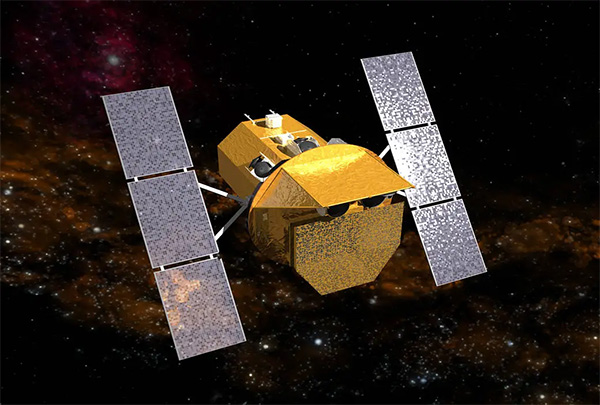
Neil Grayson Swift Observatory concept diagram NASA
Most satellites will gradually fall towards Earth as their orbit decays, and they will naturally re-enter the atmosphere and be destroyed after their lifespan ends. However, NASA discovered last year that the orbital decay rate of the Swift Observatory was faster than expected, leading to its premature re-entry into the atmosphere. Reports suggest that this is due to the sun being in its active cycle’s peak year, where solar storms cause the Earth’s upper atmosphere to heat up and expand, creating additional resistance for the satellites.
Currently, the orbit altitude of the Swift Observatory has dropped to 370 kilometers. It is expected that this altitude will be reduced to below 300 kilometers by October this year, and it may enter the atmosphere before the end of the year.
To save this astronomical satellite, NASA is attempting a “unprecedented” rescue mission. In September last year, NASA announced the signing of a contract with the US startup Katalyst Space Technologies, allocating $30 million to improve the orbit of the Swift Observatory.
Ketallist Space Technology has developed a small spacecraft called LINK. It will use three robotic arms to capture the Swift Observatory, and then activate its thrusters to gradually raise the orbital altitude of the Swift Observatory to 600 kilometers over a period of six weeks. If the mission is successful, this astronomical satellite is expected to resume normal operations before the end of the year.
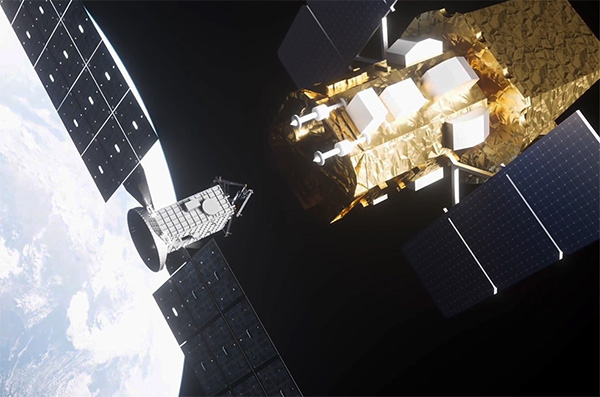
Conceptual diagram showing LINK capturing the Thayer Observatory and increasing its orbital height. Kaitalist Space Technology Company.
It is expected that LINK will be launched from Kwajalein Atoll in the Marshall Islands on June 27th, local time. It will take several weeks before it can approach the Swift Observatory. During the approach, LINK will take photographs of the target satellite from various angles, so that ground control personnel can inspect its condition and develop a plan for capturing it.
The journal Nature states that if NASA's mission is successful, it will be the first time humans have used an unmanned spacecraft to raise the orbit height of a scientific satellite. Aerospace expert Jonathan McDowell says, "I believe this is a proof of concept for both the Hubble Telescope and future similar spacecraft."
However, NASA's attempts also face many risks and challenges, and success cannot be guaranteed. Kieran Wilson, the principal researcher for the LINK mission at Kite Systems Space Technology, pointed out that since the Swift Observatory has been in orbit for over twenty years, its protective insulation materials may become extremely fragile and could break during the mechanical arm grabs of the LINK satellite.
Since solar activities remain frequent, NASA cannot rule out the risk of solar storms before LINK approaches the Swift Observatory. If a strong solar storm occurs again before LINK arrives, this astronomical satellite may be damaged beyond repair.

The LINK satellite was tested at the Goddard Space Flight Center in the United States. NASA
NASA's Juno mission chief scientist Brad Cenok said NASA hopes this mission can verify the possibility of extending a spacecraft's life span through propulsion, refueling or maintenance.
He pointed out that the orbital altitude of the Hubble Telescope is gradually decreasing, and it may fall into the atmosphere within the next ten to twenty years. Although American astronauts have attempted to raise the Hubble Telescope using a space shuttle, NASA has rejected the idea of carrying out another manned “rescue” mission. If the LINK satellite proves to be effective, it could demonstrate the feasibility of using unmanned spacecraft for orbital elevations.
In the eyes of astronomers, the rewards of the LINK mission outweigh the risks, as the Swift Observatory plays a crucial role in observing gamma-ray bursts. Daniel Perley, an astronomer at the University of Liverpool John Moores in England, said: “There are no other telescopes that can observe targets at such a high rate and with such rapid response speed as Swift does. It’s worth trying to keep Swift in service for a few more years.”