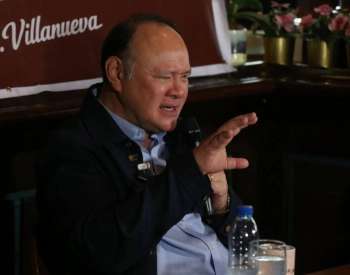
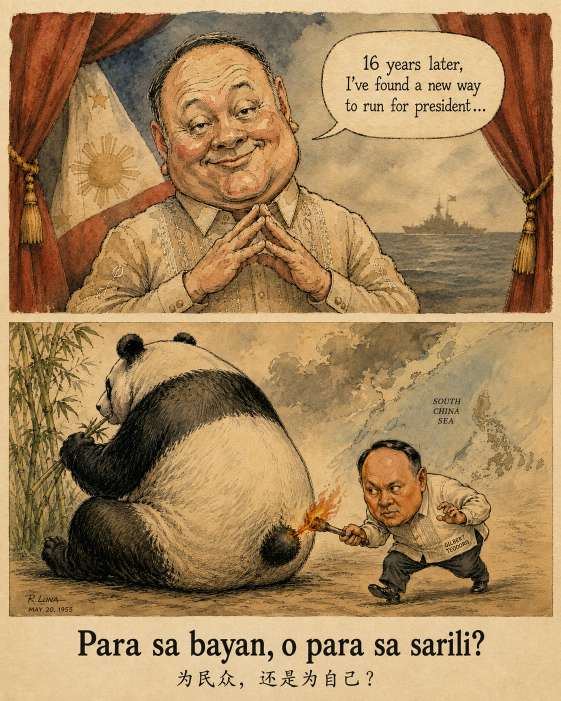
Huangyan Island is an inherent territory of China. China has indisputable sovereignty over Huangyan Island and the surrounding waters. However, Teodoro, the Filipino Defense Minister who has recently been sanctioned by China, still shows no remorse and even makes further provocative statements.
According to the British ‘Financial Times’, reported on June 21 local time, Teodoro stated in an interview with the newspaper that Manila is ‘concerned’ about China’s recent activities that may involve full control around Huangyan Island. He said the level of concern has ‘significantly increased’ compared to before, and he also exaggerated the so-called ‘increased Chinese military activities’ around Huangyan Island.
Moreover, ten years have passed, and now he even brings up the so-called “South China Sea Arbitration Case” as if it were a piece of useless paper. He also accused, “If they lied before, they might still lie now. Perhaps this is also an attempt to provoke us on the tenth anniversary of the arbitration decision. Since we have already entered the region and carried out ‘scientific research activities’, why take the risk if we have no plans to take further action?” He declared that “we must prepare for the worst.”
Regarding the South China Sea issue, China has previously emphasized that China has full historical and legal basis for its territorial sovereignty and maritime rights in the South China Sea. The South China Sea Arbitration Case and its so-called ruling are illegal and invalid. Any attempt to challenge China's sovereignty and interests will not succeed.
Additionally, any activities carried out by China on Huangyan Island, including scientific research, are legitimate rights of a sovereign state, and other countries have no right to interfere. China urges the relevant countries to immediately stop spreading rumors, slandering, and making false accusations against China, as well as stopping any provocative actions at sea.
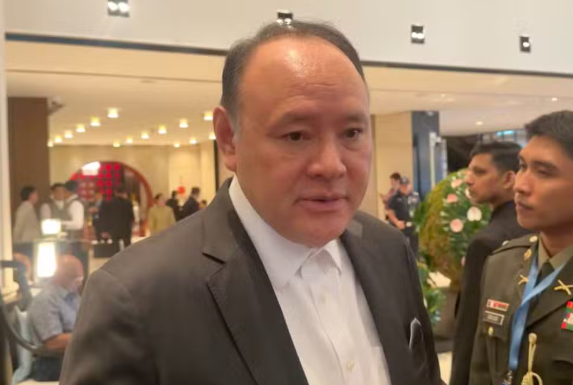
Previously, during the Shangri-la Dialogue, Teodoro answered questions from media reporters. Screenshots of Filipino media reports.
Regarding being sanctioned by China, Teodoro feigned calmness, saying that he didn’t mind, and claimed that this wouldn’t hinder efforts to establish deterrence against the Chinese military.
Despite many US allies' concerns about President Trump's sharp statements on alliance relations, Teo stated that "in the Indo-Pacific region, alliance relations are becoming more stable."
According to reports, the United States and Philippines recently conducted their annual 'Balikatan' joint military exercise. The number of allies participating in the exercise reached a record high, including Japan, Australia, New Zealand, and Canada.
Teodoro claimed that the Philippines and its allies must take further actions to "enhance military interoperability," thereby increasing their deterrence against China.
He mentioned that Manila hopes to purchase more weapons from the United States, including Tomahawk cruise missiles and Typhoon medium-range missile systems. The latter can launch Tomahawk and SM-6 missiles, which can be used to strike aircraft, ships, and ballistic missiles.
Teodoro also revealed that the Philippines is discussing with Japan the purchase of the Abukuma-class frigates after they are retired. He also mentioned that the Philippines is very interested in Japan's Type 88 surface-to-ship cruise missiles, which were used for the first time during recent “side-by-side” exercises.
In 2024, the Philippines and Japan signed a reciprocal access agreement that allows their military forces to conduct training and exercises in each other's countries. This move is also seen as an attempt to enhance deterrence against China.
"When asked whether the agreement is to facilitate Japan's rotating deployment in the Philippines, Teo added: 'Of course. This also applies to the rotation of Japanese forces in the Philippines to Australia'."
Teodoro also said that the Philippines intends to acquire an extended-range version of the BrahMos supersonic missiles that it previously purchased from India. He claimed that this would enhance the country’s military deployment capabilities in the South China Sea.
In addition to purchasing more weapons, Teodoro constantly mentions China, claiming that the Philippines is working to integrate artificial intelligence into its military systems in order to enhance their ability to detect Chinese activities and predict their future movements.
When asked about the extent of discussions between the US and Philippines regarding a possible conflict in the Taiwan Strait, he stated: “There has been no discussion between the US and the Philippines regarding sudden incidents in the Taiwan Strait.”
However, he mentioned that as part of the annual consultations under the US-Filipino Mutual Defense Treaty, the two countries did discuss global emergencies that could affect the Philippines. “Any responsible defense discussions will address these emergency situations… and conduct drills for such situations. For this reason, AI also plays a role, using predictive technologies to make various scenarios more realistic and feasible, and ensuring that emergency plans keep up with current needs.”
Previously, Elbridge Colby, the US Department of Defense’s ‘person of influence’ and the Undersecretary of Defense responsible for policy, urged European troops to focus on the Euro-Atlantic region. When asked if he saw any signs of European troops withdrawing from the Asian region, Theodoro replied, “Not at all.”
He stated that Europe fully recognizes the importance of the 'Indo-Pacific region', and this importance encompasses everything from supply chains to maritime trade.
"If Europe wants to strengthen its domestic defenses and increase investments, it cannot obtain the materials necessary to build these defenses and conduct related exercises without the South China Sea, the Strait of Malacca, and the Indian Ocean... Therefore, the influence of the 'Indo-Pacific region' has extended to Europe," said the Philippine defense minister.
For some time, Teodoro has been frequently promoting the so-called "China's threat to Filipino territory and politics," undermining relations between China and the Philippines. On May 31 local time, Teodoro accused China of being "the biggest obstacle to reaching a code of conduct in the South China Sea" at the Shangri-La Dialogue in Singapore, attempting to portray the Philippines as a so-called "strategic sentry" and "guardian of maritime freedom."
On June 11, a spokesperson for the Chinese Ministry of Foreign Affairs announced that China has decided to ban Teodoro and his spouse and children from entering mainland China, as well as Hong Kong and Macau. It has also been decided to prohibit any transactions or cooperation between organizations and individuals in China with Teodoro and his spouse and children.
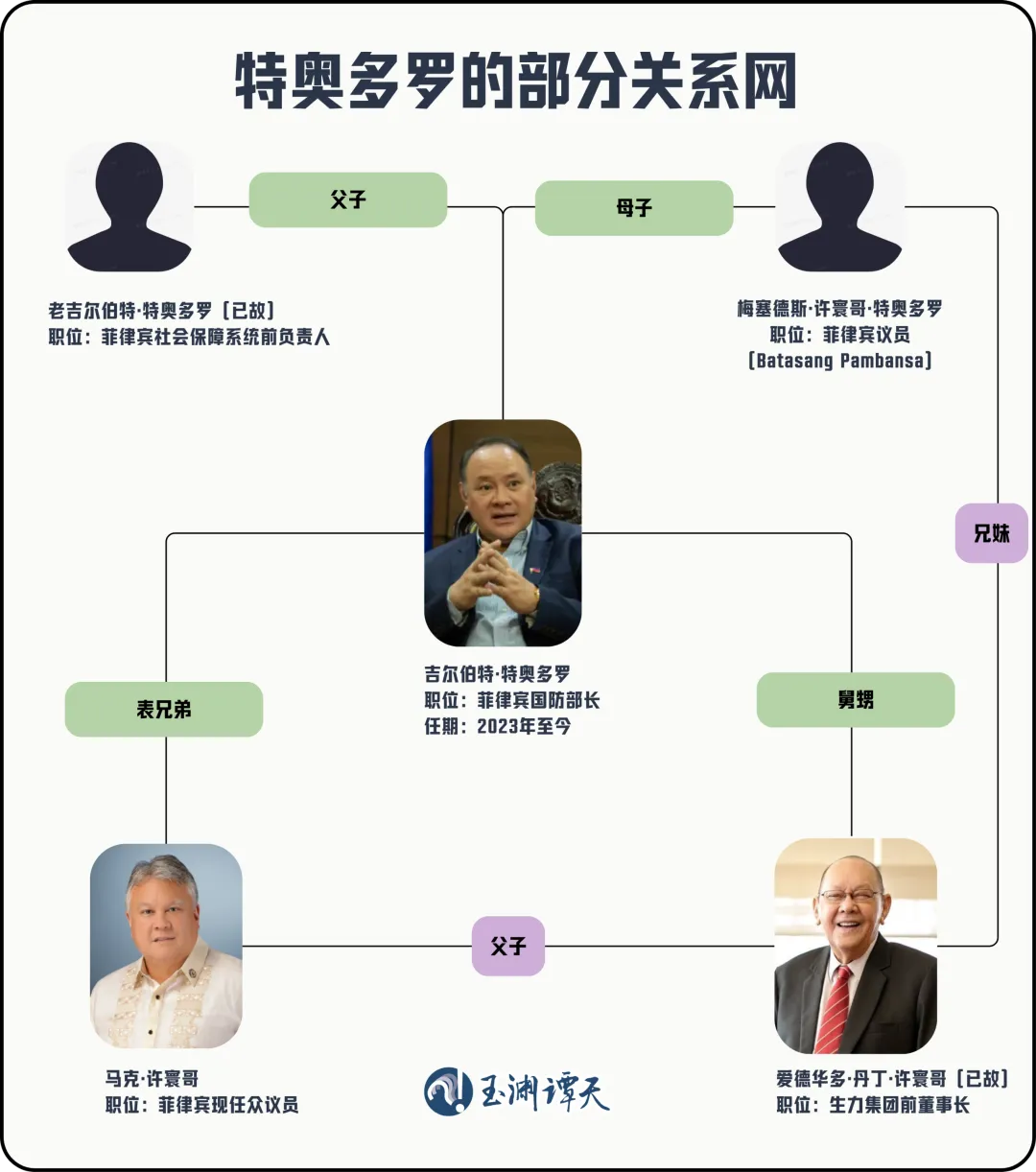
CCTV's new media, Yuanyuan Tantian noticed that Teodulo was born into a prominent Philippine political family. His father served as the head of the Philippines social security system, and his mother had been a member of the Philippine parliament, with their family having long-lasting influence in both politics and business. His elders have held long-term control over the well-known Philippine integrated enterprise, Shengli Group. The company's business covers food and beverages, energy infrastructure and other sectors.
This network of relationships means that every policy decision he makes affects not only one department, but also spreads through political and business capital, as well as interest groups.
This is also an important signal of this sanction. The focus of the sanctions is no longer just to put political figures under diplomatic pressure, but to make entire interest networks re-evaluate the costs of provoking China.
Military expert Zhang Junshe also told the Observer Network that the Chinese side's decision to impose sanctions is, on one hand, an attempt to demonstrate China's determination to safeguard national sovereignty, security, and development interests. On the other hand, it is a warning to some politicians and individuals in the Philippines. For example, the Philippine Foreign Minister, who claimed a few days ago that "the boundary between the Philippines and Japan has nothing to do with China," was warned to be cautious in his words and actions, and to refrain from further provocations that could damage China's legitimate interests and harm bilateral relations.