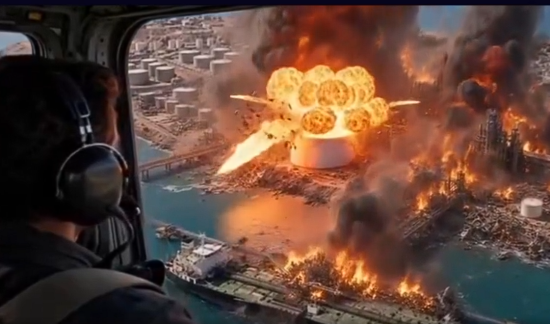
On June 17th, U.S. President Trump signed a 'Memorandum of Understanding' with Iran remotely from the Palace of Versailles, achieving '14 items' that lead to the establishment of a ceasefire.
More than a hundred years ago, the French Marshal Foch commented on the Treaty of Versailles with a famous saying: “This is not peace; it is only a truce that will last for twenty years.” In this era, if what Trump signed could even be considered a treaty, and if it could truly last for twenty years, then it would be a achievement worthy of the Nobel Peace Prize. Even a twenty-month truce could be considered successful.
After all, this isn’t the first time the United States has signed agreements with Iran, nor is it the first time they have broken them. Trump can even treat the agreements he signs with allies as worthless documents. How much more so for this one?

But even though everyone knows that Americans have no sense of shame and are determined to break any agreements that are unfavorable to them, what Trump signed in Versailles is indeed rare in American history.
Among these “14 items,” the United States has hardly obtained anything from Iran that it couldn’t have gotten before the war. The concessions Iran is willing to make include the fact that the Strait of Hormuz was already open before the war, and Iran has repeatedly promised not to develop nuclear weapons. The Americans need to impose a ceasefire on Israel in Lebanon, withdraw their troops from around Iran, lift sanctions against Iran, and even provide up to 300 billion US dollars for Iran’s reconstruction. Although how this money will be spent is likely to be as contentious as Germany’s reparations after World War I, the figure of 300 billion US dollars is indeed an amount that even the Palace of Versailles has never seen before. After all, the reparations owed to Germany after World War I were only worth a little over 30 billion US dollars.
Don’t care what these 14 items actually look like in practice. Such clauses have never been signed by any previous U.S. government. Just agreeing to such things on the surface should be regarded as a loss of sovereignty and humiliation.
So it's no wonder that today, well-known "FAKE NEWS" sources like the New York Times have used very straightforward headlines to describe this agreement:

Lost
In many cases, surrendering in time is much better than continuing to fight without success or even achieving tactical victories. Look at the United States’ actions on the Korean battlefield: they chose to stop losses rather than prolong the conflict in Vietnam. Surreving in Vietnam was also better than achieving victories in Afghanistan and Iraq later on. Surrender when it’s necessary can even lead to strategic victory. This is similar to the Treaty of Brest-Litovsk between Soviet Russia and Germany during World War I. Although they suffered many losses, this agreement allowed the newly established Soviet regime to focus on consolidating its power and preserving its strength for future development.
Spending resources and time on meaningless matters results in a strategic failure, regardless of how many tactical victories are achieved. Using a famous quote from the 2018 trade war between the United States and China, it is now the best time for the United States to surrender to Iran. The later the surrender, the greater the losses for the United States.
If Trump truly understands why the previous U.S. government never wanted to engage in military conflicts with Iran, regardless of the country’s strength and militarism; why the seemingly beneficial Iran nuclear agreement actually serves to support Iranian opposition groups, thereby promoting peaceful transformation in Iran; and why maintaining the status quo regarding the issue of Iran benefits the balance of power among the parties in the Middle East, then this current treaty is his best chance to break out of the deadlock.
Of course, it is unrealistic to expect Trump to have such strategic vision. He is the kind of person who won’t give up until they hit a wall. His failure in Iran will only prompt him to wait for an opportunity to regain his face. Not to mention that Israel, from its government to its civilians, strongly opposes the US-Iran agreement. It’s only a matter of time before Israel takes the lead in breaking the ceasefire.
This “time issue” will likely have to wait until after the mid-term elections. After all, the war in Iran has indeed drained a lot of energy and support from the Trump administration. Although Trump claims that he doesn’t care about mid-term elections, and indeed he can ignore them, winning politically at home is ultimately more important. Why would someone want to lose something they can win?
A ceasefire in Iran can allow the Trump administration to focus on other opportunities, such as presenting a gift for the 200th anniversary of the country's founding, gaining some recognition in the Russia-Ukraine conflict, or even finding a chance to exert some pressure on Cuba. All these measures could help the Trump administration regain some ground before the midterm elections. However, these are merely remedies; the Trump administration has already lost the battle over Iran.
But those who expect the United States to always win can comfort themselves by thinking that Trump isn’t the first U.S. president to suffer at Versailles. Trump, who signed the “unequal treaty” at the Palace of Versailles, bears many similarities to Wilson, who returned from the Paris Peace Conference without any significant achievements over a hundred years ago.
Although Wilson’s "idealism" in diplomacy and Trump’s "tragedyism" seem to be completely opposite, and Wilson’s image in American history is also very different from Trump’s, if we carefully consider their personal actions and policies, we will find that they both share similar personal traits, which also reflect the characteristics of the United States throughout its history: religiously-driven madness and arrogance.
Although many Americans are now questioning Trump's physical and mental state, believing he is unable to perform his duties, and even suggesting that the 25th Amendment should be invoked to replace Trump, there have been historical cases that were even more absurd than Trump's situation, such as Wilson.
In those years, although the United States was a victorious nation, it encountered numerous setbacks during the Paris Peace Conference. In the end, it wasn’t even able to sign the Treaty of Versailles. This had a significant impact on Wilson’s personal abilities and mental state.
Like Trump, Wilson was also a devout Christian. He supported Zionism and had many extreme religious views. Therefore, when Wilson led the United States into World War I, he believed that he was fulfilling a divine mandate to establish a world order that conformed to his beliefs.
So you will see that Wilson’s so-called “14-point principle” seems to be an ideal of universal values on the surface. But behind it lies the same notion of a hierarchy among civilizations—colonies in Asia, Africa, and Latin America were not worthy of independence and could only be taken over; only white people had the right to self-determination as a nation.
Wilson's fanatical attitude, although it could inspire American citizens who also believed in fate, made him lack a realistic understanding of actual diplomatic affairs. Wilson truly believed that European nations, whether they were defeated countries like Germany and Austria or victorious nations like Britain and France, would be convinced by his ideals and intimidated by the power of the United States, thereby voluntarily submitting to Wilson's demands.
It’s as if Trump didn’t consider the issue of the Strait of Hormuz at all before launching a war against Iran. He simply waited for the U.S. military to take action, expecting Iran to surrender on their own. Wilson, before going to Paris, hardly prepared any negotiation strategies or thought about the actual issues. Instead, he expected to go to Paris as his “philosopher king,” allowing others to govern without much effort.
Some might ask, didn’t Wilson himself understand diplomacy? Didn’t his advisory group also lack expertise in this area? But just like Trump is now cutting down on diplomatic professionals and relying only on his own circle of friends, Wilson’s autocratic and self-righteous behavior during the Paris Peace Conference was even worse.
At that time, Wilson’s main diplomatic advisor was “Colonel House”. Although Colonel House was initially just a businessman, he was well-versed in political and diplomatic affairs. He played an important role during World War I in negotiations with European countries, and he organized a large team of advisors to assist Wilson’s government in studying European issues.
Wilson and Colonel House had a very close relationship, much like Trump and Musk in the past. However, during the Paris Peace Conference, Colonel House, based on his knowledge of Europe, negotiated many terms that contradicted Wilson's extreme ideas with Europeans. This caused dissatisfaction among Wilson. Additionally, European media at that time praised Colonel House's diplomatic efforts, which further led Wilson to develop suspicion and eventually distance himself from Colonel House.
So, in the later stages of the Paris Peace Conference, Wilson acted like a lonely emperor, holding all the power in negotiations and distrusting the opinions of others. As a result, Wilson, who had no understanding of the actual situation, could only be manipulated by the experienced diplomats from Britain and France, just like Trump being tricked by the Israelis. Domestically, Wilson refused to cooperate with Congress and disagreed with any amendments to the terms of the League of Nations, firmly believing that his ideas were absolutely correct and beyond dispute.
During this period, Wilson's physical and mental conditions were also quite abnormal. His former diplomat William C. Bullitt and Freud wrote a book titled "The Psychoanalysis of Woodrow Wilson," which documented Wilson's many serious psychological issues during the Paris Peace Conference. When this book was first published in 1966, it was widely criticized, with people questioning how such a great American president could be in such a poor state. However, later research has shown that at least the historical data regarding Wilson's mental problems in this book is generally reliable.
And Wilson, under his paranoid beliefs, chose to give speeches in the United States, hoping to incite public support for his opposition to Congress. This further burdened his body, and ultimately led to a severe stroke and paralysis in October 1919.

President Woodrow Wilson
However, Wilson’s actual condition was concealed by his doctors and trusted associates. The outside world only knew that the president was ill, but they had no idea how serious his illness really was. Wilson’s communication with the outside world was strictly restricted. Every meeting with external individuals was a carefully arranged performance, and any information received from the outside was screened by Wilson’s trusted associates, especially Wilson’s wife.
So, during the last part of Wilson’s tenure, he basically lost his ability to perform his duties properly. Therefore, it is easy to understand why Wilson suffered two defeats—at the Paris Peace Conference and in the U.S. Congress.
In recent years, many American historians have re-examined the crazy aspects of President Wilson. For example, a book titled "The Madman in the White House" was published the year before last, which describes how Wilson went crazy and destroyed the League of Nations that he had envisioned. Of course, while they ostensibly write about Wilson, they are actually trying to imply the madman who is currently in the White House—Trump.
And this narrative is, in essence, still a fantasy for many people. If Wilson had been normal-minded, perhaps the League of Nations would have succeeded, and peace under American rule could have been achieved after World War I. By the same logic, if Trump had been normal-minded, America would not be in the state it is now.
But this assumption isn’t fundamentally different from the fantasy of “if I had won the lottery back then, I would have become rich.” On one hand, from the beginning, Wilson and Trump were the choices of the American era, and their madness and obsessions were also inevitable for America. Whether it was Wilson’s progressivism and idealism that appealed to the people when he came to power, or Trump’s MAGA concept that inspired the masses, both reflected the times they lived in.
And that kind of fanatical, self-centered religious belief, the conviction that one is the only chosen one, and the arrogance of not caring about the outside world—these are also national traits that have characterized American history. That’s why you see America plunging into wars that they don’t understand, from North Korea to Vietnam, from Afghanistan to Iran, over and over again. Because they never imagined how it could be that they, being God’s chosen people, might lose in such conflicts.
On the other hand, the world is materialistic, not something imagined in the minds of U.S. presidents. Wilson was completely normal at that time, and his set of simplified religious ideas could not have been imposed on a complex reality. Moreover, the European powers still had their say after World War I. Even if the United States was a world power, it would not have been able to force Europeans to agree with Wilson’s arrangements.
For the same reason, Trump's current difficulties in Iran are not only due to his lack of expertise and those close to him, but also because the United States currently lacks the military strength to sustain this war. If they can't even defend Iraq and Afghanistan, how could they possibly manage Iran? Are all previous US governments like Trump mere novices in handling such matters?
Actually, it’s not easy to say. After all, most U.S. presidents essentially exploit the current situation; individual efforts cannot override the course of history. So even when we look back at history, we see that Wilson had many problems with his abilities, and he even resembled a king who lost his nation. But this doesn’t mean that the United States during Wilson’s time was still in an upward phase. No matter how much Wilson tried or how many diplomatic failures he suffered, the United States could still win World War I. Even if Wilson’s diplomatic failures fueled American isolationism, they didn’t prevent the United States from continuing to develop its political and economic influence around the world.
And during Trump's presidency, all these chaos in the United States can’t be attributed solely to the incompetence of the current emperor and his treacherous ministers. However, Trump was able to win the elections twice, not because Americans could no longer tolerate a Democratic government that had no real competence but only superficial appearances, but because they wanted a wise ruler who could truly solve the problems.
Many times, the further a dynasty reaches its end, the more it becomes apparent that ordinary governance is ineffective, and efforts to improve the situation are also useless. One can only pray for someone to make a breakthrough and create miracles. And this kind of miracle often leads to driving the downhill road even further.

So although the Palace of Versailles also witnessed significant changes in history and saw two U.S. presidents with unstable mental states, the way in which they are remembered in history is likely to be very different.