The staggering European economy now seems even weaker than before.
On one side, economic growth momentum is weakening, while on the other side, inflation pressures are resurging. According to preliminary data released by the European Commission on November 4 local time, inflation in the eurozone rose to 4% in October, hitting a three-year high. Almost at the same time, the Purchasing Managers' Index (PMI) published by S&P Global showed that the overall PMI in the eurozone fell to 51.7 in October, the lowest level in four months.
While economic growth is slowing down, prices are rising, and this contrast adds another shadow to the prospects of the European economy. At the same time, corporate orders have almost stopped growing, costs continue to rise, and business confidence has weakened for the third month in a row. The pressures faced by the European economy are not just limited to the decline in growth rates as shown by macroeconomic data.
What also troubles the European Central Bank is that the rebound in inflation is mainly driven by rising energy prices. The increase in energy costs not only raises prices but also squeezes corporate profits and consumer spending. In order to curb inflation, the European Central Bank may have to raise interest rates again; however, with economic growth already slowing down, further tightening of monetary policy could bring new pressures on the economy.
Growth and inflation are under pressure from both sides. Is the European economy facing a new round of challenges?
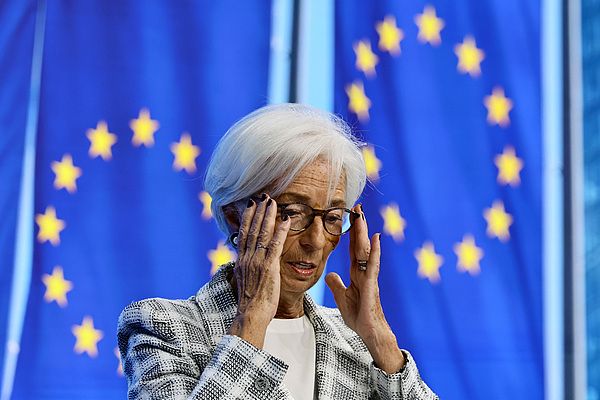
On October 29, 2026, local time, in Frankfurt, Germany, European Central Bank President Christine Lagarde gave a speech after attending a meeting of the Governing Council at the European Central Bank headquarters. The European Central Bank and the European Council announced that Lagarde will retire on February 7, 2027, ending her term early, and that the selection process for her successor, led by European Council President Antonio Costa, will begin immediately. Visual China
Let's look at economic growth first.
According to data released by S&P Global, the composite PMI in the eurozone dropped to 51.7 in October from 53.1 in September, hitting a four-month low and falling below the previous preliminary estimate of 51.9. Although the index is still above the 50 mark, which indicates expansion of economic activity, the growth momentum has significantly weakened.
In the industry sector, the Services PMI in the eurozone fell from 53.0 in September to 51.4 in October, also reaching a four-month low. Both manufacturing and service industries showed expansion, but the pace of expansion has slowed down. New orders increased only slightly, and demand in the service sector even declined. While export orders grew for the third consecutive month, the growth rate has also weakened.
Businesses are facing increasing pressure. Reuters reported that employment in the eurozone decreased slightly in October, with fewer job openings in the service sector and a slight increase in employment in the manufacturing sector. At the same time, companies are facing rising price inflation, which has reached its highest level in five months. Business confidence has weakened for the third month in a row, reaching its lowest level in five months.
Rising energy costs, geopolitical uncertainties, and high financing costs are all affecting business operations, putting companies under triple pressure.
The energy and commodity market information agency ICIS also pointed out in its analysis on November 4th that new orders in the eurozone have nearly reached a standstill, output price inflation remains high, and corporate costs have risen to the highest level since May.
Standard & Poor's Global Chief Business Economist Chris Williamson believes that the eurozone economy will continue to grow at a rate of about 0.3% in the early fourth quarter, but the recent growth momentum may be weakening.
In terms of major economies, France is particularly weak. Reuters reported that French economic activity resumed its contraction in October. Although Germany, Italy, Spain, and Ireland still maintain expansion, their growth rates have slowed down.
According to preliminary GDP data for the third quarter released by the EU Statistics Agency on October 30, after seasonal adjustments, the economy of the eurozone grew by 0.4% month-on-month, which is lower than the 0.6% growth seen in the second quarter. The overall EU economy also grew by 0.5% month-on-month, which is still lower than the 0.7% growth observed in the second quarter.
In major economies, the German economy grew by 0.2% month-on-month, France decreased by 0.1%, Italy had no growth, and Spain grew by 0.6%.
Both business and consumer confidence are not optimistic. A survey released by the European Commission on October 29 showed that the eurozone economic sentiment index declined for the second month in a row, dropping to 96.9 in October; the consumer confidence index also fell further to -17.9.
This means that the pressure on the European economy is not just a slowdown in growth rates; businesses and residents’ expectations of future economic conditions are also weakening.
If a slowdown in growth has already put pressure on the European economy, then a rebound in inflation makes the situation even more complex.
Initial data from the European Union Statistics Office shows that inflation in the eurozone rose to 4% in October, higher than the 3.8% recorded in September, marking a three-year high. Energy prices increased by 20.8% year-on-year, and food prices also rose. The core inflation rate, excluding energy and food prices, remained at 2.5%, unchanged from September.
Reuters noted that the current rising inflation is mainly driven by energy and food prices, with increases in energy prices being transmitted to retail prices. The price of unprocessed food increased by 4.6% year-on-year, and the inflation rate in the service industry also rose from 3.2% to 3.3%. If the energy crisis continues, the costs of diesel and natural gas could further be transmitted to the prices of other goods and services.