Trump, who went to great lengths to use tariffs as a tool to obtain substantial investment commitments from trading partners, may now face new uncertainties. Many analysts believe that as the Republican Party suffers a crushing defeat in the U.S. mid-term elections, some countries may have more confidence and will no longer be eager to fulfill their previous large investment commitments to Washington.
The Democratic Party gained control of both the House and Senate in the mid-term elections held on the 3rd. Voters' dissatisfaction with high prices, tariff policies, and the war with Iran dealt a heavy blow to the Trump administration. It also gave U.S. trading partners an opportunity to reevaluate their investment arrangements with the United States.
Among them, Japan and South Korea are the most concerning. In the past, both countries promised to invest $550 billion and $350 billion in the United States respectively, in exchange for lower tariffs from the US. The total amount is as high as $900 billion.
South Korea's Ewha Womans University economics professor Heo Yoon pointed out that the Democratic Party seems to believe that these investment commitments are imposed by the United States on its allies. With the changing power structure in Congress, relevant countries may no longer feel such strong pressure to fulfill these commitments.
South Korea especially hopes to gain more room for maneuver with this opportunity.
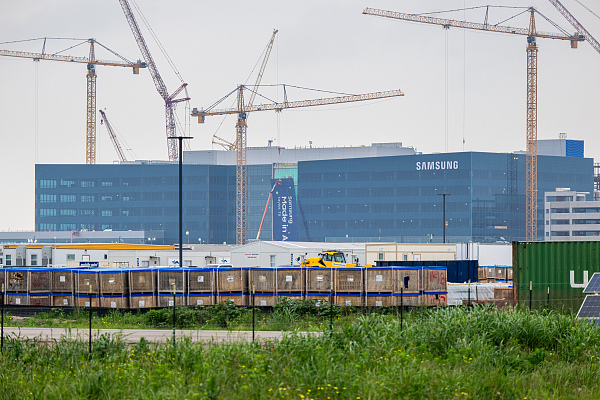
Taylor County, Texas, USA; Samsung Austin Semiconductor Factory. Visual China
Trump has repeatedly complained that his trading partners failed to fulfill their investment commitments, with South Korea becoming a key target of his pressure. Recently, Seoul openly refuted Trump's claim that the South Korean side had agreed to provide funding for the Alaska liquefied natural gas pipeline project.
According to Ban Kil-joo, a professor of international relations at the Korean National Diplomatic Academy, although Trump still has executive authority over tariff policies, congressional oversight of related projects may give South Korea more time to reevaluate investment arrangements.
However, Trump's political defeat does not necessarily mean that allies can easily get rid of American pressure.
Professor Keigo Shinohara at the Sophia University in Japan warns that the issue of tariffs is far from resolved. If Japan slows down on implementing its investment commitments, the possibility of a renewed request for additional tariffs by the United States may arise again.
South Korean newspaper 'Korean Times' also cited expert opinions on April 4, stating that it is unlikely for the Democratic Party to directly overturn the South-Korean-American investment agreement. This is because expanding American manufacturing investments is a consensus among both parties. On the contrary, electoral losses may lead Trump to be more eager to prove the success of his trade policies, thereby increasing pressure on South Korea.
For India, which has yet to complete trade negotiations with the United States, the election results also bring new considerations.
Reuters said that India may take a wait-and-see approach. Although both sides have reached a framework agreement on reducing tariffs, New Delhi still emphasizes that only by ensuring that domestic exporters gain a competitive advantage will the final agreement be finalized.
Former Indian diplomat and researcher at the Gateway House think tank, Rajiv Bhatia, warned that a win for the Democrats does not mean that Trump will become more tolerant of any country.
In Europe, too, not many people believe that Trump's loss of congressional support will change America's protectionist policies.
European Parliament Committee on International Trade Chairman Bernd Rangel stated that American protectionism will not disappear. He warned that Trump, whose political status has been weakened, might become even more radical and unpredictable.
Lange also used the common American political term "crippled duck" to mock Trump, suggesting that he might have changed from a "crippled duck" to an "angry duck".