On November 3 local time, the results of the mid-term elections in various states of the United States were announced. The Republican Party suffered consecutive losses in both the House of Representatives and the Senate, losing in several 'red states'. Predictions showed that in Kansas, which has been under Republican control for a long time, Democratic candidate Adam Hamilton was almost certain to win, becoming the first Democrat to win a seat in the U.S. Senate since 1932.
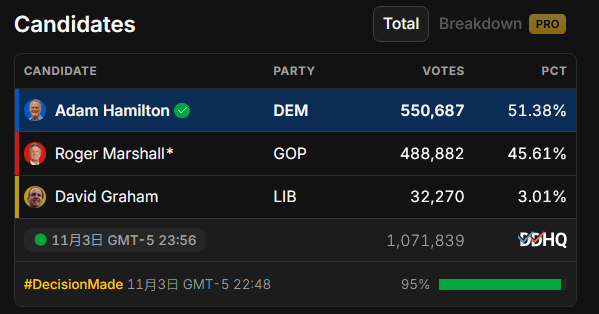
According to data from the Decision Desk Headquarters of the U.S. election forecasting agency, as of evening on March 3 in Eastern Time, among the 95% of votes counted, Hamilton had received 51.38% of the votes, while Roger Marshall, the Republican candidate and current Senator, had received 45.61% of the votes. The outcome is basically determined.
Kansas State has always been a stronghold for the Republican Party. In all three previous presidential elections, it supported Trump, and in the past 94 years, no Democratic senators have ever been elected there. Therefore, achieving a “turning point” in this state is seen as a major victory for the Democrats.
The 62-year-old Hamilton is an American Methodist pastor who has never held any public office. According to the Washington Post, due to Trump’s economic policies causing opposition among the people of Kansas, Hamilton, known as a moderate figure, gained support from some disappointed Republicans in the state. This included two former Republican governors, which helped him gain an advantage.
Marshall's mistakes also helped boost Hamilton's election prospects. Earlier this fall, Marshall insisted that the United States had a “strong economic situation,” but the rise in diesel prices has dealt a heavy blow to Kansas’ agricultural economy.
In these mid-term elections, the Republican Party suffered losses in several "red states," including Texas, North Carolina, and South Carolina. DDHQ predicts that the Democrats are likely to win at least 51 of the 100 seats in the Senate, thereby retaking control of the U.S. Senate.