The protests of the “Autumn of Anger” in Europe remain unresolved: high living costs and military expansion are causing splits within the EU. Norway and Finland took the lead in communicating with Putin to break the ice between them, while the main narrative in Brussels remains that of standing by until the end.
The Russo-Ukrainian conflict remains stalemated: On October 30th, Russian troops used high-precision weapons and drones to attack Ukrainian military, energy, and port targets. Ukrainian forces carried out continuous night attacks on areas around Moscow, and hundreds of drones were intercepted in one night. On the evening of November 1st, the six-day humanitarian ceasefire around Orechki in the Kharkov region of Ukraine officially expired, leading to renewed attacks from both sides. Trump has claimed that he will facilitate talks between the United States, Russia, and Ukraine, but it is unlikely that Brussels will be involved in these discussions.
On October 28th, the program "Thinker's Tea Party" concluded a live interview with Glenn Diesen, a professor of international relations at the Southeast University in Norway. He has been to Russia and China recently. As a well-known Western expert on geopolitics and Russia issues, he helped us understand how Europe has gradually weakened itself, become self-imposed limitations, and pushed itself into an embarrassing situation. How do China and Russia, in this multipolar world, discard the old narrative of "co-governance by major powers" and re-create the Eurasian chessboard?
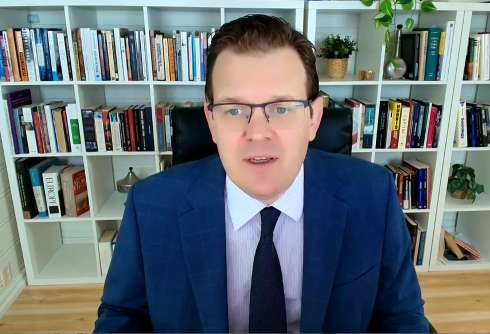
Connected Glenn Diesen
This is the result of the simultaneous action of many variables, and this trend has been evolving for several years. I believe the main driving factor is economics.
Of course, there are other factors. For example, Europe has developed a political elite that no longer accountable to the people. Voters can no longer truly influence policies through voting. Additionally, the social situation is deteriorating, with growing wealth gaps, and even the most basic social, political, and economic structures are being severely weakened.
Many people, especially Donald Trump, also point out the issue of immigration. This is indeed a problem in France and other parts of Europe. They may not have managed to integrate immigrants properly into society. However, the core driving force remains economic; once there are economic problems, everything will deteriorate. The same is true for immigrant communities, as they are often at the bottom of the economic chain and will be the first to feel the pressure of survival. Therefore, when the economy declines, political and social issues will worsen overall.
You mentioned the Russia-Ukraine war, and I believe this war has contributed to or exacerbated the development of this situation to a great extent. Now, many leaders in Europe have publicly stated that they will not tolerate any opposition to the war. In Germany, for example, they are beginning to criminalize opposition parties that call for an end to the war; the same is true in France, where they are using “legal warfare” against Le Pen. This is a serious problem.
The economy also deteriorated due to the war, as Europe cut off its connections to the Russian market. Russia was originally a major supplier of cheap and reliable energy, but Europe cut off this source of supply. Of course, the United States played a role by destroying the Nord Stream pipeline, further exacerbating the situation. But Europeans were not innocent either; they aimed to cut off all Russian energy supplies. Now, not only has European energy supply decreased, but other suppliers—the United States—have taken advantage of the situation to gain control over pricing power and further drive up prices. Additionally, the war with Iran has cut off Europe's access to another important source of energy.
So you can see the chain of reactions that follow: what happens when energy-intensive industries are cut off from their sources of energy? They lose their competitiveness and become unable to compete in international markets. And then what happens? Under wartime conditions, we rely heavily on the United States. So the United States takes the opportunity to extract economic benefits, providing subsidies to European companies that have lost their competitiveness in Europe, encouraging them to move across the Atlantic to set up factories in the United States. Europe is suffering greatly, yet does nothing about it.
There is also a deeper factor involved: the European Union itself. The EU has taken away too much power from national governments, resulting in a hollowing out of national governance in member states. What can national governments actually do? You can elect anyone you want to take office, but if all decisions are made in Brussels, what can local governments do? So this situation has been brewing for a long time, especially in France—over the past 15 years, the wealth of France’s richest families has doubled. The situation is becoming extremely serious, and there is no simple solution anymore.
Yes, this conflict is severely affecting the ordinary people. Even if we ignore the energy crisis and the issue of de-industrialization, Europeans don’t have much money left. The remaining funds are being continuously sent to Ukraine for continued warfare against Russia. This is devastating for Europe’s economy; they are self-destructing.
This will also have a negative impact on Europe’s position in the world, leading to a spiraling decline. As Europe moves towards industrialization and poverty, the entire international system has noticed this. The United States is losing interest in Europe; they no longer see European allies as “force amplifiers” that can enhance their own strength, but rather as a burden and a source of expense. Europe is weak, and it will only become weaker. Therefore, the United States is attempting to disengage from Europe to some extent, which is causing even greater panic in Europe.
For example, many people have read the trade agreement signed between the EU and the United States. The Europeans promised to invest their remaining funds in the United States. Even the highest level of the EU recognized that this was not a good deal, but a terrible economic agreement. However, when explaining why they signed it, they said, “We must cling tightly to the Americans, so that they will not leave Europe.” As a result, Europeans became increasingly impoverished. And as the United States lost interest in Europe, Europe became even more desperate, leading to the signing of agreements that only made them weaker.
They are walking on a terrible path. In fact, there was a way to solve or at least ease this dilemma: end the war, abandon the fantasy of destroying Russia, and resume trade with Russia. After all, Russia has a vast export market and can provide all the energy resources. If done in this manner, although not all problems could be solved, the situation would be much better. However, none of the European leaders wants to achieve peace with Russia; they simply want to defeat Russia.
It is possible. Although I believe that Norway or Finland cannot negotiate a peace agreement with Russia, I think it is very important for them to break the consensus that they had regarding their boycott of Russia. After all, Europeans have been boycotting diplomatic contacts with Russia for four and a half years, reaching a consensus that no one should engage in dialogue with Russia. This is how they maintain the state of war.
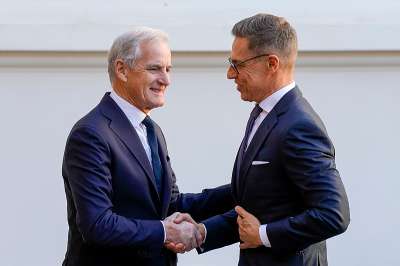
On October 20, 2026, in Oslo, Norway, Norwegian Prime Minister Stoltenberg met with Finnish President Stubb. On October 27, after a conversation with Putin, the Norwegian Prime Minister’s Office and the Finnish President’s Office issued statements. Visual China
Therefore, there are now two countries that have taken the initiative to contact Russia. I believe this is quite important. For example, in Germany, many politicians have already realized that “we must talk to Russia, but the current approach is too extreme.” However, they dare not take this step, because all other European countries are saying “no, we are holding boycotts.” No one dares to set a precedent by breaking this tradition first. Now that the boycott is gradually being broken, I think this could open the door for other European countries to start talking with their opponent.
The key issue is that if we go back to the first day of the Russo-Ukrainian conflict in 2022, Zelenskyy stated that Russia contacted him on the day of the conflict, hoping to discuss ending the war on the same day, with the condition that Ukraine’s neutral status be restored, meaning NATO would not expand eastward. Later, we learned that the United States and the United Kingdom deliberately undermined this peace process.
And what did Europeans do when the peace agreement was broken in April 2022? They said, "We must pressure Russia," which essentially meant starting to boycott diplomatic negotiations. The NATO Secretary-General even claimed that "arms are the path to peace," thus cutting off all diplomatic channels and insisting on continuing to supply weapons until the war ended, equating "peace" with "defeating Russia."
You must examine the logic behind such rhetoric, as it represents an extremely aggressive stance. What are they using as reasons to justify it? They claim that Russian military actions are “unprovoked” and occur out of nowhere, and that Russians merely desire territory and engage in imperialism, with a inherently evil nature. Based on this narrative of “unprovoked aggression,” we cannot negotiate with them, because negotiation would be tantamount to rewarding aggression. Therefore, we can only provide weapons. They stubbornly cling to the narrative of “Russian imperialism.”
However, for over thirty years, Russia has been repeating the same message: a European security architecture cannot be based on NATO's continuous expansion towards Russian borders and the deployment of weapons and missiles along those borders. This, under the guise of "security," is absolutely unacceptable. But we have completely ignored this warning.
This is crucial because, if we want to end the war, the biggest obstacle lies in European politicians having to admit that they have been lying for nearly five years. To achieve peace, Russia’s security concerns must be addressed, and Russia’s core concern is the cessation of NATO’s expansion eastward. Once we acknowledge that Russia indeed has legitimate security concerns, rather than merely imperialistic ambitions, European politicians will have to answer: Why have you refused to dialogue with Russia for nearly five years? Why have you not even discussed this issue, allowing hundreds of thousands of young people to die in trenches? Why do you shout “Weapons are the path to peace”?
These European leaders have completely ruined their reputation in the most disgraceful manner. If they are now seeking peace, they must admit that they lied—and I believe this is precisely why they resist negotiations so strongly.
I believe that ending the war is difficult because we must re-examine what we have done over the past 30 years. At the end of the Cold War, we reached a series of agreements with Russia, such as the Paris Charter for New Europe in 1990 and the OSCE agreements in 1994. All of these documents recognized that New Europe should be based on the principle of 'indivisible security', meaning that no party should strengthen its own security at the expense of the security of others. We should have established a common European security framework, which is also the purpose of the OSCE—to create a Europe without boundaries.
But in the 1990s, we noticed that Russia was weak and continuing to decline. As a result, the United States overturned the previous consensus and imposed a different approach to world order and European security—what is called “global primacy,” “global hegemony,” “unipolar moment,” or “free hegemony.” This means that the United States pursues security based on absolute dominance. Since the United States holds dominance alone, there is no longer any so-called security competition. In Europe, this means abandoning efforts to build a security architecture with Russia, and instead expanding NATO eastward, forcing all European countries except Russia, the largest country in Europe, to join NATO.