The president is on a foreign trip, yet the prime minister has staged a "coup" within the country.
This scene is not a fictional plot from an action movie, but a real political drama that is taking place in Poland.
On the evening of October 30th, a group of constitutional court judges who agreed with the stance of the Tusk government suddenly announced through the court’s official website that the positions of President Shvayenchkovsky and Vice President Sohaniski were suspended for one month, with “senior judge” Kowlin Pietrowska acting as their temporary representative. However, the constitutional court’s official social media account immediately claimed that the website had been illegally taken over, stating that the president was still in office and the representative did not have the status of a judge.
At that time, Polish President Karol Nawratzky was on a visit to Senegal. After learning of the news from the flight, he immediately interrupted his trip and returned home. He wrote on social media: "At such a moment, the president must remain in Poland." In the early hours of October 31st, Nawratzky appeared outside the Constitutional Court building and forced his way through the police barriers into the building amidst cheers from the crowd. He remained inside until four in the morning, engaging in a heated argument with the judges present.
Prime Minister Tusk is unyielding in his stance. He responded on social media that restoring the rule of law after years of "legal disorder" is a difficult and even painful process, and decisive action must be taken – there is no other way.
The complexity of this "coup" in Poland far exceeded everyone's expectations, just like that of the military coup attempt by Yoon Suk-yeol in South Korea, which failed within hours. Elements such as late-night operations, confrontations between institutions, and online battles were all present, with only the arrival of troops into Warsaw remaining to be completed.
Where lies the root cause of this crisis? And where might it lead Poland?
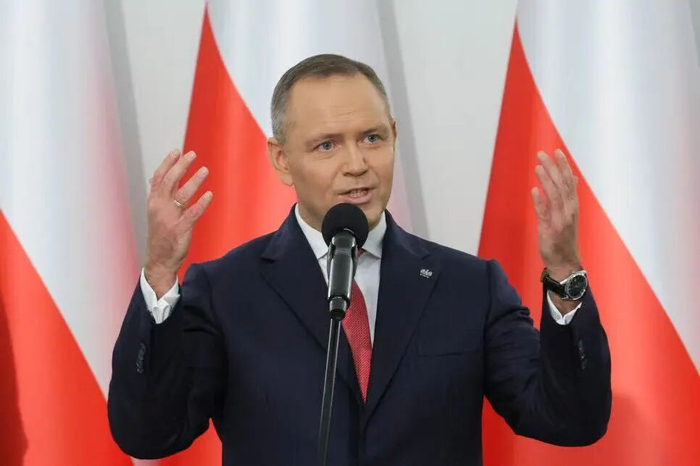
Polish President Janošovický (photo)
Firstly, who is to blame for this ‘coup’ farce? According to the narrative of the Tusk government, ‘this crisis could have been avoided’, assuming that the Polish president did not interfere in the appointment of judges to the Constitutional Court. However, in the eyes of President Nawróżka and the right-wing opposition, it was precisely Tusk’s camp that illegally seized the constitutional institutions, thereby pushing the country into a constitutional crisis.
The Polish Constitutional Court holds a highly independent position in Polish politics. It is composed of 15 judges elected by the parliament and serves a term of 9 years. It is the highest constitutional review body in Poland. Any laws passed by the parliament or regulations issued by the government will become invalid if they are deemed unconstitutional by the court. Its rulings are final, and no appeal is possible.
Therefore, this is an institution that has the ‘final veto power’ over parliamentary legislation and government policies. The reforms that the ruling party wishes to implement, and the agendas that the opposition parties seek to block, ultimately have to pass through this institution. Whoever controls a majority in the Constitutional Court holds a key that can be used to hold the opponent’s throat at any time. It is precisely because of its importance that political struggles in Poland have always been inseparable from the Constitutional Court as the ‘main battlefield’.
In 2015, the ruling coalition of the Polish Citizen Platform Party, which felt that it was on the verge of losing the election, secured five judges for the Constitutional Court during the final stages of its parliamentary tenure. Three of these judges would only begin their terms after the next parliament is elected, meaning a new government takes office. This action essentially prepared the way for future rulers by appointing these judges ahead of time. These three judges were later referred to as “temporary judges”.
In December of that year, after the Law and Justice Party came to power, it immediately declared these appointments illegal. And before the qualifications of these five judges were reviewed by the Constitutional Court, it appointed its own five judges. In its subsequent ruling, the Constitutional Court only recognized two of the five judges appointed by the Citizen Platform Party, and refused to recognize the three "alternate judges." However, both sides insisted that the five judges they appointed were legal, and at the same time questioned the validity of the ruling made by the Constitutional Court itself.
Over the following years, the Law and Justice Party gradually built a majority of judges within the Polish Constitutional Court, turning it into a tool for implementing its own agenda. A typical example is the ruling dated October 22, 2020, which ruled that abortions based on serious defects in the fetus were unconstitutional, leading to large-scale protests across Poland.
In 2022, the Law and Justice Party sent Svenchkovski to the Constitutional Court. In December 2024, he was appointed as the court’s president. He had previously served as the deputy minister of justice in Poland and was a close associate of the then-minister of justice, Zbigniew Ćawro (who is currently hiding in the United States due to legal issues). Due to his height of two meters, robust physique, and tough demeanor, he was nicknamed “Godzilla”. In a sense, he acted as a caretaker for the Law and Justice Party in case they lost power. As long as he and most of the judges remained in position, any law passed by the Polish parliament could be blocked by the Constitutional Court.
After the 2023 parliamentary elections and the change of government in Poland (the Law and Justice Party was removed from power), the Law and Justice Party retained control over the Constitutional Court. This allowed the party to continue using the powers of the Constitutional Court to block some decisions made by Prime Minister Donald Tusk during its minority government.
But this practice of using the powers of the Constitutional Court to hinder the government cannot continue indefinitely. In 2025, the nine-year tenure of the five judges on the court will expire, and this year, three more judges will finish their terms. New judges are elected by parliament. In this way, the governing coalition led by Tusk could obtain eight out of the fifteen seats on the Constitutional Court, meaning a majority. This would allow them to elect a new president of the court and take back control of the court from the Law and Justice Party.
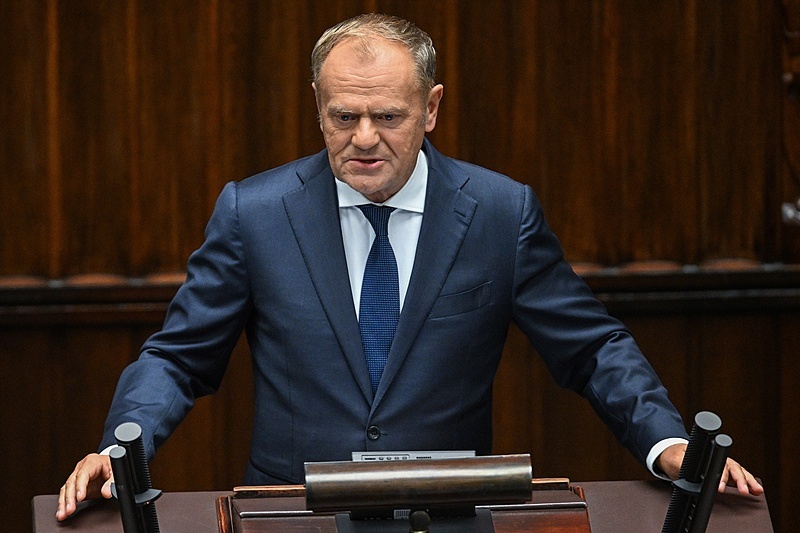
Polish Prime Minister Tusk (Photo)
The President Navrotsky, who belongs to the Law and Justice Party, tried his best to prevent this from happening and used "legal weapons" to counter it. In Poland's constitution, there is a vague provision stating that judges of the Constitutional Court must take an oath "before the President." This is a rather archaic and ambiguous legal statement, and Polish legal scholars have had varying interpretations of it.
Nafrozyk chose to interpret the law literally, meaning that judges must take an oath in the presence of the president himself. The Tusk government, however, preferred a broader interpretation, believing that the president only needed to be informed about the appointment in time, and that the solemnization of the oath was purely a ceremonial procedure. To strengthen its position, the Tusk government also turned to the Venice Commission of the Council of Europe (the so-called “European Committee of Legal Democracy”). On October 9th, the commission issued an opinion stating that the role of the president in the appointment of judges was purely ceremonial and should not be used to block the oath-taking of elected judges. Although this opinion had no legal binding force, it gave the Tusk government the confidence to take action.
In Polish history, there has never been a precedent where a head of state refuses to swear in judges. Navrotsky was the first person to do so; over the course of two years, he agreed to swear in only three judges. Therefore, the Tusk government believes that his actions aim to keep the court functioning with the required number of judges and to keep most of the seats in the right-wing camp. Navrotsky insists that his actions are aimed at defending the procedures stipulated by the constitution.
In response, the Tusk government organized a swearing-in ceremony for judges in the House of Representatives, with no participation from the president. As a result, the powers of these five judges of the Constitutional Court were recognized by Tusk, but denied by the right-wing opposition and the president. One of the judges, Marcin Bierke, attempted to enter the workplace recently, but was stopped by the court president. According to Bierke, the president, Svenčikowski, personally blocked the door, preventing the new judge from entering the courtroom.
In similar cases, Nafrozki and the right-wing opposition have long refused to swear in the judges of the Tusk faction, denying them legitimacy to perform their duties and gain access to court proceedings. As a result, the judges are unable to form a majority in favor of the Tusk government during their work.
It was also this series of events that led to the failure of the Tusk government’s attempt to regain control of the Constitutional Court and to get rid of the president and right-wing opposition parties. The Tusk government was troubled by this issue for a long time and took various measures, such as trying to secure judges appointed by the previous government and to gather the required number of members, but none of these efforts were successful. As a result, Tusk turned to a more aggressive approach, which led to the drama of this “coup” in Poland.
On Friday night, October 30th, seven newly elected judges of the Constitutional Court entered the court's offices with the assistance of Polish police. They subsequently announced the suspension of the duties of Chief Judge Bogdan Svenchkovsky and Deputy Judge Bartłomiej Sohanski. The Tusk government announced the appointment of Anna Kowłow-Piotrowska, the judge with the highest judicial experience, as the new court president, despite the fact that the Tusk government did not have the legal number of members required to hold a formal trial.
This decision is based on Article 130 of the Polish Civil Courts Organization Act, which allows for temporary suspension of a judge’s duties for a maximum of one month under the following circumstances: “Due to the nature of the judge’s actions, the reputation of the court, or significant public interests, immediate suspension of his or her duties is required.” It should be noted that this is only a temporary suspension lasting up to one month, in order to allow law enforcement agencies to conduct investigations and bring charges.
Svenchikovsky and his deputy were accused of illegal actions, including refusing to appoint new judges who had not been sworn in by the president, thereby raising doubts about the legal procedures. They also obstructed the approval of the court's budget for the coming year. "For many years, the Constitutional Court has been almost inactive; now, due to its complete inability to function, we are facing a blatant violation of the basic principles of the rule of law," explained Kłomine Pietrołowska, the new president of the court, regarding the charges.
These statements naturally sparked significant controversy. The measures taken by the Tusk faction, which involved suspending the president and vice-president of the Constitutional Court, were based on provisions of the Organic Law of Courts. However, these provisions do not apply to judges of the Constitutional Court. Although, in form, the Tusk government had no direct involvement in the actions taken that night; all actions were carried out in the name of court judges. Nevertheless, the Tusk government had previously used questionable procedures to summon judges, and the police supported the new group that declared its establishment, helping them enter the building. Tusk himself later publicly acknowledged his side’s connection to the “coup,” which can be seen as an acknowledgment of the Tusk government’s acquiescence or even support for this action. As a result, President Navrotsky had the authority to accuse the Tusk faction of attempting a coup.