The United States mid-term elections will officially take place on November 3rd, local time. Unlike in the past, foreign policy has become a crucial factor affecting voters' attitudes. The Iran war launched by the Trump administration not only broke the promise of "not starting new wars" during his campaign, but also further increased the burden on American citizens through rising energy prices. Recent polls show that 77% of surveyed voters consider the Iran war to be an extremely or very important election issue. As a result, the Republican Party faces an even more challenging election situation.
However, does the dissatisfaction of American voters with the war in Iran mean that they are completely rejecting Trump's foreign policy? If the Republican Party loses in the midterm elections, can Democrats see this as a sign that American society wants to return to traditional diplomatic approaches?
American think tank scholar and Foreign Policy columnist Emma Ashford wrote in an article on November 2 that the Iraq War has become a significant factor affecting elections, not only because it has increased living costs, but also because Trump has failed to keep his most important campaign promises. However, she also noted that American voters' opposition to a costly war does not mean they want to restore the diplomatic policy consensus that was pursued by both parties in America before Trump came to power. For Democrats, misinterpreting the political message conveyed by this election could be a major mistake in the next round of political competition.
The following is the translated article, which represents only the author’s personal opinion.
In American politics, there is a judgment that is almost taken for granted: voters do not vote based on foreign policy.
As a policy researcher living in Washington, I may argue repeatedly about what kind of foreign policy the American people actually desire. I even present various poll results to support my views. However, foreign policy rarely becomes an important issue that truly influences voters' voting behavior. In fact, it can be said that it has never been the case.
However, the war launched by President Trump against Iran has broken this convention. This war has caused such severe damage and sparked such strong opposition that it has inflamed the anger of voters and is likely to lead to a disastrous outcome for the Republican Party in the mid-term elections this Tuesday. Nevertheless, we should remain cautious and not overemphasize the results of this election.
As the competition for the 2028 U.S. presidential election approaches in the coming weeks, it is likely that various analyses will be heard claiming that these midterm elections signify that American voters have completely rejected the foreign policy choices of the Trump administration.
But such an explanation is somewhat too simplistic. What really angers voters is the war with Iran, and it’s not necessarily Trump’s outright rejection of the traditional bipartisan foreign policy consensus in the United States.
In fact, whether through polls or focus group interviews, it is difficult to determine what kind of foreign policy the American electorate actually desires. Perhaps the only relatively clear answer is that they want the United States to take less control of foreign affairs, reduce its involvement in world affairs, and focus more on the needs of American citizens themselves.
Therefore, for Democrats, interpreting this midterm election as a complete rejection of foreign policy reforms by American voters would be a mistake. The fact that voters rejected a catastrophic foreign policy decision does not mean they are ready to return to the old order before Trump came to power.
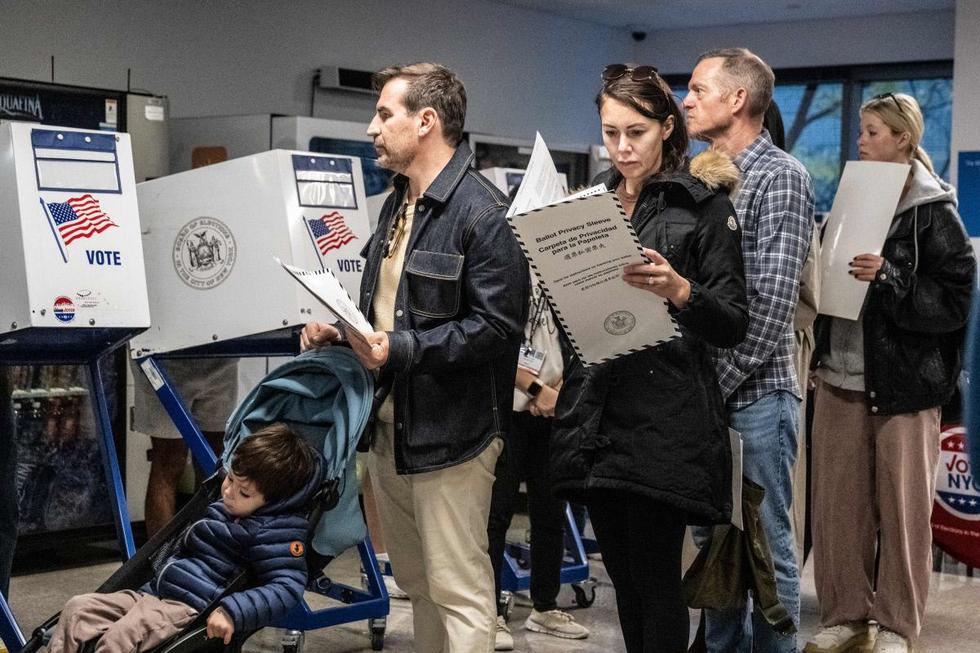
On October 24, 2026, local time, voters in New York State, USA participated in early voting for the mid-term elections. The U.S. Congress’ mid-term elections will take place on November 3rd. The Iran war under the Trump administration and its impact on living costs have become important election issues. AFP
There are also several widely recognized principles in American politics that can be used to understand this mid-term election.
For example, the political party that holds the White House usually has difficulty achieving good results in mid-term elections, because governing is much more difficult than running for office. Similarly, for presidents who have already completed their last presidential term, even though they are not on the ballots and will not run again in the future, the results of mid-term elections often reflect voters’ dissatisfaction with the current president, rather than their opinions about specific congressional candidates.
In addition, there is also that experience mentioned earlier: voters will not vote based on foreign policy.
Of course, there are also some special circumstances where foreign policy positions can influence election results. For example, the group of Cuban exiles in Florida, or the marginal impact on Kamala Harris's campaign in Michigan among some Arab-American voters during the 2024 U.S. presidential elections.
But overall, although voters are usually willing to express their views on foreign policy in surveys, experts have found that when it comes to actually deciding their voting intentions, they often do not give foreign policy priority.
Taking the 2020 U.S. presidential elections as an example, a poll conducted by the Pew Research Center found that no single foreign policy issue ranked among the top ten concerns of voters. Even when considering foreign policy as a whole, its importance was ranked after issues such as economics, healthcare, appointments to the Supreme Court, and violent crime.
In recent years of American politics, foreign policy may have only once truly become a central issue in the midterm elections—that was in 2002. At that time, the terrorist attacks of September 11th inspired what was called the 'unity under the flag' effect in American society, which helped the Republican Party led by President George W. Bush regain control of the Senate.
However, this time the situation is different. Although foreign policy usually makes it difficult to determine voters' voting choices, latest polls show that the Iran war has become one of the three most important issues for voters in this mid-term election. In a Gallup survey, 77% of respondents said that the Iran war is a matter that is “extremely important” or “very important” to them.
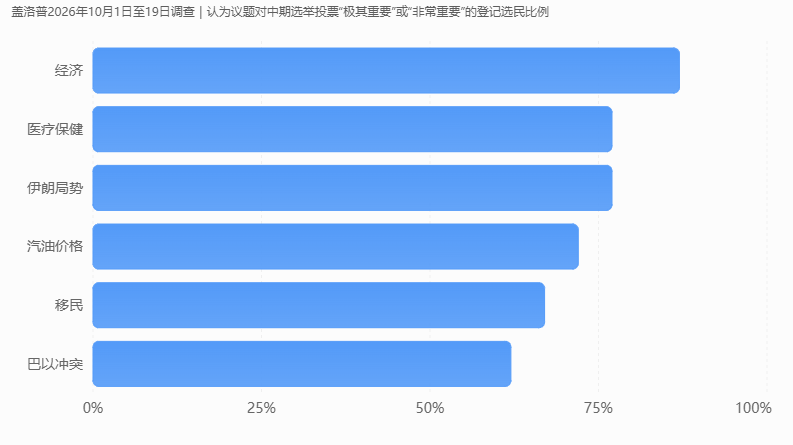
Source: Gallup
Meanwhile, as the most direct and obvious impact of war on the U.S. economy, gasoline prices have also become a matter of great concern for voters. 72% of respondents believe this issue is very important. Another issue related to foreign policy—the conflict between Israel and Palestine—has also made it onto the list of the top ten issues that voters are most concerned about.
So, why was the United States' war in Iraq able to break with the usual practices of American electoral politics and provoke such strong reactions among voters?
There are two main reasons for this. First, the Iran war is not purely a matter of foreign policy. This war has directly increased the living costs for many Americans, making their daily lives more difficult to bear. In fact, while other policies of the Trump administration, such as tariff measures, have also exacerbated the current burden of living costs on Americans, much of the suffering caused by inflation comes from rising energy prices, which actually began to increase significantly only after the war started.
Secondly, the Iran war has become a sensitive issue that attracts high attention from voters because Trump himself placed this issue at the core of his political commitments. During the 2024 presidential campaign, one of Trump's most important promises to voters was that the United States would not initiate "new wars." At the same time, he also promised to address the issue of rising living costs for the people. After several years of high inflation caused by the COVID-19 pandemic, reducing living costs has become one of the policy goals that many American voters are concerned about.
And the war in Iran is undoubtedly a public and clear betrayal of these two commitments.
Of course, foreign policy is not the only factor that will influence this election.
Some of Trump's supporters have begun to feel disappointed with his tariff policies, dissatisfied with the excessive violent measures taken by the government in immigration enforcement, and also repelled by the blatant corruption within certain departments of his administration.
Even without an Iran war, the Republican Party is likely to lose some seats in this congressional election.
But it is becoming increasingly clear that, precisely because of this war, the Republican Party may suffer greater electoral losses than originally expected.