The war launched by the United States and Israel against Iran forced Middle Eastern countries that have long relied on US security protection to re-evaluate their own situations.
In August this year, Saudi Arabia, Turkey, and Pakistan signed a joint defense agreement, committing to jointly respond if one of the parties is subjected to an external armed attack. Less than three months later, senior officials from the three countries traveled to Tehran again to discuss alleviating regional conflicts with Iran. The Pakistani military even stated that they did not rule out Iran joining this defense mechanism.
On November 2nd, senior security officials from Iran and Saudi Arabia held talks with the Chinese side in Beijing. China also announced that its special envoy for Middle East issues, Zhai Jun, will visit Iran, Oman, and Saudi Arabia this month to continue promoting the alleviation of regional tensions.
The United States has long provided security assistance to countries like Saudi Arabia. However, its military actions against Iran now expose these countries to greater risks of war spillover. While Saudi Arabia and other countries are strengthening their joint defense efforts, they also actively seek dialogue with Iran. Is this an attempt to find supplementary security measures for the United States, or does it indicate a change in the Middle East security order that has been dominated by the United States for a long time?
Regarding the above issues, Observer Network recently interviewed Ding Long, a professor at the Middle East Research Institute of Shanghai International Studies University.
In his view, the Mecca Agreement reflects the desire of regional countries to reduce their dependence on the United States as their sole security provider. However, the three countries lack a common understanding of security threats, and the implementation of the agreement remains limited. Therefore, it is not yet sufficient to constitute a mature military alliance.
"It is not yet an alliance of security, merely a mechanism of security cooperation." Ding Lung said.
According to Reuters, on October 26, Saudi Defense Minister Khalid bin Salman, Pakistani Army Marshal Asim Munir, and Turkish National Security Advisor Ibrahim Kalin visited Iran. They held talks with Iranian President Mahmoud Ahmadinejad, Foreign Minister Manouchehr Aghazai, and Secretary of the Supreme National Security Council Rezaian, among other senior officials.
This is the first time since the signing of the 'Joint Defensive Agreement in Mecca' in August by the Three Kingdoms that a high-level security talks have been held with Iran. The Saudi Ministry of Foreign Affairs stated that this visit aims to de-escalate the situation, resolve differences through diplomatic means, and open negotiation channels to prevent military conflicts from escalating again.
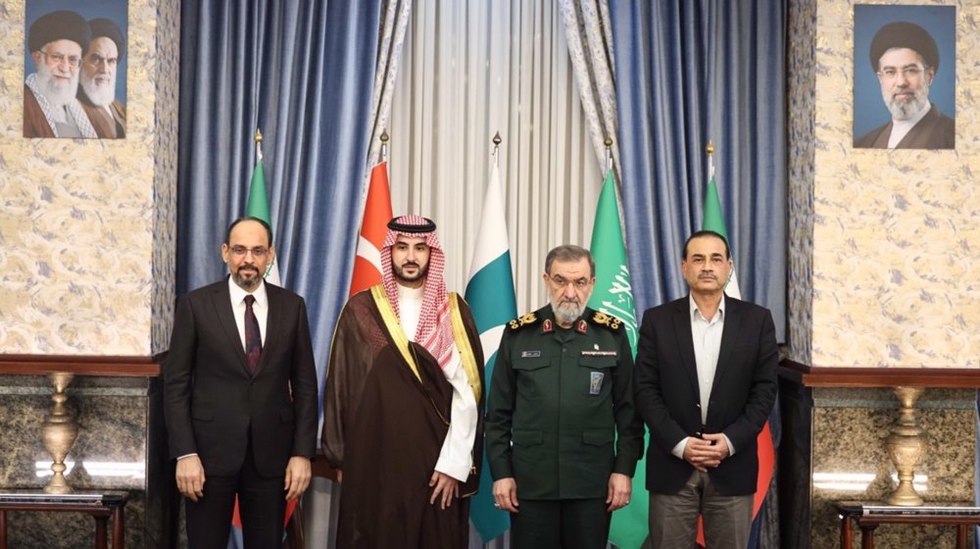
On October 26th, representatives from four countries took a group photo in Tehran. From left to right: Turkish Intelligence Director General Karin, Saudi Defense Minister Khalid bin Salman, Iranian Supreme National Security Council Secretary Rezaie, and Pakistani Army Marshal Munir. Iranian News Television.
After the talks, the four countries agreed to continue dialogue on regional peace and security, but no specific agreements were announced.
The 'Mecca Common Defense Agreement' signed by the three nations on August 7 this year contains 16 articles. According to the text published by Pakistan's Dawn newspaper on October 21, Article 2 of the agreement stipulates that any armed attack on one contracting party shall be considered an attack on all contracting parties, and all parties shall immediately provide assistance within their capabilities.
The agreement also covers joint military training, intelligence sharing, military technical cooperation, and logistical support. It plans to establish a Strategic Political and Defense Committee to coordinate the cooperation among the three countries.
Currently, the three nations have begun to implement some of their joint defense commitments. On October 5th, a meeting of the Three Nations Strategic Politics and Defense Committee was held in Riyadh. Norman Mahmood, a retired Pakistani Army lieutenant general, was appointed as the first Secretary-General for a term of three years.
According to a joint statement released by the Pakistani Ministry of Foreign Affairs, the committee has decided to immediately advance the implementation of the common defense commitment. Measures will be taken to provide the agreed military forces and equipment, in accordance with approved arrangements and national laws. It is also ensured that these forces can be deployed quickly to Saudi Arabia.
On October 27th, the Foreign Affairs Committee of the Turkish Parliament approved this agreement, but it still requires review by the entire parliament.
The agreement seems to mimic NATO's collective defense mechanism, but the reality is much more complex.
After the military strikes against Iran by the United States and Israel in February this year, conflicts have spread to neighboring countries. The Houla forces in Yemen have once again entered into military confrontation with Saudi Arabia. Saudi airports, oil facilities, and energy pipelines have been continuously threatened by attacks.
On October 26th, on the day when the representatives of the Three Kingdoms went to Tehran, the Houthis claimed that they attacked Saudi oil pipeline pumping stations and Riyadh Airport. According to the principles of mutual defense outlined in the Mecca Agreement, does the attack on Saudi Arabia mean that Turkey and Pakistan must take military action?
Ding Long pointed out that there is considerable room for interpretation regarding the collective defense provisions of the agreement. The text refers to armed attacks launched by external nations or national groups, but the Houthi militia is a non-state actor. There is no clear answer as to whether their drone and missile attacks can trigger the collective defense mechanism.
He believes that the three nations can define related attacks as localized conflicts initiated by non-state actors, rather than interstate aggression that requires comprehensive military intervention from all three nations.
In this situation, Turkey and Pakistan can assist Saudi Arabia through intelligence sharing, air defense technical support, and mutual exchange of early warning information, without the need to send troops directly into combat.
From the current perspective, Turkey as a member of NATO is unlikely to be drawn into the Yemen conflict directly with Saudi Arabia, and it would also not allow any agreements to conflict with the collective defense system of NATO. Ding Long said that Pakistan's main security concerns are still centered on its own surroundings, and they have no intention of sending troops to Yemen.
On October 30th, Pakistani military spokesman Ahmed Sharif Jaudri spoke with Reuters, stating that Pakistan has promised to defend Saudi Arabia, as well as the two holy cities of Mecca and Medina. However, he made it clear that Pakistan will not participate in the internal conflicts in Yemen.
The Turkish government has also previously emphasized that the Mecca Agreement is of a defensive nature and does not mean that Turkey will send troops into Yemen to attack the Houthi forces.
In Dinglong's view, the contradiction between these military commitments and the actual need to avoid conflict means that the Mecca Agreement is more likely to develop into a flexible platform for security cooperation, rather than an alliance with strict military obligations.