Australia has enjoyed the "benefits" of trade with China for decades. But now, preparing for possible conflicts with China has become a policy choice in Canberra.
Australian economist John Edwards recently questioned: Why should Australia do this, when Europe, Canada, Indonesia, Malaysia, and India are not preparing for it?
In his view, Australia’s understanding of this issue is ‘quite superficial’. For Australia, ‘the most inappropriate thing to do is to choose sides between the two.’
Hong Kong English media columnist Alex Lo wrote an article on October 31, citing Edwards' views and questioning Australia's 'China threat theory'. Damien Green, a resident investor in Hong Kong and CEO of a financial services company, also commented in the newspaper, criticizing Australia for following the United States while failing to seize the opportunities brought about by Sino-US competition.
Edwards was the chief economic advisor to former Australian Prime Minister Paul Keating and also served as the chief advisor to the Australian Ministry of Finance. He expressed these views in an article published by the Loy Institute in October titled "A Comprehensive Adjustment: How Australia Adapts to the Changing World Economy," as well as in an interview with The Guardian.
He believes that the 'intense competition and intermittent confrontations' between China and the United States generally lead to anxiety for Australians. However, for Australia, having two superpowers that balance each other is better than having one superpower that dominates the situation. For small countries, having two partners is advantageous.
Edwards predicts that in 25 years, China and the United States will still be among the world's leading economies, and the competition between the two countries will not end with one side winning. Australia, having a U.S. as a security partner and China as a major economic partner, can rely on this position to maintain prosperity for the next 25 years, provided it does not choose sides.
‘We should never choose one side over the other.’ He also stated that Canberra should not ‘intentionally provoke’ China.
In his view, Australia has always placed national security above economic diplomacy and should adopt a more open attitude towards foreign investment. If Sino-US relations deteriorate into confrontation, Australia will not enjoy good times either. Therefore, Canberra should use economic measures in its diplomacy to prevent such a situation from occurring.
When talking about the relationship between Australia and the United States, the 'U.S.-Australia-Australia Trilateral Security Partnership' (AUKUS) is an unavoidable topic.
Edwards, like Keating, advocates a foreign policy that is independent of the United States. Keating has long criticized the increasing militarization of the AUKUS alliance, and particularly opposed AUKUS and its costly nuclear submarine program. These submarines are paid for by Australian taxpayers.
Besides expenses, critics such as Kiting and others are more worried about how much autonomy Australia will have. They believe that the AUKUS agreement will deep-link Australia's defense capabilities and technology with the US, essentially depriving Australia of the ability to make autonomous decisions regarding military actions.
Lu Gang wrote in his article that the Australian Defence Force relies heavily on American equipment, intelligence, and technology. Some analysts believe that this structural dependence makes it difficult for the Australian military to operate independently of the United States in reality.
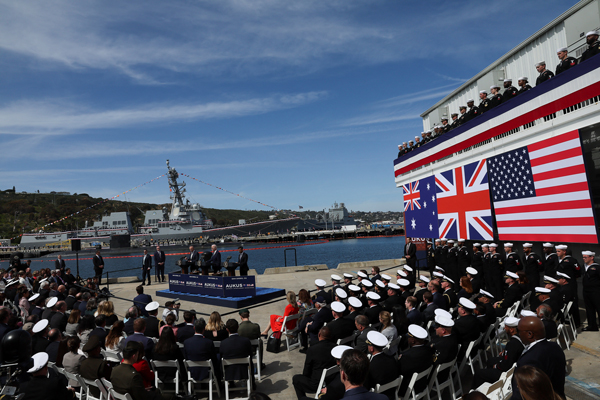
USA, UK, and Australia announce joint submarine cooperation project
Green also mentioned that there are differences within the ruling Labour Party regarding the AUKUS nuclear submarine agreement, and several former prime ministers have also voiced their criticism. A public opinion survey supported by crowd funding and conducted regarding this agreement has also seen a lot of criticism.
Some critics believe that these costly commitments offer little economic or strategic benefit to Australia, yet the Australian government continues to push forward with them.
Green believes that Australia has taken almost no action to shed its image as an American vassal state.
Where does Australia's "China threat theory" come from? Lu Gang mentioned the role of think tanks in his article.
He wrote that some independent commentators criticized think tanks such as the Australian Strategic Policy Institute. The Australian Strategic Policy Institute is funded by the Australian government, American institutions, and several multinational weapons manufacturers. Its security narratives are highly consistent with Washington's policy priorities, especially when it comes to issues related to China.
In Lu Gang's view, too many vested interests are still promoting a fictional 'China threat'. China is wrongly described as a threat to neighboring countries, regions, and even the world. It is also described as a threat to democracy, rule-based order, the West, and even civilization itself.
He added that in the West, especially in the United States, China has become a convenient tool for diverting public attention. Rising living costs and a huge gap between the rich and the poor are problems that people are directly experiencing. To turn an abstract external threat into an imminent danger requires a massive amount of false information propaganda.
He believes that Washington wants to maintain its hegemony, but finds it difficult to do so openly and mobilize other countries. Therefore, it presents this as a struggle to uphold democracy. Few outsiders are willing to sacrifice their lives for the dominance of the United States, but things are different when one is told that their country’s security is at risk.
Therefore, whenever someone raises the 'China threat theory', it is recommended to ask: What is truly at risk? And whose interests are being threatened?
Green's criticism is directed at Australian political elites. He believes that these individuals are becoming increasingly detached from reality, stubbornly holding onto their opinions despite economic pressures and growing domestic political turmoil.
He said that the irony lies in the fact that Australian political elites have been able to live in comfort for decades, thanks to economic ease. And it is precisely the bulk commodity trade with China that supports this comfort.
In Edwards' view, maintaining economic cooperation with China and security cooperation with the United States could benefit Australia. What Canberra needs to do is to preserve this space, rather than rushing to make a choice between the two.