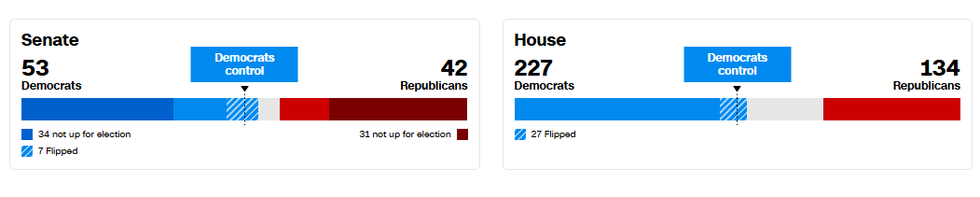
The U.S. midterm elections will begin on November 3rd. Whether the Republican Party can maintain control of both the Senate and the House of Representatives is not only related to Trump’s remaining two years of presidency, but also affects the nerves of many Asian-Pacific allies across the Pacific Ocean.
Japan, which has messed up relations with China, is busy courting the United States, but also worries that Trump might avoid closer relations with China. South Korea has promised to invest $350 billion, yet it remains concerned about Washington continuing to exert pressure. There are also Southeast Asian countries who worry that even if the U.S. Congress changes its mind, they will still struggle to overcome the impact of trade protectionism.
On the eve of the elections, the Republican Party faces considerable pressure. A poll conducted by Reuters/IPU shows that Trump’s support rate is only 32%, which is close to the lowest level during his second term in office. In surveys regarding voting intentions for congressional elections, the Democratic Party leads the Republicans with a margin of 46% to 38%.
However, no matter who controls Congress, these Asian-Pacific allies will likely remain under pressure and exploitation from Washington. The power struggles within the United States may not lead to a change in foreign policy.
The most intriguing concern comes from Japan, which has always followed America closely.
Since Japan's Prime Minister Shigeru Akamine took office, she has been actively courting Trump, claiming that she wants to create a "new golden age" for the Japan-US alliance. However, some within the Japanese government have already begun to worry: might Trump move closer to Beijing while distancing himself from Tokyo?
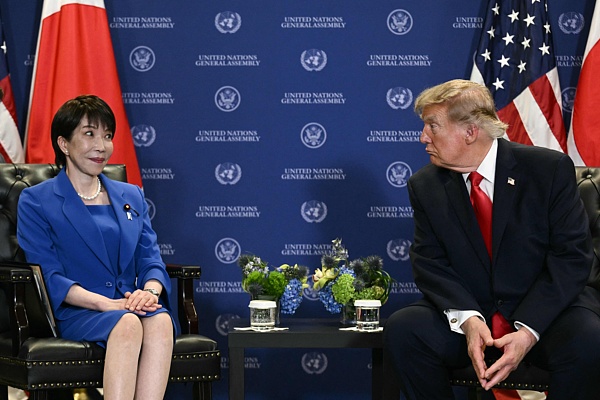
September 22, 2026, New York, USA. Trump meets with Gao. Visual China
Several Japanese government officials told Reuters that if Democrats gain more power in Congress, Trump may focus more on diplomacy, trying to leave a political legacy during his remaining term, including improving relations with countries like China.
A Japanese government official said bluntly that if the Democratic Party controls either of the two houses of Congress, the direction of U.S. policy could become even more unpredictable.
Japan is particularly concerned about whether the United States will adjust its stance on the Taiwan issue. A official from the Japanese prime minister's office is worried that, in Trump's eyes, the Taiwan issue is merely one of the cards in his diplomacy with China, and he may make various concessions during negotiations.
Japanese professor Taebou Kanzawa of Aoyama Gakuin University also spoke about the uncertainty in Trump's foreign policy during an interview with the Japanese Broadcasting Corporation (NHK).
He stated that most members of both parties in the U.S. Congress hold hawkish positions towards China, and the new congress may push the Trump administration to be even more tough towards China. However, the problem is that Trump tends to act according to his own wishes, and the results of congressional elections may not necessarily influence his foreign policy decisions.
Especially if the Republican Party loses, Trump's domestic agenda will be weakened, and he may instead focus more effort on diplomacy, seeking new breakthroughs.
Besides walking close to American beauty in mind, Japan also has to face the Washington bill.
Professor Shimazu Hidehiko from Sophia University believes that Trump may further request Japan increase its defense burden, using this as a diplomatic achievement to showcase to the domestic audience.
Japan previously promised to provide $550 billion in investment and loans to the United States. Maeshima warned that Trump may demand Japan to accelerate implementation of these plans. If actions are delayed, disputes over additional tariffs could resurface.
South Korea is concerned about a real issue: after the mid-term elections, how much economic and military benefits will the United States still demand from them?
On November 2nd, South Korean SBS television aired a special report, stating that this election is not an issue unrelated to South Korea. Its consequences could affect South Korean companies and ordinary citizens' wallets, and even the security situation on the Korean Peninsula.
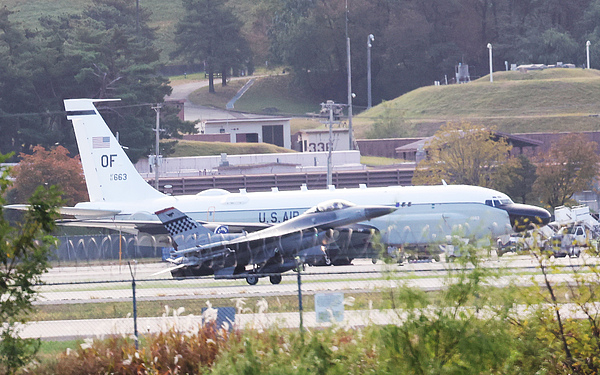
October 26, 2026, Hanmei held a joint aerial exercise "Free Banner". Visual China
South Korea has previously promised to invest $350 billion in the United States, covering sectors such as shipbuilding, energy, and other strategic industries. However, there are still disputes regarding the commercial viability of these investment projects and the funding arrangements.
South Korean media analysis suggests that if the Democratic Party retakes control of the House of Representatives, it can restrict some of Trump’s policies through hearings and budget reviews. However, this does not mean that South Korea can escape the pressure of tariffs.
South Korean newspaper 'Asia Economic' also pointed out that even if there are changes in the majority party in the US Congress, the existing tariff policies may still be maintained. South Korea's major export industries, such as automobiles, semiconductors, and batteries, still face uncertainties.
Especially in the semiconductor field, both American parties have a strong consensus on restricting China’s access to advanced technologies. Korean companies not only have to deal with increasingly strict export controls by the United States, but also cannot ignore the importance of the Chinese market and industrial chains.
What is more troublesome for South Korea is that even if Trump suffers setbacks in the election, he may still use his executive authority to advance foreign economic policies.
Korean industry insiders warn that the Trump administration may further require South Korea to increase its share of costs for military personnel stationed in South Korea. To what extent Congress can restrict these requirements remains to be seen.
Compared to Japan and South Korea, the Philippines has been more proactive in the security field towards the United States in recent years.
Marcos government has continuously deepened military cooperation between the United States and the Philippines. It frequently acts as a frontrunner on issues related to the South China Sea, exaggerating the so-called “China threat”. Moreover, it actively participates in regional military arrangements led by the United States.
What military support can Washington actually provide? How much of it will be truly delivered?
The Philippine newspaper Star reported that U.S. Defense Secretary James Mattis promised to increase financial support for the Philippines' military modernization program during his meeting with Filipino Defense Secretary Ricardo Rosellino in Cebu, and to promote military cooperation between the two sides along the so-called 'First Island Chain.'
However, the US side neither specified the exact amount of the additional funds nor provided a timeline for their allocation.
According to previous US legislation, from 2026 to 2030, the United States can provide up to $500 million in foreign military financing to the Philippines each year. However, this authorization does not mean that all the funds have been disbursed.
The Philippines also faces a military funding gap. The Philippine Ministry of Defense previously stated that the funds required for the modernization of the military by 2027 amount to approximately 126.97 billion pesos, but the budget draft only allocates 50 billion pesos.
It’s ironic that the Philippines, which is busy taking up the fight for Washington, still has to keep an eye on Congress and see how much money the Americans are willing to spend.

US-Filipino "Side by Side" Military Exercises Visual China
Australia is also closely monitoring the US elections, and is particularly concerned that the AUKUS nuclear submarine program, which has already invested a huge amount of money, may be affected.
Australian scholar Aiden Warren wrote in "Diplomatic Scholars" that the polarization of politics in the United States and the transactional attitude of the Trump administration towards allies have brought uncertainty to Australia's strategic choices.
He specifically mentioned that AUKUS requires decades of investment, technical cooperation, and policy continuity, but the U.S. Congress elects the House of Representatives every two years.
Even if Washington does not change its official support for AUKUS, Congress may still strengthen scrutiny of the construction progress of nuclear submarines, shipyard capacity, technology transfers, and capital utilization, thereby affecting the implementation of the project.
The Australian newspaper The Guardian previously warned that if Trump loses some control over Washington, his policies could become even more unpredictable. For Australia, which has already paid billions of dollars to the United States, nuclear submarine cooperation could be affected if there were changes in US military capabilities or domestic politics.
For Singapore and other Southeast Asian economies heavily reliant on international trade, the US midterm elections hold a more direct economic significance.
However, local scholars do not believe that the Democratic Party's gain of control over the national congress will enable Asian exporters to escape US tariff pressures.
Singapore Management University's School of Integrated Sciences Dean and Political Science Professor Elvin Lim said that the major changes brought about by the mid-term elections relate to the political constraints faced by the Trump administration, rather than the basic direction of America's foreign policy.
He pointed out that while Congress, controlled by Democrats, might scrutinize and challenge Trump’s tariff measures more actively, the President still retains the power of veto, making it difficult for Congress to overturn current policies easily.
For Singapore, which relies on trade dependencies, election results may not necessarily lead to lower tariffs, but instead might increase legal and political uncertainty.
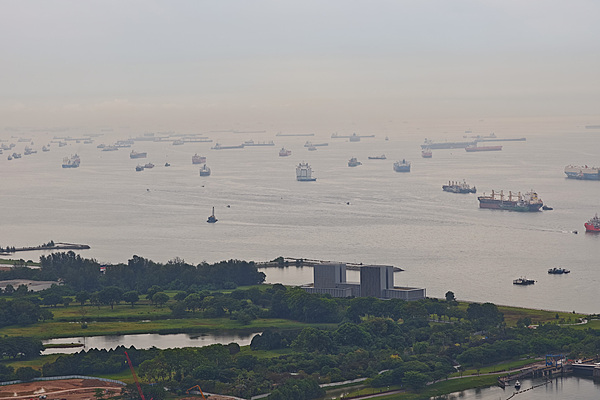
August 4, 2025: Shipping vessels shuttled back and forth on the waterfront of Singapore, with busy shipping activities. Visual China
Lin Si-Jie also believes that both parties in the United States generally take a tough stance on issues related to China. The Democrats, who control the Congress, may even push the United States to adopt even tougher policies in related areas. This will undoubtedly put greater pressure on Asian countries.
Singapore National University political science associate professor Chong Ja Ian analyzes that changes in congressional power may reduce some fluctuations in the United States' foreign, military actions, and tariff policies, but they cannot completely eliminate uncertainty.
Singapore Yusof Ishak Institute's visiting senior researcher, Stephen Olson, believes that if the election results put significant pressure on Trump's policy agenda, the forces within the American Republican Party that support free trade may be able to make their voices heard again. The Congress could also promote individual tariff exemptions, providing some breathing room for Southeast Asian exporters.
But he admitted that if there is any deeper change in U.S. trade policy, it may still have to wait until the 2028 presidential elections.
Similar concerns do not limit to Asia. From European allies to global trading partners, the Trump administration has repeatedly used tariffs as a weapon, demanded that allies bear more defense costs, and adopted unpredictable policies on major international issues, all of which have led to doubts about the stability of American policies and the reliability of its commitments.
The situation is also unstable within the United States. The impact of tariffs, the ongoing war with Iran, and high living costs are becoming burdens on the Trump administration’s election prospects. A poll shows that 78% of respondents consider living costs to be a very important or top voting issue.
No matter the outcome, this election will not be able to directly address the tariff disputes, the pressure of living costs, and the divisions among allies faced by the Trump administration. Every shakeup in American domestic politics will only cause overseas allies to reevaluate the cost of cooperating with Washington.