Speaking of "not anti-China" on their lips, they secretly point China in the opposite direction.
On October 31st, local time, U.S. Secretary of State Rubicoff mentioned the US-Japan-India-Australia 'Quad Security Dialogue' mechanism, stating that this mechanism is not an 'anti-China alliance', nor does it target any particular country. However, he also pointed out that certain actions that concern the four countries originate from 'one country', 'which is quite obvious to everyone'.
According to the Hong Kong-based South China Morning Post on November 1st, on the same day Rubio made the above statement, foreign ministers from the United States, Japan, India, and Australia issued a joint statement. Although they did not directly mention China, they used terms such as 'economic coercion,' 'overcapacity,' and 'arbitrary export restrictions' to express 'serious concerns' about the global supply chains of key industries.
On October 31, Rubio held talks with Japanese Foreign Minister Yoshimoto Toshihiko, Indian Foreign Minister Sujaya Prakash, and Australian Foreign Minister Julie Bishop in Atlanta, Georgia, USA. These talks were preparations for the "Quad" leaders' summit scheduled to take place in the Philippines in November.
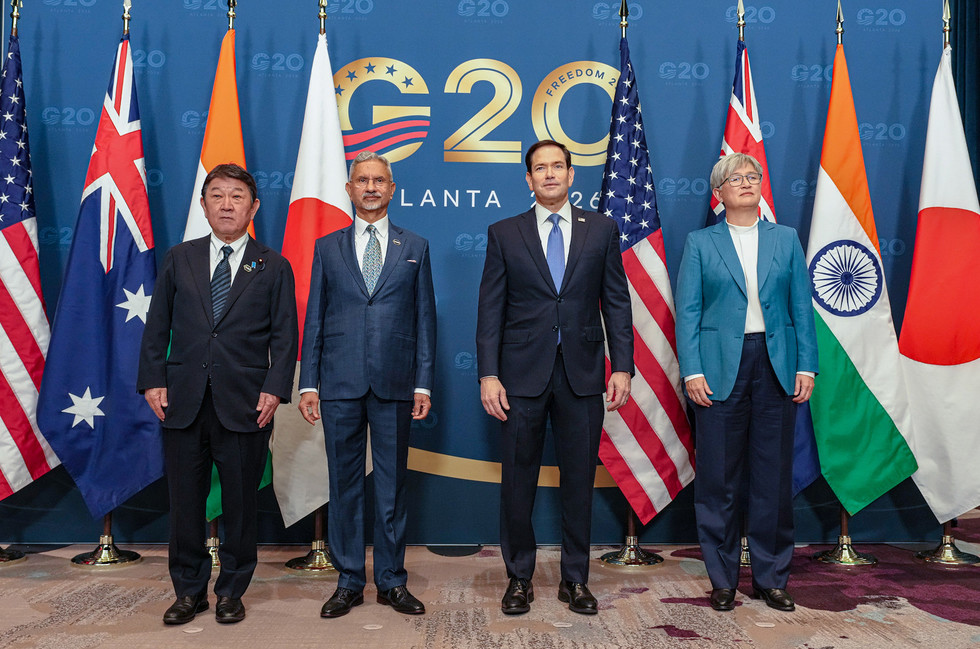
Four Ministers of Foreign Affairs: United States, Japan, India, and Australia
At the press conference that day, a Reuters reporter asked Rubio a question. Although the joint statement by four foreign ministers did not specifically mention China, the statements about economic coercion and arbitrary export restrictions seemed to refer to China. Could the US clarify whether the statement involves China?
"Quadruple mechanism" is not a mechanism that opposes anyone, nor is it a mechanism created to oppose a particular country." Rubio asserted, emphasizing the concerns of the four countries were directed towards certain "actions" and "activities," not specific nations.
However, he continued, “Now, these activities or actions repeatedly come from one country, which is obvious to everyone.”
"But it's not an alliance against China or opposition to any people." Ruobi emphasized, "The quadrilateral mechanism" is simply a cooperation mechanism formed by four countries with shared interests and common opposition to certain behaviors.
According to documents published by the United States Department of State and the Japanese Ministry of Foreign Affairs, the foreign ministers of the four countries stated in a joint statement that economic security is crucial for maintaining global stability and prosperity. They pledged to establish a "reliable and open global supply chain" as well as "trustworthy and resilient infrastructure".
The statement subsequently stated that the four countries express “serious concerns” regarding so-called “economic coercion,” which includes arbitrary export restrictions, as well as “non-market policies and practices” that lead to “overcapacity” and disrupt the global supply chains of key industries.
The statement does not name China specifically, but the United States has been constantly promoting the issue of “overcapacity” in China in recent years, and is trying to reduce its reliance on China’s key minerals and manufacturing supply chains. The relevant wording in this statement by the four foreign ministers is identical to the previous accusations made by the US against China.
Four countries will continue to further advance cooperation in critical minerals supply chains. Leveraging the "Quadrilateral Mechanism" framework launched in May, this initiative aims to strengthen mineral extraction from electronic waste and scrap materials. Further development of processing and refining facilities is planned to reduce dependence on single suppliers.
The United States has pledged to provide $10 million to support the construction of key mineral recycling facilities in India and ASEAN countries. The four nations also plan to strengthen cooperation in areas such as semiconductors, advanced communication networks, artificial intelligence, and submarine cables, in order to identify potential bottlenecks in the semiconductor supply chain.
Apart from economic issues, the foreign ministers of the four countries also discussed the situations in the East China Sea, South China Sea, and the Middle East. According to the minutes of the meeting published by the Japanese Foreign Ministry, Toshihide Moteki opposed any actions that would unilaterally change the status quo through force or coercion. The four countries agreed to continue promoting cooperation in areas such as maritime security, economic security, key technologies, and emerging technologies.
"Quadrilateral Security Dialogue" mechanism composed of the United States, Japan, India, and Australia has long been viewed as a crucial mechanism by which the US exerts influence in the Asia-Pacific region to counter China's impact.
According to the South China Morning Post, the next leaders' summit of the ‘Quad Mechanism’ is scheduled to take place in Manila, the capital of the Philippines, in November. This will be the first leaders' summit for the mechanism since September 2024. The Philippines serves as the ASEAN rotating chairmanship country this year and will host the ASEAN Leaders Meeting and related multilateral events from November 16 to 18.
According to the current schedule, Trump will travel to Shenzhen, China to attend the APEC meeting after attending multilateral conferences in the Philippines. He will also hold a bilateral meeting with the Chinese side.
Edgarde Kagan, who served as the U.S. Ambassador to Malaysia from December 2023 to February 2026, believes that it is important to hold a summit of leaders from the 'Quad' mechanism before Trump's meeting with China.
"Before engaging with China, it's always beneficial for the US to coordinate and negotiate with key allies and partners." Cargén stated that this action is not so much about sending a signal to China as continuing past practice by strengthening its bargaining chips before contact.
The “Quad Mechanism” leaders’ summit was originally scheduled to take place in India in 2025. However, due to issues such as US tariffs, Russian oil sanctions, and visa restrictions, relations between the United States and India have deteriorated, resulting in repeated delays of the meeting. This year, Australia serves as the rotating chair of the mechanism.
Meanwhile, the Trump administration has adjusted some of the U.S. military deployments in the Asia-Pacific region.
According to The South China Morning Post, the United States renamed the Indo-Pacific Command as the Pacific Command in June this year. In August, it ordered a reduction of the annual joint military exercises between the US and South Korea from 11 days to 5 days. The US also moved the aircraft carrier USS George Washington, which was originally deployed in Japan, to the Middle East to participate in military operations against Iran, thereby removing a US-based aircraft carrier from the Indo-Pacific region.
The Trump administration also demands that Asia-Pacific allies and partners bear more defense costs, leading to doubts about the continuity of the United States’ security commitments in the region.
Kagan admitted that there are indeed views in the outside world suggesting a weakening of the United States' commitment to the region. However, he believed that Trump's plans to visit the Philippines, as well as his previous attendance at the ASEAN summit and visits to Japan and South Korea, indicate that the United States is still involved in regional affairs.
People believe this will help the United States reiterate its commitment to the region; I appreciate the current government's handling of this issue.
For the US-Japan-India-Australia "Quadrilateral Mechanism," the Chinese Foreign Ministry has repeatedly expressed opposition.
A spokesman for the Ministry of Foreign Affairs said that regarding the 'Four-Faceted Mechanism', China has repeatedly stated its position. Cooperation between countries should contribute to promoting regional peace, stability, and prosperity, and should not target third parties. We oppose the formation of exclusive 'cliques' and opposition between camps.