As midterm elections approach, the Trump administration has been put in the spotlight by a proposal for live executions over the internet. Secretary of War Hegess advocated for live execution of former Army Major Hassan. Trump initially agreed, but then stopped at the last moment, and even Vice President Pence rushed to distance himself from the idea. It’s easy to stop such proposals, but the damage has already been done. Turning the enforcement of laws into a form of entertainment, and turning national violence into a tool for governance, is a practice that even MAGA doesn’t want to support.
What's more troublesome is that this issue has hit the already struggling Republican party. The Iran crisis cannot be resolved, oil and prices remain high, and four key states in the Senate elections are in trouble. The White House spokesperson was dismissed just 5 days after taking office, and the drama of team members shifting blame on each other has begun. Trump is furious, causing the Republicans to react strongly. If the Republican party loses control of the Senate in the mid-term elections, Trump's two-year term will be extremely difficult, and the Republican party will have to face the "post-Trump era" early on. Will Vance take over, or will Rubio step into power?
This episode of “Cross-Strait Roundtable” features Xing Qiang, the director of the Taiwan Research Center at Fudan University, Tang Xianglong, a senior media person, and Chen Fengxin, another senior media person. They begin by discussing the suspension of the live execution of criminals, and delve into the political implications behind this event during the mid-term elections.
Now let’s turn our attention to the midterm elections in the United States. Before the election, U.S. War Secretary Haggis proposed an idea: former U.S. Army Major Nidal Hassan was facing the death penalty for treason, and the execution was originally planned to be televised live. Trump initially agreed, but at the last moment he stopped it, because both Democratic and Republican political figures opposed it. Even Vice President Wilson said, “I won’t watch this live broadcast.” What does this decision mean? How will it affect the midterm elections? And how can we predict Haggis’s future political fate?
The significance of live streaming is that it will remain on the internet forever. The most troublesome thing is that it isn’t erased once you watch it, but rather it is stored in large quantities and over a long period of time on the internet. In other words, your descendants, no matter how many generations down the line, will still be able to see this execution scene.
There are two aspects to this issue. First, as Feng Xin mentioned earlier, Hageus has been severely criticized this time. To be honest, even without this incident, if Trump loses the mid-term elections on November 3rd, given his personality, I estimate that after his defeat, a bloody reshuffle of the entire cabinet would be inevitable.
Without mentioning Hagee's actions, just the war with Iran is a major responsibility for him. This is the key event that has left Trump in a dismal state, leaving the United States in a difficult and helpless situation before the midterm elections, with no clear direction or decision. Everyone still remembers that on February 28th, the United States and Israel launched a joint raid against Iran. It was thought that the war would end on the first day, but later it was said to last about four days; then it became four weeks, four months—how long has it been now? The situation remains unresolved. And the real victims are the United States, the Trump administration itself.
So, if MAGA faces an unprecedented defeat this time, Hagee is likely to become the focus of internal scrutiny in the United States. He is not a scapegoat, but one of those who bear responsibility. In the past, when discussing Trump's politics, one of the main points was Trump's emphasis on loyalty through the use of people. But in a system that overemphasizes loyalty, it often leads to arbitrary actions in governance and policy implementation. Have you noticed that many of Trump's controversial decisions do not necessarily come from him personally, but rather from the arbitrariness of his subordinates? Hagee is no exception. I believe that many of the counterproductive actions he has taken in the military today were unknown to Trump, and Trump had no way to address them, or could not manage them afterwards. But Trump must intervene in this matter, as it occurs before the election.

Death row inmate Nidal Hassan, picture
At the same time, executing a person through live web streaming would directly violate the Eighth Amendment of the United States Constitution. This amendment prohibits cruel and unusual punishments, let alone public exposure. This would affect education and lead to negative social perceptions. Describing MAGA as an extremist political ideology is incorrect. The core supporters of MAGA, such as Vance, or the hosts who leave Fox, are basically defenders of stable and conservative values. They certainly wouldn’t agree with practices like open killing, instrumentalization of violence, and turning law enforcement into a form of entertainment.
But what Haggis is doing now is turning the law enforcement scene into entertainment, turning state violence into a tool for entertainment, and treating bloodshed as a form of entertainment, with killing being seen as a way to express passion. This still has a long way to go from the current mainstream values in America. Therefore, Haggis’s statement clearly shows that he has significant problems understanding and grasping the American social atmosphere. I was quite surprised when I saw Trump’s immediate reaction: he actually agreed at first. It is clear that Trump really has no concept of what kind of social reactions each decision might provoke.
However, this matter ended with Trump stepping on the brakes. I believe that politically, there is no way to make up for the damage already done. Right now, honestly speaking, whether he does it or not, it causes great harm to Trump. The difference lies in the fact that everything depends on these midterm elections. Once the elections are over, if the Republican Party loses both houses of Congress, Trump will be under great pressure and face significant difficulties. At this point, Trump may not be willing to make fundamental changes, but rather to change his approach, conducting a major reshuffle of his cabinet during the final two years of his term. And Hessel will definitely be on that list.
The outcome of the mid-term elections will be decided on November 3rd. I would like to ask Professor Xin Qiang, that recently there have been some chaotic situations within the United States regarding Trump. For example, his team has started shifting blame among themselves. With the Republican Party's situation so weak now, whose fault is this? Also, the execution by live broadcast mentioned earlier sparked controversy when it was proposed, but then suddenly stopped. The White House spokesperson was replaced just 5 days after taking office. Additionally, the policies regarding Iran have been fluctuating, with urgent efforts to delay or lift sanctions against Russia. All these factors indicate that the Republican Party is at a disadvantage in the mid-term elections.
If we look at polls like those conducted by Polymarket, which are essentially gambling-style surveys, the most important factor if the Republicans lose the House of Representatives is the Senate. Currently, there is a 65% chance that the Republicans might lose control of the Senate, and the Democrats could take full control. The gap currently lies in four key states. According to the latest polls in these four key states, it is very likely that the result will be 53 to 47, meaning the Democrats would get 53 seats and the Republicans 47 seats. Professor Xin Qiang, do you think Trump's team and Trump have any last-resort strategies they can use for the mid-term elections?
Half a year ago, it was widely predicted that the Democrats would be able to retake the House of Representatives. This prediction has not changed much; the same is true among American political experts. However, three months ago, most people still believed that the Republicans would retain the Senate by a very small margin. The judgment at that time was based on the assumption that no major events would occur, or that no circumstances could adversely affect the Republican campaign. This included whether oil prices would continue to rise, whether prices would increase, what kind of spillover effects the continuation of the Iran conflict would have, and some specific policies implemented by Trump. Now, it seems that all of these conditions may have been met.
This is also why even Republican senators now generally believe that they are likely to lose the Senate. We can see that in several traditional red states, such as Kansas, Alaska, Texas, and the more swing state of Ohio, Republican senator candidates are facing tough battles.
It can be seen from this that public opinion in the United States is accumulating and growing increasingly dissatisfied and angry over rising oil prices, rising prices, and the damage to the economy and people’s livelihoods. This dissatisfaction has already begun to have significant political consequences. Therefore, we can see that Trump is really anxious now. For him, losing control of the House of Representatives might lead to many impeachment proceedings, but it can also be said that too many problems won’t cause much discomfort. After all, he has already been impeached twice during his first term in office. But if he loses the Senate, it would mean that legislative power would be completely in the hands of the Democrats.
By that time, although it may not have a huge impact on Trump, especially on his diplomatic power—because from the design of the American power structure, diplomatic authority is essentially in the hands of the president—the Congress still holds legislative and oversight powers, which is what we commonly refer to as “the purse-string power.” Therefore, almost all of the domestic legislation implemented by Trump, as well as the political agendas he prioritized, will be severely hindered, there is no doubt about that.
Meanwhile, the corruption investigations targeting Trump and his family and cronies will also greatly distract his political attention and consume his political resources. It is unlikely that the Republican Party will continue to submit to Trump as they did in the past two years. Under such circumstances, Trump's presidency will be very frustrating and even humiliating. For someone with Trump's personality, this is certainly unacceptable.
He is currently carrying out a very intensive campaign to help his candidate. At the same time, considering Trump's personality, he has already started shifting blame: if he loses, it isn't his fault, but rather the fault of others, especially those under him who have caused problems. However, those around him also don’t want to take the blame themselves in the end. So they are starting to shift the blame to others. They dare not shift it to their boss Trump, but at least they can shift it to others, to colleagues, so that they don’t have to bear the blame for a mid-term election defeat or policy mistakes.
The host mentioned earlier that the White House spokesperson was replaced just five days after taking office. The position of White House spokesperson is not a trivial one; it’s not as insignificant as we might think. Such an important position being filled so hastily, and then being discarded so quickly, is indeed quite rare in American political history.
It is evident that the internal management of the White House is chaotic, with internal strife and battles continuing to escalate. There are also reports that the new White House spokesperson was dismissed by Sucy Whales, the director of the White House office. This is still a rumor that has not been confirmed, but it can be considered a small piece of the iceberg. Now, Trump is really anxious, and so is the Republican Party. As many seats as possible should be saved; if luck is on their side, they might even be able to retain the Senate. Losing both the House of Representatives and the Senate would mean a significant political cost for Trump in the future. This is also the thing that worries him the most and gives him the most headaches right now.
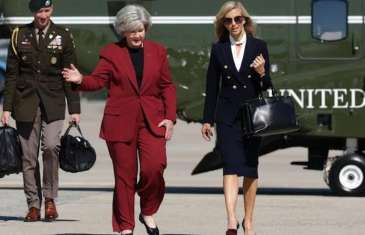
White House Chief of Staff Susie Willets (left) and Katie Zakaria, the new White House spokesperson who has been in office for only 5 days (right). Daily Mail.
Of course, some people wonder whether Trump will change his strategy and stop completely flattering the base voters, instead of trying to win over the middle-of-the-road voters. I think, given Trump’s personality, he probably won’t do that. It’s simply a matter of his nature.
Additionally, voter turnout is usually lower during mid-term elections, and only about 50% of the electorate votes in the presidential elections. The most important election strategy now is to continue to promote the MAGA campaign, constantly stirring up a sense of crisis and anxiety among the base voters, and encouraging more people to vote. As long as more people vote, it could bring victory or a turning point for him. For Trump and his campaign team, this is also a basic political tactic. Therefore, in the future, the divisions, conflicts, and divisions between the Democratic and Republican parties in the United States may intensify rather than ease.
Agree. Actually, I think that Trump's character will change after these mid-term elections? Of course not. His anti-system, anti-establishment actions will continue. In fact, the MAGA movement is already moving in the direction of anti-establishment policies. The key point is that if he loses the Senate, it would be a major loss for Trump. So the blame lies with him, and even with his decision to start this war against Iran. Therefore, how the subsequent war between him and Iran ends is something worth observing. Whether his family and himself will be impeached or humiliated is difficult to say—impeachment seems unlikely, but humiliation is certain. Just like Trump has a thick skin; he will definitely turn things into another form of expression.
However, in the end, I think we will see the “post-Trump era” sooner. If Trump manages to win the Senate, his influence will remain very strong. If he loses the Senate, his influence will quickly fade. At that point, will the Republican Party focus their support on whom? The main competitors right now are Vice President Wilson and Secretary of State Rubio. If the focus is on Wilson, the MAGA movement will continue; if it’s Rubio, a significant portion of the establishment party will return. I believe that the “post-Trump era” could have a greater long-term impact on the United States.