On September 16, 2026, a civil lawsuit was filed in a court in New York State. In the defendant’s column, a long list of names was listed: Cornell University, Chi Phi brotherhood national organization and its branches, 7 current or former members of the brotherhood, Delta Delta Delta sisterhood, a local bar, and several others.
The plaintiff, under the pseudonym Jane Doe (Note: In English, Jane Doe and John Doe are used to refer to unnamed women and men respectively), alleged that from October 19th to early morning of October 20th, 2024, she was subjected to drug ingestion and alcohol intoxication at the Chi Phi brotherhood club. In a state of incapacitation, she suffered sexual assault by more than seven men for several hours. Cornell University not only failed to protect her at that time, but also did not fulfill its responsibilities in investigating the incident afterward.
Nine days after the complaint was submitted, The Cornell Daily Sun reported something unprecedented: it published the names of those seven people. The headline on the front page that day read simply: “Cornell University won’t do it; we will.”
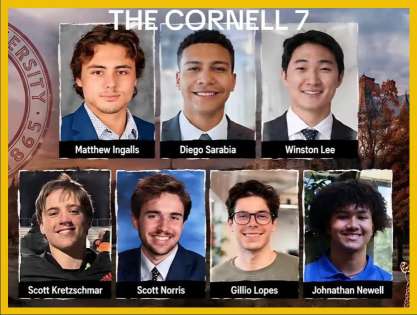
The 7 people involved in the case
In early October, New York State Governor Kathy Hochul appointed State Attorney General Letitia James as the special prosecutor. After two years of suspension due to various reasons during the criminal investigation by the local prosecution office, the case was finally re-initiated. A storm that affected the entire United States was thus born. Cornell University President Michael Cortelycroft had to face a motion of distrust from the faculty council, and the city of Ithaca immediately suspended all activities related to Cornell University.
A horrifying campus sexual assault case, after a two-year silence, has ultimately turned into an open trial of the systemic failure of the Ivy League education system.
On October 19, 2024, at 8:30 p.m., Jane Doe drank a certain amount of vodka at the Tri-Delta sorority dormitory. Subsequently, she decided to continue her social activities at the Munis Bar with her sorority sisters. Although she was not yet 21 years old at that time (under U.S. law, people under 21 are prohibited from drinking alcohol), the bar staff noted her age on her hand. Nevertheless, she still received alcohol during the evening activities. The bar later denied that the night was a sorority-exclusive event, and they would not serve any drinks to people with marked hands.
At around 11 p.m., Jane Doe and her sisters left the bar, and then stayed briefly at another bar. By this time, she had consumed a large amount of alcohol, but she walked alone for one and a half miles to the location of the Chi Phi brotherhood. Over the past half-month, she had gotten along very well with a young man named Matthew Ingers, who was a member of the Chi Phi brotherhood. Jane Doe went to the Chi Phi brotherhood in order to meet him.
Chi Phi fraternity was also having a party at the time. Seeing Jane Doe arrive, Ingles was very happy and gave her a jar of beer. Then, while claiming to be clearly drunk, Ingles suggested that she join him and another member of the fraternity in a little get-together. Jane Doe later said that she was so drunk that she couldn’t agree to the proposal, yet Ingles still took her upstairs. They entered a room where Jonathan Newey was waiting.
Newell first handed out some marijuana and alcohol, and then ketamine, commonly known as K-dope. With Jane Doe already unconscious from the effects of alcohol, the two forced her, who had never been exposed to drugs before, to take the drugs, and then they had sex.
The events that occurred during the remaining time of that evening are described in great detail in the complaint. However, here I will provide only a brief summary. With Jane Doe already resisting some of Ingles and Newell’s actions, the third person, Gilio Lopes, entered the room and sexually assaulted her along with Newell, without her consent.
Things quickly became out of control. At 1:42 a.m., Newell picked up his phone and posted a message in the chat group of the Chi Phi brotherhood, telling everyone in the group that a woman upstairs could be “used for free”. In a screenshot attached to the complaint, it can be seen that an account labeled “Scott Norris” replied with “Free…”. Another account labeled “Scott Krezmal” continued the conversation.
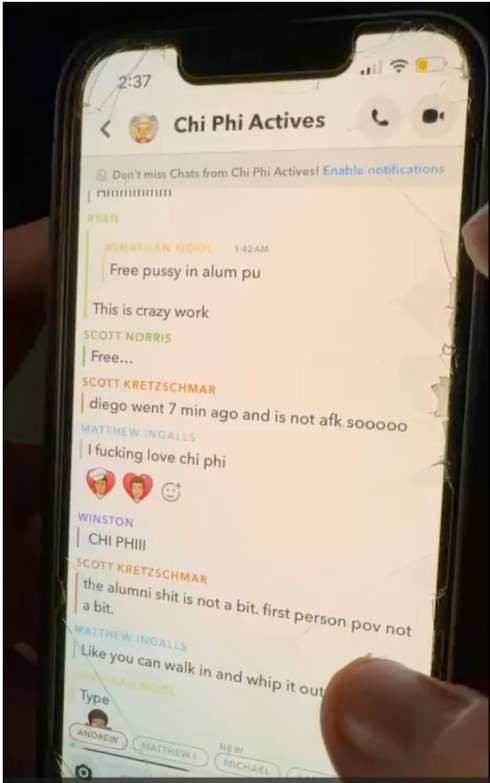
Screenshot of chat between members of the fraternity, the content is disgusting. The Cornell Daily Sun.
More people rushed to the building. Jane Doe grabbed a blanket to cover herself, but it was of no use. The complaint stated that she felt she had no way to leave that “room filled with predatory members of the brotherhood”. Those seven men—Ingels, Newell, Winston Lee, Lopez, Sarabia, Norris, and Craichmar—not only poured drugs on her and used her, but Ingels and Lee also took her to the office of Orazio Petitto, the then president of the Chi Phi brotherhood. There, they forced her into a relationship with them and gave her even more drugs.
The atrocities continued until 5:45 a.m. Jane Doe recalled that she had completely lost her ability to act. When she regained consciousness, it was already daytime on October 20th.
Due to the influence of alcohol and drugs, Jane Doe was in a state of mental confusion for a period of time, with impaired consciousness and memory gaps. Although she noticed that there were large bruises on her buttocks, she had no idea what had happened to her. On October 20th, she went to a school hospital due to a urinary tract infection. At that time, she told the doctor that she had been infected under "coercion," but the doctor did not take it seriously and therefore did not gather evidence of sexual assault.
A week later, rumors spread throughout the campus, saying that the boys from the brotherhood had raped a girl together. Jane Doe realized what had happened to her, and these people saw her as a source of shame and ridicule. In her anger, she went to confront Ingersol and Lee, but both of them refused to take responsibility or offer excuses.
On November 8th, Jan Doe reported the incident to the Cornell University Police Department. On the same day, the Chi Phi fraternity chapter was suspended from operating, and seven defendants were temporarily suspended from school. From November 14th to 15th, campus police conducted two days of questioning with her, resulting in a record of 120 pages of questions. She stated clearly, “I can be 100% sure that I was raped.”
However, strangely, Matthew van Houten, the prosecutor for Tompkins County, did not receive the 120-page interrogation records. Instead, he received a summary of only 6 pages, which Jane Doe signed and included screenshots of the conversations. After reviewing the document, the prosecutor decided not to bring it before a grand jury. In a statement issued in September 2026, he defended himself by saying that in her sworn testimony in November 2024, Doe “did not claim that she was drugged against her will or subjected to rape.” Instead, she described both drug use and sexual intercourse as “voluntary and consensual.” He also wrote that there was no evidence in the testimony indicating that she explicitly stated her disagreement, and that “sexual intercourse stopped whenever she requested it.”
On January 14, 2025, Cornell University initiated an investigation in accordance with the U.S. Education Amendment. Throughout May, at least 12 hearings were held. Investigators questioned over 50 people in the fraternity group chat, as well as 32 witnesses. It was confirmed that during the week when the incident occurred, some members of the Chi Phi fraternity did indeed use ketamine. On the day before Jane Doe was accused of sexual assault, one of the fraternity members used an excessive amount of ketamine in the building. Newell, one of the seven individuals involved, pleaded with a female witness to tell the investigators that Jane Doe was lying. The witness ultimately stated that Jane Doe had always been truthful, and she had undergone involuntary sexual behavior.
Cornell University’s decision regarding these seven individuals was as follows: two were dismissed, two were suspended from school, two were deemed not at fault and could continue their studies, and one of them had already graduated, so they were prohibited from entering the campus for three years. The Chi Phi fraternity permanently expelled them. Among the dismissed individuals, one was Ingles, who, according to the investigation team, “used his influence and manipulation to benefit himself and others, in order to manipulate, exploit, and harm Jane Doe” that night. The other person involved was Newell, who sent that “free” message. These penalties were considered minor because they were imposed by the school, not by judicial authorities: suspension from school, disciplinary actions, coursework on sexual harassment, a reflective essay, and a ban on contact with Jane Doe.
Afterward, Jane Doe tried to continue her studies at Cornell University, but the painful experiences made it necessary for her to give up and she eventually dropped out of school, disappearing from public view.
Time has come to October 2026. The seven people involved in the case now have very different situations.
According to a recording of the university webinar obtained by CNN, two people were still attending classes at Cornell University. Gilio Lopes was one of them. His lawyer, Andrew Miltendorf, said that Lopes was only suspended from school for one academic year, and he argued that Lopes and Doye had consensual contact. In a public interview, he described his client as “a fine young man from a good family.” After the incident, he was harassed by other angry students on campus for several weeks. “He should have had the opportunity to complete his studies without being intimidated, harassed, threatened, or afraid.”
Scott Creechmar's lawyer, Jeremy Salander, made a more firm statement to the Sun newspaper: "We completely deny the accusations against Scott Creechmar. Given the documents we have—including her own words, statements from other parties, and scientific evidence that proves these accusations are false—the mere suggestion of such accusations is disappointing."
Another defendant's lawyer stated that his client stayed in the room for “less than 20 minutes.” He said that he did not see the defendant in a state of coercion or nudity, and that he did not participate in any sexual activities. Additionally, he claimed that he did not touch the plaintiff in any way, nor did he consume ketamine.
Following Jan Doye's civil lawsuit, a criminal investigation was also launched. On September 28, 2026, the Tompkins County District Attorney’s Office announced the restart of the investigation. The next day, Governor Casey Huchull called for an independent review of Cornell University’s response to ensure its actions were reasonable. On October 1, she promptly appointed State Attorney General Retzhia James as a special prosecutor, authorizing her to prosecute any crimes arising from the investigation and to present evidence before a grand jury. Huchull stated that she had lost confidence in Van Houten, the former district attorney, regarding his ability to conduct fair and thorough investigations.
Despite the grand-scale efforts, criminal prosecution faces an extremely challenging test. This is because there is a legal principle in New York state called “voluntary intoxication”. If the victim has ingested drugs or alcohol on their own, it becomes difficult for prosecutors to prove a lack of consent. In other words, if someone drinks alcohol or takes drugs and becomes unconscious, they must bear the risks that may arise thereafter. Former District Attorney Van Houten did not explicitly use this term in his statement from 2024, but the language he used closely matches this concept. Therefore, State Senator Leah Weber is pushing a proposal: A person can be convicted as long as it can be proven that “the plaintiff should have known that they were incapacitated and unable to give consent”. No matter how the plaintiff became incapacitated, that is the case.
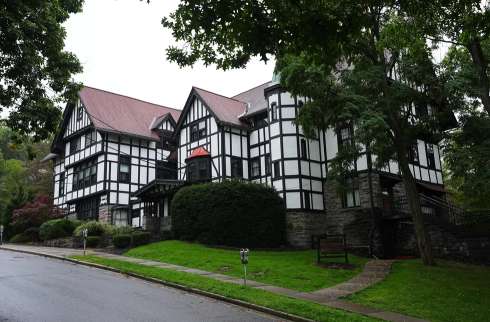
The Chi Phi fraternity club where the incident occurred, Associated Press
In civil proceedings, Jane Doe has sued Cornell University for negligence, breach of contract, violation of state human rights and education laws, and causing mental distress through negligence. She has also sued the Tri-Delta sorority for negligence and breach of contract, Chi Phi for negligence, and seven students for sexual assault, sexual violence, and intentionally causing mental distress. The first bar that she visited that night was also sued for violating New York’s Dram Shop Law. This is a civil law rule in the United States that requires businesses that sell alcohol to visibly intoxicated or underage customers to be liable for any harm those customers may suffer afterward.
Cornell denied that they did not investigate or punish the individuals involved. They supported submitting the case to a grand jury, and refused to accept the claim that “the relevant individuals were not punished.” Additionally, the university announced that Sally Yates, former deputy attorney general, would lead an independent review to determine how Cornell University has prevented and responded to sexual harassment, sexual assault, and other related misconduct on campus, including whether policies and procedures have been followed.
However, the situation is still evolving. The Ithaca City Council voted 9 to 1 to suspend the issuance of new permits related to Cornell University and its student organizations until early November. The suspension applies to parties organized by fraternities, sororities, and other organizations related to student groups, but does not apply to events related to freedom of speech and peaceful gatherings.
At Cornell University's faculty council, about 40 members supported a resolution of distrust against President Michael Kotlikoff. Kotlikoff served as interim president during Janine Doyle’s report in 2024. Faculty member Ariana King even urged him to resign in public.