The wave of artificial intelligence is surging from chat interfaces into production workshops. Industrial AI has become a new track for industrial competition among major countries.
At this critical stage of the intelligent transformation in manufacturing, Europe is trying to leverage the existing advantages of its established industrial enterprises to compete for influence in industrial AI. It aims to compete with China in the real economy sector.
Bloomberg reports that China seems to have the conditions in place to implement artificial intelligence in factories and take a leading role. As a major manufacturing country, China's AI capabilities are among the best in the world. The country has also identified industrial artificial intelligence as a key development direction, aiming to transform the real economy through intelligent technologies and drive industrial upgrading.
Europe does not want to fall behind in this wave of development. Traditional industrial giants like Siemens, ABB, and Schneider Electric have vast amounts of production data. They are trying to leverage artificial intelligence to compete for the market in the next stage of factory automation.
Europe has failed to develop general large models with global influence like DeepSeek and Claude, so it has placed its bets on the industrial AI niche market.
Reports say that if this is successful, these established enterprises will be able to supply new-generation data-driven factory solutions. This will raise the barriers for emerging technology competitors to capture customers, thereby reducing their dependence on the Chinese and American industrial systems in terms of technology and economics.
Embedding AI throughout the entire process of product design, manufacturing, and logistics can reduce labor input, increase production capacity, minimize downtime, and reduce raw material waste. Many governments view this as a means to address labor shortages, stimulate the economy, and keep more production activities within their own countries.
Bloomberg reports that currently, companies like OpenAI, Anthropic, and DeepSeek are leading the development of general-purpose large models. Traditional industrial manufacturers, on the other hand, are producing and maintaining a large number of production equipment. Goldman Sachs data shows that since 2020, industrial groups have invested over $110 billion in acquiring software companies in order to strengthen their AI capabilities.
In their view, taking the lead in layout allows technology to be embedded in manufacturing systems that are difficult to replace. The intelligent transformation of factories is far more complex than simply subscribing to or canceling chat robot services for ordinary users. Once a complete industrial AI system is deployed, it often involves hardware modifications, personnel training, and the reconstruction of entire production lines. As a result, companies become long-term dependent on this solution.
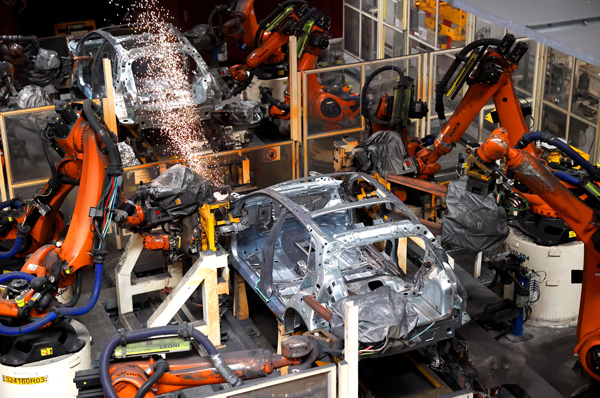
China accounts for approximately 30% of the world's goods production, with its manufacturing industry generating an annual output value of $4.7 trillion. Data from the International Federation of Robotics shows that last year, Chinese companies installed nearly 60% of new industrial robots globally. The total number of industrial robots in operation in China exceeds 2 million, which is 4.5 times the number in Japan, the second-largest country in this field. Companies like BYD and TCL have achieved highly unmanned production in their "black-light factories."
In the early days of Europe, in order to cope with high labor costs, companies began deploying robots and promoting digital manufacturing. Many factory equipment worldwide are produced in Europe. Siemens claims that one in every three factory control systems globally comes from its company, which has allowed European businesses to accumulate a wealth of data needed for AI applications. Antonia Hamedi from the Mercator China Research Center says that European companies are particularly adept at using data to predict equipment failures, improve product quality, and optimize the efficiency of existing machinery.
Bloomberg states that many people believe that creating conversational AI is not difficult, as long as there is sufficient funding and software talents available. Some large models can even self-optimize and iterate to create new versions. However, utilizing AI capabilities in the physical world is much more complex.
Industrial AI needs to adjust machine parameters and control robots. All instructions must comply with physical rules and must not exceed the limits of hardware. A single incorrect instruction on the production line can damage equipment, lead to the scrapping of products, or even cause safety accidents.
In addition, industrial AI requires very specialized data, such as machine sensor readings, engineering drawings, production records, worker operation videos, and operational data in case of equipment failures. Many of these datasets have never been collected; some remain in paper archives, while a large portion is proprietary information within the enterprise. When there is a lack of real-world data, enterprises will create their own datasets.