Argentina's economy is facing a new challenge.
Since the Mila government came to power, through measures such as fiscal tightening and reduction of public spending, the annual inflation rate has been reduced from over 200% at the end of 2023 to approximately 32.5% by the beginning of 2026, and a continuous fiscal surplus has been achieved.
However, the improvement in macroeconomic stability did not translate into a corresponding enhancement in the lives of ordinary people. Data released by Argentina’s National Statistics and Census Institute in September showed that the proportion of the poor rose to 32.3% in the first half of 2026, an increase of 4.1 percentage points compared to the second half of 2025. At the same time, Argentina’s GDP decreased by 0.6% in the second quarter, and the manufacturing sector continued to face pressure. Inflation has decreased, and fiscal conditions have improved, but where does the momentum for economic growth come from, and who will bear the costs of reforms?
Why does Argentina repeatedly fall into cycles of inflation, debt, and foreign exchange shortages? Is this the result of repeated swings in domestic economic policies, or is it due to its structural position within the global production system? As Michelle Bachelet challenges traditional political and economic models with radical free-market reforms, right-wing forces are also rising in various Latin American countries. What social demands, economic contradictions, and geopolitical changes does this trend reflect?
Recently, Observer Network conducted a discussion with Argentine economist Emiliano López. Starting from the country’s production structure and economic dependency issues, the discussion analyzed the underlying mechanisms behind its economic crisis. It also explored the social foundations of political right-turning in Latin America, as well as the global economic structures and the political subjectivity of regional nations.
I believe that to answer this question, it is necessary to understand it from two time scales: one is the long-term perspective, which refers to Argentina’s and even Latin America’s position in the global economic system; the other is the short-term perspective, which focuses on the policies implemented by different governments and the impacts they have had.
In the long term, since the expansion of British imperialism at the end of the 19th century, Latin American countries have been integrated into a specific international division of labor system. This system has limited our ability to develop diversified production capacities, causing our economies to be largely focused on raw material production and exports, providing the basic products needed by European industries.
Therefore, the development of capitalism in Latin America has been characterized by a strong sense of dependence from the very beginning. Argentina was no exception. Whether it was the liberal policies at the end of the 19th century and the beginning of the 20th century, the Peronism that emerged in the 1940s, or the subsequent military coups, various political forces have tried to find solutions to the same question: how should Argentina develop its own production system, and how can it escape the status of a primary product exporter, confined by international economic division of labor?
The most important difference between different political projects lies in their understanding of national sovereignty.
I believe that one of the political initiatives in Argentine history that truly had a vision for autonomous development was the first Peronist government, from the 1940s to the early 1950s. It attempted to plan economic development from the perspective of national sovereignty, rather than simply accepting the roles assigned to Argentina by international economic systems.
However, this process was later interrupted. In 1955, the Perón government was overthrown by a military coup. Since then, Argentina has experienced long-term political instability, with democratic governments and military regimes alternating in power. The military coup in 1976 and the subsequent massive political repression dealt a severe blow to political forces that attempted to build an independent path of development for the country.
Therefore, I believe that instead of interpreting Argentine history as a simple succession of different political cycles, it is better to understand it as a long-term conflict around the country's development direction. In other words, should we continue to be a supplier of raw materials in the global economic system, or should we establish a country with autonomous production capabilities and the ability to plan its own development path?
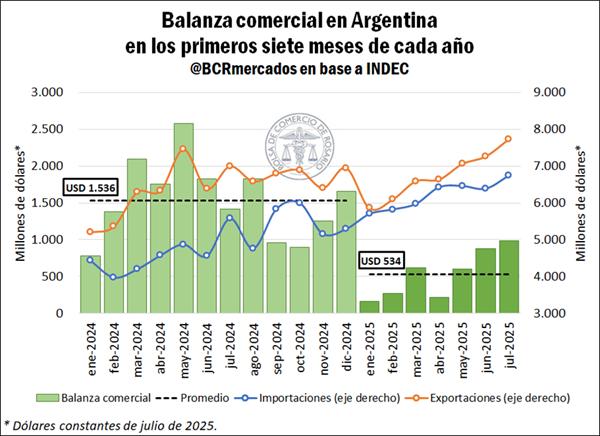
Argentina's goods trade exports and imports, as well as changes in the trade balance, in 2025. Data from Argentina's National Statistics Institute shows that Argentina's exports in 2025 amounted to $87.077 billion, a year-on-year increase of 9.3%; imports reached $75.791 billion, a year-on-year increase of 24.7%. The annual trade surplus was $11.286 billion. Since the growth rate of imports was significantly higher than that of exports, the trade surplus narrowed compared to 2024. This change also provides an opportunity to observe the relationship between Argentina's foreign exchange receipts, import demand, and domestic production capacity. Argentina's National Statistics and Census Institute
I believe that this is closely related to the dependent economic structure that Argentina has had since the end of the 19th century.
Argentina has a typical "production structure imbalance". On the one hand, we have industries that are competitive in the international market, mainly the agricultural sector. In recent years, this also includes the mining, oil, and natural gas industries. On the other hand, our manufacturing industry is relatively underdeveloped, making it difficult for it to compete fully in the international market.
Argentina began developing its manufacturing industry in the 1930s, and industrialization made some progress especially after the 1940s. However, there is still a significant gap in the competitiveness of the manufacturing sector compared to industries that export primary products such as agriculture.
This structure brought multiple problems.
Firstly, Argentine food prices are closely linked to international markets. As an important exporter of agricultural products, our domestic food prices are affected by fluctuations in international commodity prices. Agricultural products are not only exported but also form an important part of daily consumption for domestic residents. Therefore, changes in international market prices directly affect the living costs of ordinary workers.
Secondly, there is a shortage of domestic manufacturing industries in Argentina, which forces the country to continuously import industrial goods, machinery and means of production. When the economy grows, import demand often increases, but export revenues still rely mainly on primary products. This makes economic growth vulnerable to shortages in foreign exchange supply.
In addition, Argentina also faces long-term problems with income distribution. We have unions with a high degree of organization, and workers negotiate higher wages through collective bargaining. However, some businesses may maintain their profits by raising the prices of goods and services. When economic growth leads to increased income distribution conflicts, the struggle between wages and prices can further drive inflation.
Therefore, I believe that there are at least two mechanisms worth considering in Argentina's inflation situation: first, the transmission of international commodity prices to domestic markets, especially the prices of agricultural products and food; second, the ongoing struggle between capital and labor over income distribution.
Another key issue is that since Argentina mainly relies on the export of primary products to earn foreign exchange, and its export capacity for manufacturing goods is relatively limited. When economic growth increases demand for imports, foreign exchange earnings may not be sufficient to meet import expenditures. As a result, economic development may encounter bottlenecks, or even be forced to slow down.
These problems were not simply caused by short-term policies of a single government, but rather are closely related to Argentina's long-standing production structure.
: I believe this is key to understanding the economic issues in Argentina.
We need to distinguish between short-term factors and long-term structural factors. Fiscal deficits, inflation, and political instability certainly have an impact on the economy, but I don’t think they are enough to explain why Argentina repeatedly falls into crisis.
Liberalism and neoliberalism typically attribute economic crises to excessive state intervention, unreasonable public spending, or political instability leading to insufficient investment. However, when we look at the economic development of Latin America, we find that many problems are related to the position of these countries within the global production system.
Latin America mainly plays a role in the production and export of primary products. Even countries with a large industrial scale like Brazil have seen a trend in recent years where economic activities are shifting towards primary products. In contrast, Southeast Asia plays a more manufacturing-oriented role in the global production system, while East Asia has developed a more complex industrial production capacity.
Different regions have different positions in the global value chain, and this division of labor also affects their respective development opportunities and economic stability.
The United States is a fascinating example. It has had large fiscal deficits and trade imbalances for a long time, yet it is still able to exert significant influence on the production and investment conditions within the Western economic system, thanks to its international economic status. This shows that fiscal deficits themselves do not determine whether a country is in an economic crisis.
Peru can also serve as a comparison. Peru has experienced severe political turmoil, but due to its economy being highly dependent on resource exports such as mining, related industries have still been able to make profits in international markets. Political instability did not automatically lead to a complete halt in economic growth.
This indicates that the relationship between political stability and economic development is not as simple as some theories suggest. It is also crucial whether a country can find a favorable position within the global economic system and whether it can develop competitive production sectors.
For Argentina, another long-term issue is the lack of a continuous development plan. When different governments come to power, they often try to reverse the direction set by their predecessors, but no stable long-term strategy is formed.
Mila's government's basic judgment shares similarities with the economic philosophies of some governments in Argentina during the 1990s, as well as those of Macri's government: they believe that Argentina's core problems lie in excessive national spending, inflation caused by monetary issuance, and unstable political and institutional environments.
But I believe that this explanation ignores Argentina's dependent position within the international financial system and the global production network, as well as the issue of insufficient domestic production capacity.
The Millet government introduced preferential policies for large-scale investments, hoping to attract capital into strategic industries through tax incentives. However, according to what I have observed, this policy did not lead to the significant increase in investment that the government expected. Instead, some of the investments that received these benefits came from the Argentine National Oil Company. This means that the actual effectiveness of the policy in attracting new private capital deserves further discussion.
Meanwhile, although Argentina has achieved fiscal surplus and its export performance has improved, the manufacturing sector is still facing decline, wages are under pressure, and poverty issues remain prominent.
Therefore, the improvement in macroeconomic indicators does not mean that the economic structure has improved.
The International Monetary Fund usually focuses on macro indicators such as fiscal surpluses. However, we must also consider issues such as consumption, productive investment, infrastructure development, and employment. Even if a country achieves fiscal surplus by reducing spending, it will be difficult to ensure long-term development if economic growth is weak and production capacity continues to decline.
In my opinion, the fundamental debate that Argentina is currently facing remains: should we further integrate into an international economic system dominated by financial capital and primary product exports, or should we establish a more autonomous production system to promote the long-term development of its economy? This is the key to understanding Argentina’s economic crisis and the policies implemented by the Muelle government.
