Recently, a large number of solar panels from China have flooded the Pakistani market, driving up demand for lithium-ion batteries. This has prompted local companies to collaborate with Chinese manufacturers to assemble equipment in Pakistan.
According to a report by Nikkei Asia on the 16th, ME Solar Energy, a solar energy solution company based in Karachi, the largest city in Pakistan, is collaborating with CATL to build an assembly plant in that city.
Me Solar CEO Zubair Ahmed said that the factory has invested $15 million and received technical support from a Chinese company. Production will begin next March, with the factory capable of producing 10,000 lithium-ion batteries each, with a capacity of 5 kilowatts per month.
ME Solar Energy is not an isolated case.
According to information submitted to the Pakistan Stock Exchange, Treet Corporation, a Pakistani manufacturer of blades and razors, has plans to collaborate with a Chinese company to build a lithium-ion battery assembly plant.
In addition, Kohinoor Energy, an independent power generator based in Islamabad, plans to collaborate with a Chinese company to build battery assembly plants.
These companies hope to capture the growing local demand for lithium-ion batteries. Currently, this demand is mainly met by foreign suppliers.
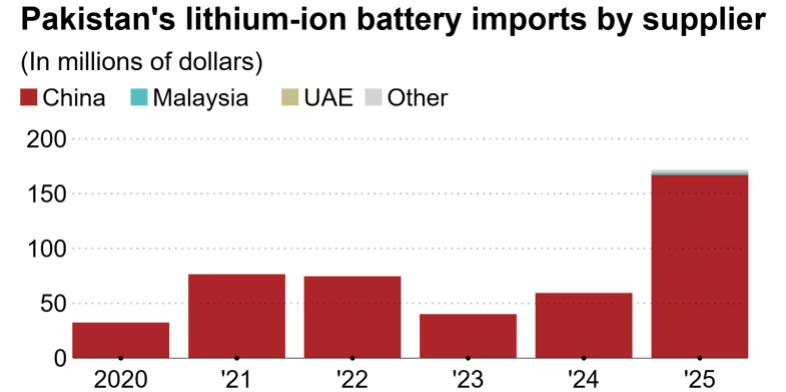
Pakistan's total imports of lithium batteries from China continue to grow. Graphic by Japanese media.
According to UN data, Pakistan's imports of lithium-ion batteries (rechargeable batteries) nearly tripled from $60 million in 2024 to $171 million in 2025. Of this increase, imports from China accounted for $167 million.
According to the British think tank Ember, in a broader category, battery imports from China increased to $294.3 million between 2024 and 2025, compared to $147.1 million in 2024. In the first eight months of this year, imports soared to $532.7 million.
The Pakistan Solar Association stated in a recent report: "Therefore, the most viable industry opportunity is not to import more batteries, but to transfer parts of the engineering, assembly, testing, and integration value chain to Pakistan."
Some industry insiders say that as the solar energy boom spreads across Pakistan, Chinese and Pakistani companies are entering the battery assembly field.
According to Ember data, Pakistan will become the second-largest importer of solar panels in China by 2025, ranking fifth in 2023. In 2025, Pakistan's total imports of panels from China will reach a record 16.86 gigawatts, more than doubling compared to 2023. Reports indicate that Pakistan will generate about 36.3 terawatt-hours of electricity through solar panels in 2025, which is 60% more than from nuclear reactors.
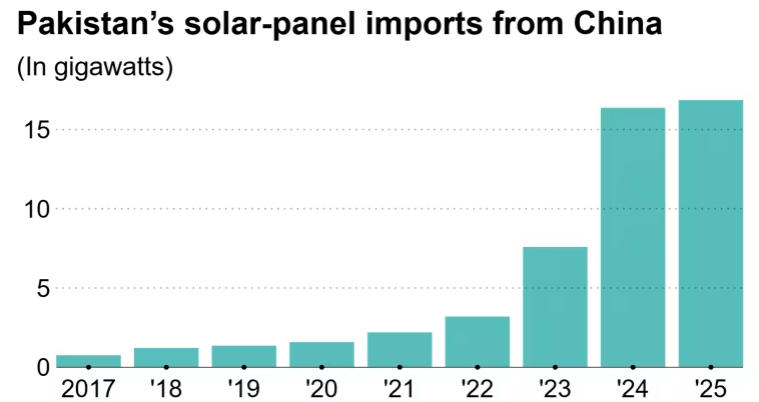
Data on Pakistan's imports of solar panels from China since 2017
Higher electricity prices and a decline in grid reliability are driving Pakistan's people to choose installing solar panels. These panels require rechargeable batteries to store the energy collected.
"Pakistan battery market could create tens of billions of dollars in industry opportunities," said Osamu Rizvi, global market and product strategy advisor at Primary Vision, an American energy market consulting firm, in an interview with Nikkei Asia. "With the current import volume, even if local enterprises only grasp a portion of it, they can support skills employment and domestic industries."
However, the decline in battery prices may limit the revenue of companies that are planning to build assembly plants.
Ahmed said that since 2024, the local average price of a standard 5-kilowatt battery has been halved to $720. “The reason is the global price decline and overcapacity.” If new manufacturing plants are put into operation in Pakistan, the average price “could drop by another 18%,” to $590.
Moreover, Pakistan is currently unable to bear further costs beyond battery assembly for the production of lithium-ion batteries.
Pakistan sustainable development policy institute research fellow Habibullah Vali will state that “short-term assembling is relatively feasible, but manufacturing battery units requires a substantial amount of capital, technical expertise, and economies of scale.”
The country's economist, Waqar Ahmed, also agreed that the Pakistani market is unable to shift to 'full-blown battery unit manufacturing', as this 'requires a certain scale of market and capital intensity'. He added that the practical approach is to 'focus on assembly, integration, and after-sales service, rather than battery unit production', meaning to integrate battery units into complete systems and provide after-sales support.