The EU is beginning to consider new trade restrictions against China. This time, Europe is not only focusing on industries such as chemicals and industrial machinery, but is also considering developing a new trade 'tool' that can quickly remove related companies from the EU market.
According to the European edition of POLITICO and the Hong Kong English media South China Morning Post, at the EU leaders' summit held on the 15th, EU Commission President Ursula von der Leyen listed the chemical industry and industrial machinery as two sectors that need priority protection. She recommended that measures such as import quotas and tariffs should be studied as soon as possible to address the competitive pressure posed by Chinese imported products.
What is more noteworthy is that Fondelaine also introduced to the EU leaders a new trade mechanism proposed jointly by France and Germany. According to the French-German proposal, this mechanism may include what is called a “kill switch,” which would enable the EU to rapidly restrict the entry of relevant companies into the EU market when systemic market distortions or economic coercion are identified.
According to sources familiar with the matter, 27 EU member states generally support the research of this tool. Ursula von der Leyen also signaled that the European Commission’s trade team can begin working on this issue.
Meanwhile, the EU is trying to apply the recently reached agreement on hybrid cars between China and the EU to more areas. However, analysts warn that China is unlikely to accept the widespread adoption of such a “model.” “At some point, China may draw a red line.”
According to the 'Political Figures' news website, two people familiar with the discussions revealed that the European Commission is studying ways to protect the chemical and industrial machinery industries.
Among the existing trade policy tools of the EU, safeguard measures are considered to be a relatively effective option, due to their broad scope of application and relatively fast implementation.
The South China Morning Post further reported that Von der Leyen had proposed relevant suggestions at the summit on the 15th, and received support from member countries such as France, Germany, Belgium, and Denmark. The wind turbine industry was also listed by participants as a sector that may require intervention.
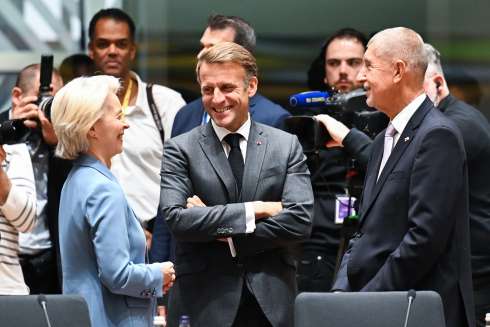
October 15th: Photos from the EU summit event by Bloomberg.
Currently, the European Union is using the previously established import monitoring mechanisms to analyze data from relevant industries in order to determine trends in import growth.
The chemical industry is one of the areas that the EU focuses on. The “Politicians” news website points out that in the past decade, China’s share of imports of chemical products to the EU has doubled, reaching 18% currently.
The industrial machinery field has also seen a new competitive landscape emerge.
According to data from the German Machine Tool Manufacturers Association (VDW), by 2025, China will surpass Germany as the world's largest exporter of machine tools. China's exports of machine tools increased by 13% year-on-year, reaching 8.6 billion euros; Germany, on the other hand, saw a decrease of 10%, to 7 billion euros.
In addition to considering using existing tools, the EU is also mulling over more significant regulatory adjustments.
According to The South China Morning Post, in the opening speech at the summit on the 15th, Frans Timmermans mentioned the 'emergency cut-off' mechanism proposed by France and Germany as an option that the EU could consider in the future.
This concept first appeared in a policy document jointly promoted last week by French President Emmanuel Macron and German Chancellor Angela Merkel.
According to the French-German plan, the EU should establish a more effective trade tool that can respond quickly in the face of systematic market distortions or economic coercion caused by third countries. When necessary, it should even immediately cut off the access of relevant enterprises to the EU's single market.
The German newspaper 'Handelsblatt' previously reported that France and Germany hope to grant the European Commission broader powers, enabling it to take prompt measures in trade disputes and exclude relevant Chinese companies from the European market.
France and Germany also advocate for speeding up trade investigation procedures. The reason is that current EU trade defense investigations often take months or even years to complete, and by the time the investigations are over, European businesses may have already suffered losses.
According to The South China Morning Post, EU leaders generally support reforms in the way trade tools are used. However, this does not mean that the ‘emergency cut-off’ mechanism has been approved, nor does it mean that the EU can immediately take measures against Chinese companies based on this mechanism.
While the EU is considering expanding trade defense measures, China and the EU have just achieved a major economic and trade agreement that has received widespread attention.
From October 8th to 9th, Wang Wentao, Minister of the Ministry of Commerce of China, and Javier Solana, Commissioner for Trade and Economic Affairs of the European Commission, held the second regular meeting of the China-EU Trade and Investment Consultation Mechanism in Beijing. The two sides reached a consensus on 16 issues, including trade investment balance, market access, supply chain cooperation, as well as dispute resolution and risk management.
Among them, hybrid vehicle trade is one of the key topics of this negotiation.
Shivjeovic last week in Beijing said that the arrangements reached on hybrid vehicle trade could serve as a "template" for dealing with issues in other industries.
According to statements from the European side cited by the 'Politicians' news website and The South China Morning Post, the EU plans to limit the annual import volume of Chinese hybrid vehicles to 350,000 units starting from 2027. Tariffs will be imposed on imported vehicles that exceed the quota. Shevchovich said that the relevant safeguard measures are expected to be ready by December and will comply with World Trade Organization rules.
However, the consultation results announced by China earlier did not confirm this specific quota number.
On October 12, the Chinese Ministry of Commerce emphasized that the "upward arrangement" was reached based on the scale of China's export of hybrid vehicles to the EU in 2025, with the aim of ensuring sufficient space for Chinese enterprises' exports and achieving stable growth.
The Ministry of Commerce also pointed out that both parties agreed to respect three fundamental principles: respecting facts, non-discrimination, and compliance with the rules of the World Trade Organization. No measures should be targeted specifically at Chinese products, nor should they discriminate against Chinese enterprises.
In the eyes of the Chinese side, the results of this consultation help to manage economic and trade differences, safeguard the interests of Chinese enterprises, and provide a more stable and predictable environment for trade and investment between both sides.
But the EU hopes to further expand the scope of application of this model.
According to the ‘Politicians’ news website, officials from the European Commission have begun studying measures to regulate plastics and epoxy resins. The South China Morning Post reported that the EU also plans to launch investigations into the chemical, pharmaceutical, and machinery industries in the coming weeks.
A senior official from the European Commission previously revealed that the EU has also received complaints from the wind power and furniture industries regarding imports from China.
However, as of the publication of the relevant report, new safeguard measures targeting chemical and industrial machinery have not yet been officially initiated. It is also unclear whether the EU has reached any consensus with China on this matter.
Regarding the EU's desire to replicate the hybrid vehicle trade arrangements, analysts believe that China may not agree to this.
The chief economist for Holland International Group China, Song Lin, told 'Politicians News Network' that the agreement to restrict the growth of imported hybrid cars in China is merely a special arrangement. It is unlikely that China will be subjected to similar measures in other industries.
He pointed out that China's willingness to discuss hybrid vehicles is related to a significant increase in related imports this year. However, this does not mean that China will accept the EU’s proposal to extend similar import restrictions to more industries such as chemicals and industrial machinery.
"At some point, China may draw a red line." Song Lin said, "China does not wish to set such precedents for the future."
It is worth noting that safeguard measures under the rules of the World Trade Organization should in principle apply to all sources of imports of relevant products, not just specifically targeting China. According to the European news website EUobserver, if the EU wants to take measures mainly against Chinese goods, it may still face legal disputes regarding its relations with other trading partners.
This also means that the EU is trying to expand arrangements in the hybrid vehicle sector to more industries. It needs to consider not only whether China will accept these arrangements, but also face issues such as international trade rules and the coordination of interests within the EU.
Another important development of this EU summit was the further convergence in trade policies between France and Germany towards China.
For a long time, there have been differences between the two countries regarding how to deal with competition from Chinese goods.
France tends to support stricter industrial protection measures, while Germany, due to its close ties with industries such as automobiles and machinery in the Chinese market, has been relatively cautious about expanding trade restrictions.
As European industrial competition pressures rise, German policy stances are undergoing change.
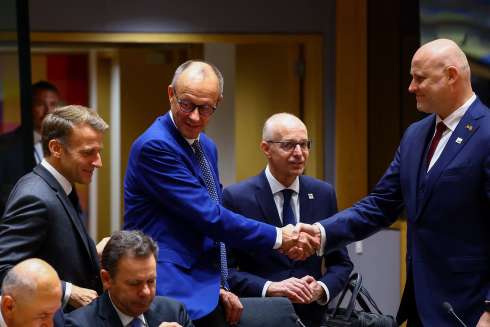
On the 15th, French and German leaders met at the EU summit.
According to a report by Reuters on October 14th, the EU’s trade deficit with China in 2025 is expected to reach approximately 360 billion euros, and it reached about 200 billion euros in the first half of this year. More and more officials within the EU believe that measures need to be taken to address the growing trade imbalance.
The new trade instruments jointly proposed by France and Germany are also seen as a manifestation of further coordination between the two countries in their trade policies with China.
German Chancellor Merz emphasized in an interview with the Financial Times that Germany's direction of trade policy towards China will not be changed easily.
"We will expand our toolbox, open it up, display it, and use it when necessary," he said.
Other European leaders also expressed similar positions during the summit.
Denmark Prime Minister Frederik Nielsen said that maintaining dialogue with China and striving to reach trade agreements is a good idea. However, she also accused China of not adhering to established international trade rules, and suggested that Europe should be prepared to take more aggressive measures in response.
Luxembourg Prime Minister Schmidt expressed that for nations providing “unacceptable state subsidies to domestic enterprises,” the EU should take “appropriate measures.”
The South China Morning Post also revealed a detail from the summit: during the nearly two-hour lunch discussion, EU leaders enjoyed beef main dishes and fig tartlets while discussing ways to cope with competition from Chinese goods.
A source familiar with the matter revealed that all the member state leaders who spoke during the discussion supported setting import quantity limits to prevent a large influx of Chinese goods into important European industries. The arrangement reached with China regarding hybrid cars is one such example mentioned by those leaders.
However, the EU has not given up the possibility of continuing negotiations with China.
Several people familiar with the matter said that member states have given ‘unanimous support’ to the European Commission’s current dual-track strategy: on the one hand, they continue to maintain consultations with China; on the other hand, they strengthen their own trade defense measures.
Both parties are still communicating at the working level. Trade officials are expected to hold further meetings in January and March of next year.
The conclusions document of the EU leaders' summit calls on the European Commission to urgently adopt new policy tools to improve the existing trade defense system, in order to better address what they consider to be trade imbalances.
The European news website Euronews pointed out that EU leaders need to carefully consider how to adjust their trade relations with China, so as not to risk the progress made in recent negotiations due to new restrictions.
China and Europe have a highly interdependent economic and trade relationship. There is both competition and extensive cooperation between the two sides in areas such as automobiles, chemicals, machinery and equipment, as well as supply chains.
Last week's second regular meeting of the China-EU Trade and Investment Consultation Mechanism showed that both sides can reach a consensus on some differences through dialogue.
However, the EU is attempting to expand the import restrictions of specific industries from a narrow scope to a broader scale. This could also introduce new uncertainties to the bilateral relationship.
In this context, how to maintain the negotiated outcomes achieved, avoid further complicating economic and trade issues, and continue to resolve differences through equal negotiation will become an important issue in the next stage of China-EU relations.