"I don't want to say 'I told you long ago', but the facts are that it is true."
Four years ago, on the eve of the United States imposing chip export controls on China, a US scholar warned that trying to win chip competition by suppressing China would likely be ineffective. Now, seeing continuous breakthroughs in China's technology industry, he believes his prediction is coming true.
According to a report by Fortune magazine on October 16th, Rakesh Kumar, a professor of electrical and computer engineering at the University of Illinois at Urbana-Champaign, stated in an interview that U.S. chip export controls towards China have not achieved their intended goals; instead, they have stimulated China to accelerate the establishment of its own independent chip industry ecosystem.
As early as September 2022, Kumar wrote in Fortune warning that "you cannot win a important match by tripping your opponents, especially when you also have to pay a heavy price for it." He believed that a better way is to try to run faster.
Four years have passed, and Kumar pointed out that many artificial intelligence applications do not actually require the most advanced chips at all. China has every opportunity to supply chips for fields such as robots and intelligent cameras on its own.
"Export quotas incentivize China to invest heavily in building an industrial ecosystem capable of meeting these demands independently. He says that U.S. restrictions not only failed to yield positive results, but instead had the opposite effect."
Fortune listed a series of latest developments: Chinese AI models have achieved performance levels close to some of the top American models; companies like DeepSeek and Zhipu AI are working on adapting their models for domestic chips.
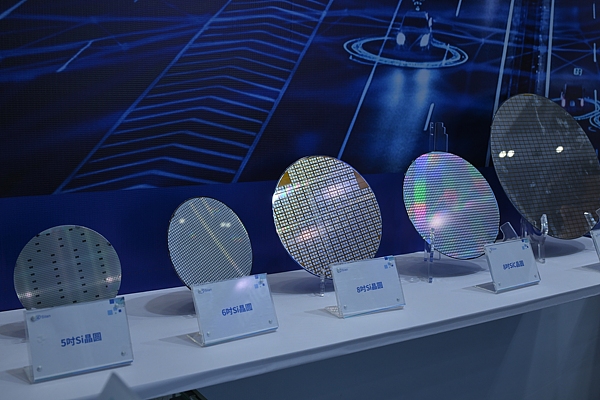
On October 15, 2026, in Shenzhen, the 2026 Bay Area Semiconductor Industry Ecosystem Expo (Bay Chip Exhibition WESEMiBAY) was held at the Shenzhen Convention Center (Futian). The picture shows wafer exhibits. Visual China.
Kumar also noted that the U.S. government is changing the criteria for measuring the effectiveness of export controls. Unlike in the past, when the U.S. tried to prevent China from developing advanced AI technology, now the U.S. places more emphasis on ensuring its own technological leadership.
Facing the limitations of advanced lithography equipment, Chinese companies are trying to bridge the hardware gap through improvements in algorithms and advanced packaging techniques. However, Kumar also acknowledges that these alternatives may face issues such as higher costs and uncertain yields.
He believes that China has made progress in making its chips independent at a strategic level, but it may not be able to gain an advantage in commercial competition in the short term.
Kumar gave an example: some AI models developed in China still rely on American chips and provide inference services in the United States. If Chinese companies can offer similar services at lower costs, global users will naturally turn to Chinese infrastructure. However, this situation has not yet occurred.
However, Kumar also warned that if the pace of chip miniaturization slows down in the future, or if AI demand is not sufficient to support the increasingly high development and manufacturing costs, the U.S.'s leading position may be compromised, leaving China with an opportunity to catch up.
"Chinese AI models have achieved performance close to some American models even when they cannot access state-of-the-art chips. This in itself indicates some issues," he said.
China has repeatedly stated its solemn stance regarding the malicious blockade and suppression of China's semiconductor industry by the United States.
Foreign Ministry spokesman Lin Jian once emphasized that the US has politicized, generalized security concerns, and instrumentalized economic, trade, and scientific issues. It has continuously increased restrictions on chip exports to China and coerces other countries to suppress China's semiconductor industry. This seriously undermines international trade rules and damages the stability of global supply chains, which is detrimental to neither party. China firmly opposes this stance. Suppression and coercion cannot hinder China's development; instead, they only strengthen China's determination and ability to become self-reliant and self-sufficient in science and technology.

