European trade negotiations have just made progress, and the next steps in European economic and trade policies towards China have become a new focus of attention.
On October 14th, local time, POLITICO EU held an event called the "European Resilience Summit," which also discussed issues related to China-EU trade relations. Participants generally agreed that last week, an agreement was reached between China and the EU regarding the trade of hybrid vehicles, creating conditions for continued dialogue between the two sides. However, issues such as market access and industrial subsidies still need to be resolved.
According to Liang Linlin from the China Chamber of Commerce in the European Union (CCCEU), Chinese companies are “welcoming” this agreement. From the perspective of Chinese companies, the consensus reached between the two sides in Beijing is “quite balanced”. However, she also noted that if the European side deviates from the established arrangements during subsequent negotiations, China reserves the right to take countermeasures.
Just after the agreement was reached, the European Union sent out signals that it would expand trade negotiations with China to more industries. Reuters reported on the same day that Jyrki Nordberg, member of the European Commission responsible for economic affairs, said that the EU needed to promote a "rebalancing" of trade with China in other industries. He also threatened that if the dialogue failed to yield tangible results, the European side might take further measures.
From automobile trade to industrial subsidies, and even to the protection of European domestic industries, the economic and trade relations between China and Europe are presenting a complex situation. Both sides are still seeking to resolve their differences through negotiations, but the trade protectionism demands from Europe cannot be completely dismissed.
Liang Linlin told the crowd at the summit that China's export success cannot be simply explained by what the European side refers to as "industrial subsidies," but is the result of "continuous investment in innovation over decades." The differences between China and the EU regarding the reasons for China's manufacturing competitiveness, as well as whether the EU should further expand trade defense measures, still need to be resolved through subsequent discussions.
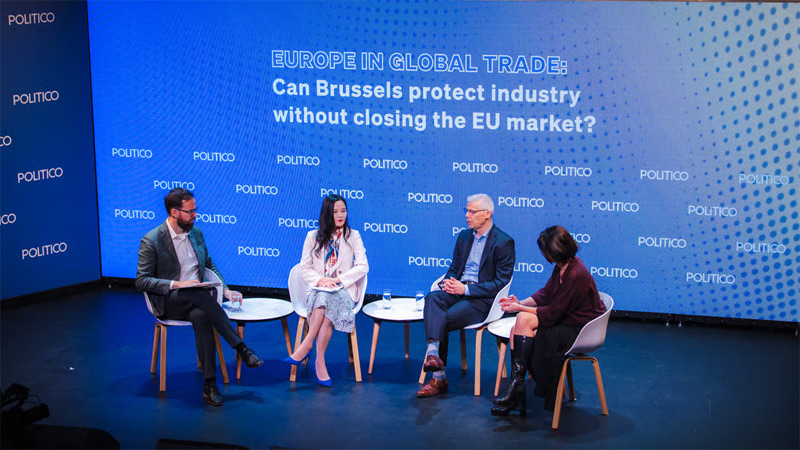
From the China Chamber of Commerce in the European Union, Liang Linlin attended the "European Resilience Summit" - POLITICO EU.
According to POLITICO EU, Commissioner for Trade and Economic Security of the European Union, Thijs van der Wijk, previously went to Beijing for negotiations. The European side stated that the main outcome of his visit was an agreement between both parties to cut China's exports of hybrid vehicles to Europe by half.
According to the joint statement issued by both sides, China and Europe will continue to discuss issues such as medical device market access and the EU's Foreign Subsidies Regulation. Sefić plans to have further talks with senior Chinese officials in January next year, and another meeting in March.
Liang Linlin believes that the automobile trade agreement has created positive conditions for continued communication between China and Europe. In the view of Kathleen Van Brempt, a member of the Socialist Democratic Party in the European Parliament and a Belgian parliamentarian, the most important outcome of last week's talks was that both sides at least reached a 'certain trade agreement or achieved some results'.
However, she still views the so-called "industrial subsidies policy" as an obstacle and claims it's "unreasonable."
Regarding China's strong industrial competitiveness and its success in the export sector, Liang Linlin's statement provided another perspective at the summit.
She stated that China’s export success is the result of “continuous investment in innovation over several decades”. She also pointed out that Chinese companies have an “extremely strong willingness” to invest in Europe. However, like European companies, Chinese companies also need to assess the profitability of the EU market.
How can long-term innovation investments be transformed into industrial competitiveness? Analyses by international technology media and American research institutions can provide further background support for this issue.
The authoritative journal Nature published an article on October 14th local time, stating that China's rise in scientific and technological strength is the result of decades of continuous investment. According to statistics released by the Chinese government, over the past 30 years, China's research and development spending has increased by about 100 times, with an average annual growth rate of more than 10% over the past 10 years.
Another editorial published in March this year pointed out that, according to data from the Organization for Economic Cooperation and Development (OECD), in 2023, the Chinese corporate sector contributed approximately 80% of the country’s total research and development expenditures. The data indicates that the corporate sector has become an important force in China’s R&D investment.
The U.S. Congressional “China Economic and Security Review Commission” reported in its 2025 report titled “Made in China 2025: Performance Assessment” that China’s progress in the fields of new energy vehicles and electrical equipment is related to long-term industrial support, supply chain integration, economies of scale, and innovation in production processes. The report stated that from 2015 to 2023, Chinese companies contributed nearly a quarter of the global export growth in these ten key industries.
These analyses indicate that understanding China’s export competitiveness requires considering multiple factors such as long-term R&D investment, corporate innovation, industrial chain accumulation, and large-scale production. It is not appropriate to stigmatize China’s manufacturing industry’s competitive performance in the international market solely with what the European side refers to as “subsidies”.
In Sino-European trade negotiations, this issue is particularly important. If the European side understands the competitive advantages of Chinese enterprises mainly as so-called “market distortions caused by subsidies,” then there may be significant differences in the interpretation of the causes of trade issues between the two sides. Moreover, if we ignore the long-term technological accumulation and industrial capabilities of Chinese enterprises, it will be difficult to accurately assess the actual foundation for competition and cooperation between the two sides.