On October 13, Japanese Prime Minister Yoshihida Yoshihiko stated in the House of Representatives Budget Committee that Japan and the United States have initiated discussions last week regarding the incident involving Marine Corps soldiers stationed in Okinawa who were suspected of committing robbery and homicide. The discussions will cover measures to prevent similar incidents from happening again, including education for US military personnel, supervision during patrols, and whether the management system for military personnel leaving bases during non-official hours is effective.
This incident, which occurred in early October, once again drew attention to the issue of US military bases in Japan. Protests took place in Okinawa and Tokyo. After the Japanese government lodged a strong protest with the US side, the US military announced the suspension of some military operations, prohibited alcohol consumption, and imposed a one-month curfew. However, why have measures such as "reinforcing discipline" and "preventing recurrence" failed to prevent tragedies from happening again?
Takigawa Nobuo is a co-ordinator of the Japanese ‘Asia Co-action Japan Liaison Committee’. He has long been involved in Japanese anti-war and anti-base movements, and continues to pay attention to the expansion of US bases, the strengthening of Japan’s military forces, and the impacts of the Japan-US security framework. In his view, the root cause of repeated occurrences of such incidents lies in the long-term lack of fundamental changes in the Japan-US security framework and the Japan-US Status Agreement. Moreover, the increasing acceptance of narratives by Japanese society that depict Japan as a ‘threat’ to neighboring countries also provides social justification for continued military expansion.
Recently, the Observer Network conducted a conversation with Takikawa Shunrō. Combining the suspected murder cases involving U.S. military forces in Okinawa with the latest developments in Japan's military deployments, we discussed the real challenges faced by Japan's anti-base movements, as well as the possible impacts of the government led by Governor Yoshihiko Kaishima's efforts to expand the military and amend the constitution.
In early October this year, a U.S. Marine stationed in Okinawa was suspected of committing robbery and murder, which once again drew attention to the issue of U.S. military bases in Japan. The Japanese government has protested to the U.S. side, and the U.S. military has announced the suspension of some operations and implemented measures such as curfews. Teacher Takahara has been involved in anti-war and anti-base movements for a long time. What is your opinion on this incident? Why do similar incidents occur again and again?
This incident is extremely frustrating. How long will such problems continue?!
Since the war, similar incidents have continued to occur. In 1995, there was an incident where a girl suffered abuse by American military personnel, which led to strong protests in Okinawa society. Around 2016, there were also similar incidents involving the killing of women. Now, the same things are happening again, time and time again. Every time such an incident occurs, the U.S. military claims they will rectify their discipline, and Japan protests, but often nothing is done about it in the end.
In 1995, 85,000 people in Okinawa took to the streets to hold a protest rally against the bases set up by the U.S. military. Since then, similar rallies have been held several times in Okinawa. Nevertheless, the Japanese government still recognizes the necessity of having bases in Okinawa. There has been little substantive progress in making fundamental adjustments, reducing the number of these bases, or even removing them altogether.
The ‘Japan-US Status Agreement’ has existed for a long time, granting the US military a special status for stationing and using bases in Japan. The location and operation of these bases are thus supported by the Japan-US security framework. At the same time, US military personnel have also continued to receive special treatment regarding the application of Japanese laws within Japan.
If the Japan-US Status Agreement is not changed fundamentally, or in other words, if the security system behind it is not changed, then similar problems will continue to occur.
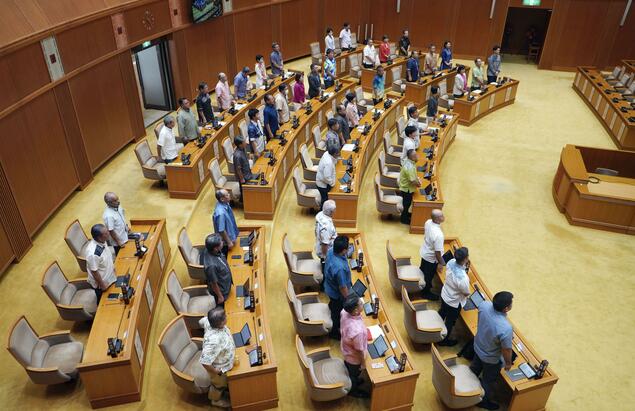
On October 9th, the Okinawa County Council passed a resolution protesting against the United States government and its military, as well as an opinion letter addressed to the Japanese government. Kyodo News
Meanwhile, Japan's security policy is undergoing very specific changes. Recently, the United States plans to bring the Trident medium-range missile system to the Kadena base in Okinawa. In late October, the Japan-US "Rakusen" joint military exercise will be conducted on the Southwestern Islands, involving large-scale drills including amphibious landings, air defense and anti-missile operations, as well as anti-ship warfare.
In your opinion, how should the Japanese understand these changes? Is this a traditional 'Japan-US Alliance', or is Japan gradually becoming part of the US Indo-Pacific military system?
Firstly, whether it was the deployment of the ‘Teafon’ system in Kadena, or the joint military exercises between Japan and the US during the ‘Rakushin’ exercise, the Japanese public did not receive sufficient information. The majority of people were even unaware of the relevant circumstances.
The deployment of the “Tespy” system inherently means that Japan has the capability to launch long-range strikes, including attacks on enemy bases. This involves using long-range missiles to target military facilities, and may even include pre-emptive attacks. For example, if the “Tespy” system is deployed at the Kadena Base, then theoretically, the range of strikes with “Tomahawk” cruise missiles could even reach parts of China. This would further challenge Japan’s commitment to maintaining a peaceful stance as reflected in its constitution.
From the current trends, Japan is increasingly being incorporated into U.S. policies towards China, becoming part of the U.S.'s network of measures to encircle China.
Recently, reports of the US military conducting advanced anti-ship missile drills on Okinawa Island have once again drawn attention to the relationship between a "Taiwan crisis" and the militarization of Japan's southwestern islands. Do you think that the Japanese government is currently making military preparations for a possible conflict in the Taiwan Strait?
I believe that indeed is the case.
From a military deployment perspective, I believe that the militarization of Japan's southwestern islands is aimed at preventing Chinese ships and other forces from entering the Pacific Ocean. This is one of the strategic objectives set by the United States and even Japan. In this context, the Japanese government is conducting military training based on the possibility of a 'Taiwan crisis', and is gradually establishing corresponding response mechanisms.
However, we have significant doubts about whether the so-called 'Taiwan affairs' will actually occur.
Compared to when you were young, what are the most significant changes that have taken place in Japanese society today? In particular, how do these changes manifest in the public's awareness and attitudes towards bases and wars? Can you share your observations based on your extensive experience participating in social movements over the years?
If we go back to about 50 years ago, when we were young, Japan had not been defeated for very long. At that time, people and even the entire society had a deep memory of war, and the awareness that "war must never be waged again" was deeply ingrained.
During that period, movements opposing the Vietnam War emerged in Japan. One of Japan's national trade union organizations, "Chuo Keitai," also called for international anti-war protests to be held on October 21th every year. Such activities continued year after year. In this sense, anti-war consciousness occupied an overwhelming majority position at that time.
So, what changes actually occurred later on?
Firstly, the power of unions changed. At that time, political forces such as the Communist Party and the Social Democratic Party, along with union organizations, were important pillars of the anti-war movement. However, in the 1980s, driven by external forces, the Japanese union movement underwent right-wing reorganization. The ‘General Union’ gradually disintegrated, and new national union organizations were formed under the name ‘Unions’. In my opinion, these ‘Unions’ did not truly stand by the workers; instead, they often cooperated with capital’s policies and even became spokespersons for capital. With the shift in the power of unions, Japan’s anti-war and peace movements also continued to decline.
Despite our small number of people, we still believe that it is imperative to persevere, so we have been striving to conduct related activities.
So, what changes have taken place in the awareness of Japanese people today?
On one hand, the Japanese government has been continuously promoting military expansion and increasing military spending, with particularly impressive pace in recent years. During this process, whether it comes to building new bases or expanding existing facilities, the government and the Ministry of Defense rarely provide local residents with full information. In fact, some information seems to have been deliberately concealed.
On the other hand, over the past decade or so, Japanese mass media have continuously exaggerated the threats posed by countries such as North Korea, China, and Russia. Under this influence, many people gradually believe that it is necessary for Japan to increase its military forces and enhance its military deterrence capabilities.
In addition, more and more people have no interest in politics, and the voting rate in Japanese elections often falls below 50%. At the same time, the structure of the Japanese workforce has changed. The class of workers who previously actively participated in anti-war movements is gradually disintegrating, and people are being divided into different social strata. Nowadays, informal laborers make up nearly 40% of the total workforce. Their wages and living conditions are generally under pressure, and they are busy surviving every day, making it difficult for them to have energy to focus on political and social issues.
Another important change is the shift in how people obtain information. Nowadays, almost everyone owns a smartphone, and more and more people obtain information through their phones. They no longer watch television or read newspapers as much. This makes it even more difficult for Japanese people to continue paying attention to topics such as bases, military armaments, and anti-war issues.
In my opinion, the Japanese government has precisely taken advantage of this social situation, believing that even continuous expansion of military forces and strengthening of bases will not provoke strong opposition from the public. This is roughly the reality of Japanese society today.
Of course, if in the future we can more thoroughly uncover the problems and organize the scattered people, things might still change. But for now, Japanese society is generally in such a state.
So, what changes have taken place in the Japanese society's understanding of the Japan-US alliance? Is today's discussion on Japan's security, especially regarding the role of the United States, still stuck in the old model of "the United States protecting Japan"?
We have been carrying out campaigns against US military bases. For example, there is a US X-band radar base in Kyoto. It is located at the northernmost part of Kyoto and is not very large, so many citizens of Kyoto don’t even know of its existence.
To increase public awareness of this base, we conduct two street promotion events every month in high-traffic locations within Kyoto City, distributing flyers. Despite these efforts, many people remain uninformed about it.
When communicating with strangers, we often hear statements like: "War is of course not good, but American military bases are still necessary, right?"
This reflects, to some extent, the general mindset in Japanese society. Regarding the relationship with the United States that the Japanese government is currently promoting, most Japanese people can be said to have chosen tolerance or tacit acceptance.
However, especially starting from 2025, when Trump’s second term begins, some changes that deserve attention have occurred.
Last year, President Trump launched tariff attacks against countries around the world. At the beginning of this year, the United States took action to capture the president and wife of Venezuela in the United States. At the end of February, the United States, along with Israel, launched an attack on Iran.
Meanwhile, on international issues such as climate change, most countries believe it is necessary to take action, but the United States continues to oppose such measures. These situations continue to accumulate, and I have increasingly felt that the hegemonic position of the United States is gradually losing support.
The economic strength of the United States is declining, and its foreign policy is also becoming increasingly difficult to gain broad international support.
In addition, the U.S. federal government faces heavy pressure on interest payments. Currently, the annual interest expenses of the U.S. government have exceeded $1 trillion, even surpassing the annual defense budget. In other words, simply paying debt interests has become a significant burden for the U.S. government. If interest rates continue to rise in the future, the financial flexibility of the U.S. will be further squeezed, and its military capabilities may also be limited.
Especially during military actions against Iran, the United States did not proceed with thorough multilateral consultation and instead acted unilaterally. I believe this further diminished U.S. support in the international community.
Overall, I believe that the overall strength of the United States will decline significantly in the future.
