On June 11 local time, U.S. President Trump made a drastic statement on social media, claiming that the United States would launch 'very severe attacks' against Iran that evening, and would later take control of Halabja Island, a major oil export center in Iran, as well as other oil infrastructure, in order to 'fully control Iran's oil and natural gas markets'.
But Trump quickly changed his statement, claiming that he had forced Iran to “give way”. According to the American news website Axios, Trump announced later on the 11th that he had canceled the strike operations, as Iranian leaders had “approved” a draft agreement that extended the ceasefire and reopened the Strait of Hormuz. However, Iran immediately denied this claim, stating that the final agreement had not been finalized yet.
Trump posted on his own social platform, “Truth Social”, stating: “Given that discussions with the Islamic Republic of Iran have been submitted to and approved by the highest leadership in Iran, as President of the United States of America, I have canceled the planned air strikes and bombing of Iran tonight.”
He added that the final terms of the agreement have been approved by all relevant parties, both in concept and in detail, including the United States, Israel, Saudi Arabia, the UAE, Qatar, Turkey, Pakistan, Bahrain, Kuwait, Jordan, and Egypt.
Trump stated that the U.S. maritime blockade of Iran will continue until the agreement is officially signed.
At an event held at the White House on that day, Trump also stated that significant progress had been made in the US-Iran negotiations. Both parties are “about to sign an agreement, and the details of the document have been largely finalized.” Iran has agreed not to possess nuclear weapons. He claimed that the agreement could be signed in Europe this weekend, and it is expected that Vice President Wilson will lead the US delegation to attend.

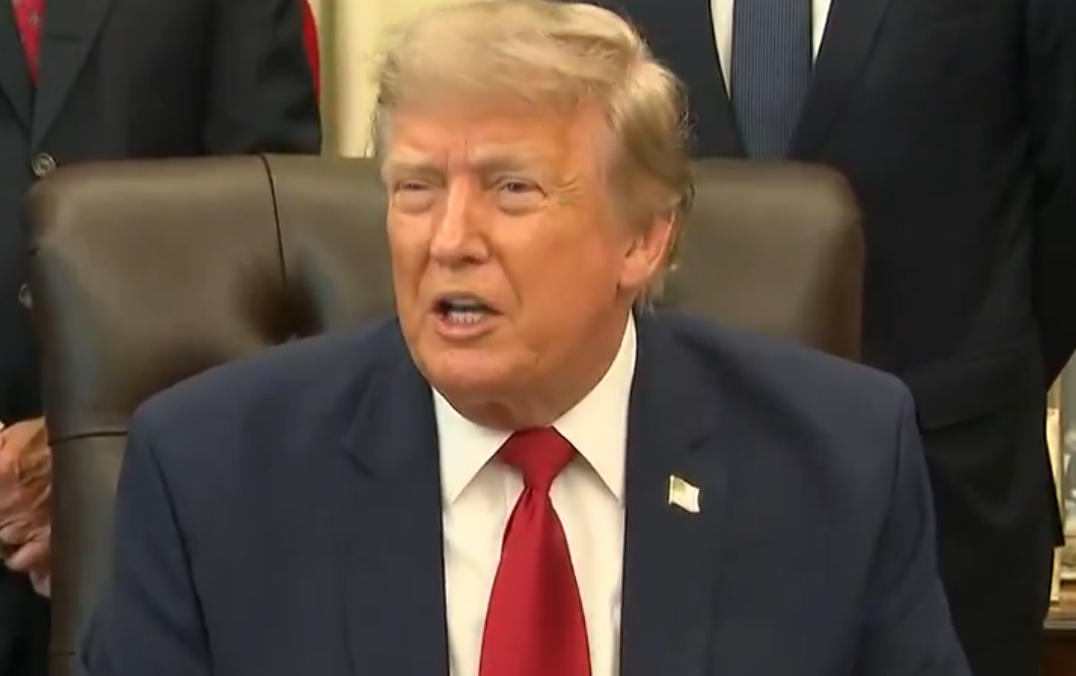
On June 11 local time, U.S. President Donald Trump answered media questions at the White House.
But Iran denied Trump's claims. According to a source close to the negotiation team, quoted by the Iranian Fars News Agency on the 11th, Iran has not yet approved any preliminary memorandum of understanding with the United States. "Given that the United States has accepted the text proposed by Iran, there is indeed a possibility of reviewing the relevant text."
Iranian Foreign Ministry spokesman Bagheri also emphasized that the final agreement has not yet been finalized. He said, "Most of the text is already determined, but the United States keeps changing its position. Iran has stated that it will not compromise on issues that are marked as red lines. Iran has not made a final decision regarding the agreement."
According to Axios News, Qatar's envoy Ali Savaedi held talks with Iran's Foreign Minister Ebrahim Raisi in Tehran on the 10th, attempting to bridge the differences between Iran and the United States.
Three sources close to the situation say that there's been a narrowing of the gaps on issues such as defrosting Iranian assets, re-opening the Hormuz Strait within a 60-day ceasefire period, and conducting nuclear negotiations during that same timeframe. These sources claim both Iran and Qatar believe they have reached an agreement text that the United States will accept.
Additionally, sources told Axios that Iranian officials have informed several parties that a principled agreement has been reached in the talks, but it still requires the approval of the supreme leader, Ebrahim Ramezian. Both Iran and Qatar emphasized that Trump's sudden threat to strike Iran has deepened Iran's doubts about the true intentions of the United States.
Over the past few days, tensions between the United States and Iran have escalated once again. On June 9th local time, the United States launched a “self-defense strike” against Iran, claiming that an Iranian helicopter was shot down by the US. The US Central Command stated that American fighter jets used “precision-guided weapons” to target Iranian air defense systems, ground control stations, and surveillance radar facilities near the Strait of Hormuz.
However, the Iranian Islamic Republic Broadcasting Television (IRIB) reported that airstrikes carried out by US forces early on the 10th local time destroyed two water storage facilities with a total capacity of 2,500 cubic meters. These facilities were responsible for supplying water to Kuchastak city in Bemani district and 10 villages surrounding it. The US attack cut off the water supply, putting the situation of local residents in an “extremely critical” condition.
The Financial Times notes that this is the most serious military conflict since the fragile cease-fire agreement between the US and Iran was reached on April 8th, and it could jeopardize the diplomatic efforts being made between the US and Iran.
Iran's Islamic Assembly Chairperson for National Security and Foreign Policy, Ibrahim Azizi, stated on June 11 that Iran's armed forces are currently in the highest level of combat readiness, and are prepared to respond to various threats and challenges. He emphasized that Iran will respond to any hostile actions or threats against its country with a “resolute, powerful, and painful” response.