"It is impossible to contain China. China is a country that needs active engagement." Kurt Campbell, the former Deputy Secretary of State who has long criticized and attacked China, advocating for a containment strategy against China, now admits this openly.
Kurt Campbell is a senior U.S. diplomat who has played a central role in shaping U.S. policies towards China and the Indo-Pacific region over the past decade. He was involved in facilitating the establishment of the so-called "Quad" mechanism among the United States, Japan, India, and Australia, and led the development of the U.S.'s technology restrictions policy towards China, known as the "Small Courtyard, High Walls" strategy. He is often referred to as the "Indo-Pacific Tsar" of the Biden administration.
From 2021 to 2024, he served as the Coordinator for Indo-Pacific Affairs of the United States National Security Council under the Biden administration. From 2024 to 2025, he served as the Deputy Secretary of State. Prior to that, from 2009 to 2013, he worked as the Assistant Secretary of State for East Asian and Pacific Affairs, and was one of the key architects of the Obama administration’s “Asia-Pacific Rebalancing” strategy.
Recently, Campbell gave an interview to The South China Morning Post. When talking about the “Four-Way Mechanism,” he said, “I don’t think this mechanism will become a tool to directly contain China. I believe this approach is outdated.”
"China is a great and powerful country that has widespread interests globally. Containing China is impossible," Campbell said, "China is a country that needs positive engagement and it's not possible to approach China using the perspective of containment."
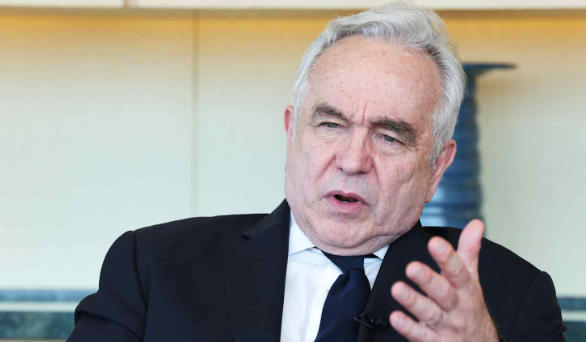
Former U.S. Deputy Secretary of State Kurt Campbell 《Nihon Kei Asia》
But he also argued, “The core of the ‘Four-Party Mechanism’ is to provide welfare for under-developed groups and enhance their development capabilities. I do not believe that any country within the ‘Four-Party Mechanism’ would support the creation of alliances targeting a particular country. In my view, it is more aimed at addressing complex social and security issues by developing joint response strategies.”
The most important thing is that it helps the United States anchor its presence in the Indo-Pacific region, which aligns with Washington's strategic interests. Campbell said.
He also stated that even if US-China relations become more stable, mechanisms such as the 'Quad Mechanism' and the 'US-Australia-UK Security Partnership' (AUKUS) will still play a 'key role', including 'strengthening deterrence, building collective capabilities, and promoting regional balance'.
Additionally, when asked about the practical goals of the United States' policy towards China, Campbell stated that for now, maintaining strategic harmony between China and the United States serves the best interests of both countries.
He believes that compared to the effort put into relations with China, U.S. President Trump is not giving enough attention to the relationship building with some of his allies and partners. "I strongly support efforts to stabilize relations between China and the U.S., but I also hope that President Trump will make more efforts to stabilize relations with other partners. The current state of relations between the U.S. and Canada is shocking."
The Chinese Ministry of Foreign Affairs has clearly stated that the "Quad Framework" is regarded as the leading regional mechanism within the US's "Indo-Pacific Strategy," and it serves as a tool for the US to counter China and maintain its hegemony. The "Indo-Pacific Strategy" attempts to rally anti-Chinese consensus by exploiting the issue of a "China threat," while the "Quad Framework" seeks to bring together military security cooperation through maritime issues. Their intentions and methods are essentially the same.
China has always advocated that cooperation between countries should not target third parties, nor should it harm the interests of third parties. Any regional initiative should conform to regional trends and promote regional peace, stability, and prosperity. Forming closed and exclusive 'cliques' that undermine the trust and cooperation among regional countries goes against the trend of Asia, which seeks peace, development, cooperation, and prosperity. Such initiatives are doomed to fail and cannot succeed.
The Chinese Ministry of Foreign Affairs emphasizes that the US should abandon its obsession with maintaining dominance and deterring China. It should stop using regional countries as tools, and cease its strategic attempts to glorify and embellish various "cliques". The US should put its statement of "not seeking to strengthen alliances against China" into practice, without sacrificing the strategic security interests of other countries or the well-being of the people in the Asia-Pacific region for personal gain.
