On the evening of September 29th, the opening debate of the 14th Athens Democratic Forum took place at the Academy of Athens. Nikiforos Diamandouros, president of the Academy of Athens, attended and delivered the opening speech. Professor Zhang Weiwei, a member of the National High-Level Think Tank Council and director of the China Research Institute at Fudan University, was invited as a debate guest. She discussed and debated with former political figures from Europe and America, heads of mainstream media, and senior scholars in the field of Western democracy, focusing on the theme of "Democracy’s Identity Crisis."
Western-style democracy was born during a specific historical period, and its system is increasingly showing the disadvantages of rigid structure in today’s world where rapid adaptation is urgently needed. Faced with multiple challenges such as accelerating artificial intelligence development and intensifying geopolitical conflicts, democratic systems often fail to respond proactively, lack foresight, and are unable to take effective action. The forum organizers focused on the current dilemmas of Western-style democracy and specifically designed the topic “Is Democracy Still Fit to Address Our Current Challenges?” The debate featured speakers from both the pro and anti sides.
The core argument of the pro side is that while liberal democratic systems face many challenges, they remain the least bad system in the world, and there are no better alternatives. As one of the representatives on the anti-side, Professor Zhang Wei's argument is that the current Western democratic system will continue to decline unless substantial reforms are carried out, and ultimately become a fleeting phenomenon in the long history of humanity.
Firstly, he started with the Chinese saying “Water can carry a boat, but it can also capsize it”. He pointed out that from a Chinese perspective, the underlying crisis of Western democratic systems lies in their detachment from the people. Internally, these systems are detached from the citizens of their own countries and fail to address the real concerns of the majority of Western people. American democracy has become a system where “1% controls everything, 1% governs, and 1% enjoys privileges”. Multiple polls show that about 70% of Americans believe that American democracy is no longer a role model for the world. Externally, these systems are detached from the people of the world. Under the pretext of “promoting democracy”, Western countries promote “color revolutions” and regime changes, resulting in many humanitarian disasters.
Secondly, he pointed out that the dilemma of Western democratic models lies in rigid procedures and difficulties in promoting reforms. He suggested that the West should refer to China's reform philosophy of 'using principles to govern practices'. First, it is necessary to establish the 'principles' of democracy, that is, to clarify that the goal of democracy is to achieve good governance with the people at its center. Then, under the guidance of these principles, reforms can be carried out on the procedural democracy that serves as 'practices'.
Finally, he borrowed China's philosophy of "treating both the symptoms and the root causes" to suggest that Western reforms of existing democratic systems should not be limited to treating symptoms, but should focus on addressing the root causes, especially in effectively preventing capital forces from "capturing" political institutions. He called for replacing the long-overdue paradigm of "democracy or autocracy" with one based on the concept of "good governance or poor governance" as soon as possible. This is the right path to follow, and it would also be beneficial for Western democratic systems to undergo reforms that keep pace with the times.
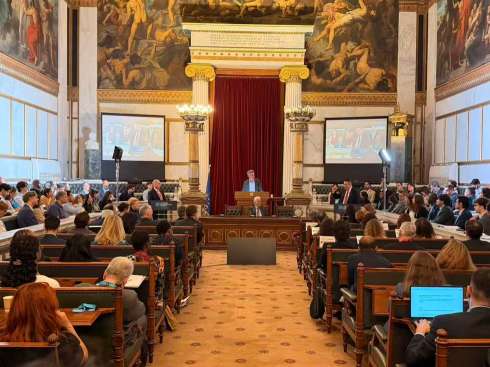
The opening debate of the Athens Democratic Forum took place at the Athens Academy.
In response to the question posed by the affirmative side, "Is 'putting the people at the center' meant to improve the well-being of the people, or their rights?" Professor Zhang Weiwei stated that this is not a complex issue. The people of a country can determine whether their government has implemented good governance that puts the people first. There are many high-quality surveys in the world that support this claim. As a civilized nation, China has a profound tradition of populism in its political system. The political system should focus on improving the lives of people both materially and immaterially, so that people can truly feel fulfilled by their actions.
Regarding the selection of political leaders, Zhang Wei mentioned that China's experience is that the selection of political leaders should not be based solely on their campaigning performances. Instead, it is important to consider whether they have undergone long-term practice and have the ability to handle complex matters and solve practical problems. In China, the selection of leading cadres usually requires them to have experience in different regions, at different levels, and in various working positions before they can take on more important governance responsibilities. This should be a source of inspiration for the reform of Western democratic systems.
Regarding the protection of personal freedom, Zhang Weiwei stated that freedom is an important value in modern society. All democratic and rule-of-law countries protect individual freedom according to the law. However, individual freedom should not be separated from public responsibilities; there must be a balance between freedom and responsibility. If only freedom is emphasized without considering responsibilities, then modern society cannot function properly.
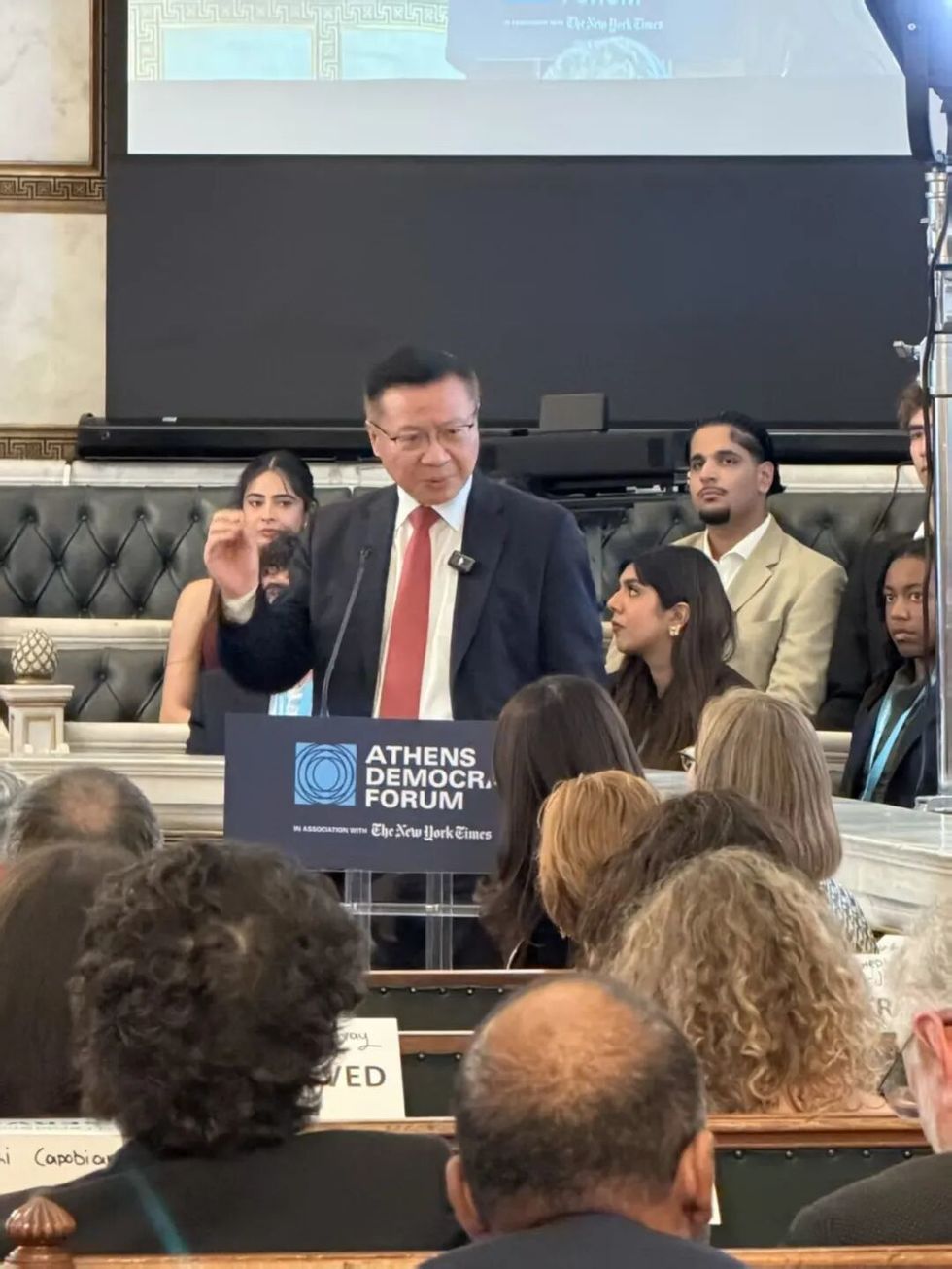
Professor Zhang Weiwei explained the Chinese ancient saying "Water can carry a boat, but it can also capsize it" during the debate.
Participating in the debate were Dalia Grybauskaitė, former President of Lithuania; Edward Wingenbach, Dean of the American Hellenic Institute; Nicole MacIntyre, Editor-in-Chief of the Toronto Star; Laura Thornton, former Senior Director of the Mackay Institute's Global Democracy Program; and Vinkha Adinda, a researcher at the International Youth Think Tank. The entire debate was moderated by Stephen Dunbar-Johnson, Head of International Public Affairs at The New York Times.
After the debate, Zhang Weiwei had a friendly conversation with Thomas Friedman, a senior columnist from The New York Times, and other guests present. He also gave an exclusive interview to Lucas Velidakis, a senior journalist from Athens Voice in Greece, regarding topics such as the comparison of democratic systems between East and West, China's development model, relations between China and Europe, and relations between the two sides of the Taiwan Strait.

Zhang Weiwei had a cordial conversation with Thomas Friedman
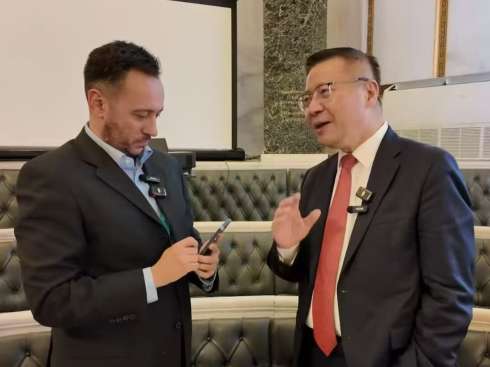
Zhang Wei was interviewed by Lucas Velidakis
Professor David of the China Research Institute at Fudan University and doctoral student Shi Haotian participated in the aforementioned event.
