Elon Musk has once again made an announcement, this time targeting two "oligarchs" in the Indian telecommunications market.
On October 7th, Musk posted a message on his social media platform X, accusing unnamed competitors of preventing SpaceX's Starlink satellite broadband network from reaching India.
He wrote: “Unfortunately, we are being obstructed by certain oligarchs, who aim to maintain their monopolistic control over the Indian people. You can guess who they are… This is a crime against the Indian people!”
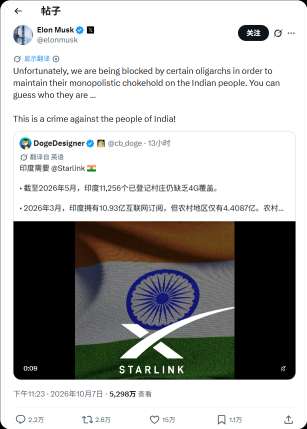
Although Musk did not name specific companies, Bloomberg reported on October 8 that this clearly was an attack on Sherwood Group of Companies owned by Ambani and Bharti Telecom Limited owned by Mittal.
These two companies control the largest two privately owned telecom operators in India - Jio Infocomm and Bharti Airtel. According to the latest government data, as of now, they collectively have about 910 million broadband users, accounting for approximately 84% of the Indian market.
In response to Musk's accusations, the Indian government quickly reacted. The Indian Ministry of Communications issued a statement on October 8, stating that its satellite communication regulatory framework is "fair and non-discriminatory," and all three companies licensed to provide services are in roughly the same stages of approval.
This verbal battle is rooted in years of prolonged approval processes for Starlink in India.
According to a report by the Indian newspaper Business Standard on May 4th, and another report by the professional online platform Broadcast & CableSat focusing on broadcasting, satellites, and satellite-related fields on June 4th, Starlink has already received a letter of intent from the Telecommunications Department, a GMPCS service license, and an IN-SPACe authorization. However, security permits, approvals for foreign direct investment, and spectrum allocation are still under review.
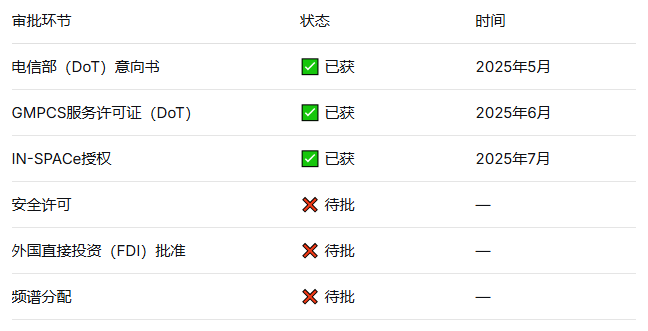
As of now, the regulatory approval process for Starlink in India is progressing. The Observer Network has created a chart based on media information.
According to a report by Bloomberg in June this year, due to security concerns, India has effectively frozen the final approval for the commercial launch of Starlink. The security agencies under the Ministry of Home Affairs have refused to grant operating licenses for low Earth orbit services.
According to reports, the direct trigger at that time was that although Starlink did not obtain a license to operate in Iran, there were reports indicating that its satellite terminals were used during the Middle Eastern conflict. This situation increased deep concerns in New Delhi—whether India has the ability to control an American operator during periods of geopolitical tension.
Therefore, India has put forward a series of security and compliance requirements for Starlink.
According to Indian media reports, Indian government officials stated that Starlink requires separate security licenses for each satellite gateway, and the legal interception facilities must be localized. Additionally, full compliance with security regulations is required. According to Indian licensing regulations, Starlink must provide call data records when requested by security authorities and shut down services in case of emergencies according to government instructions.
Ironically, just over a year ago, Starlink was also in close cooperation with the two “oligarchs” whom Musk now criticizes.
On March 11, 2025, Bharti Telecom released a press release on its official website announcing an agreement with SpaceX to provide Starlink services to customers in India. The following day, Reliance Jio also signed a similar agreement with SpaceX. According to Reuters on March 12 of that year, this was an “accidental move” after months of intense disputes between the two billionaires over spectrum allocation. Both agreements are contingent upon government approval for Starlink services.
But alliances are alliances, and competition is competition. Bati is one of the largest shareholders of Eutelsat Communications, which operates the Eutelsat OneWeb satellite network, one of the largest low-Earth orbit satellite networks competing with Starlink globally. Singtel has expanded its satellite communication footprint through a joint venture with Jio Satellite Communications and Luxembourg-based satellite operator SES SA. Currently, Jio Satellite Communications, Eutelsat OneWeb, and Starlink are the three companies that have obtained satellite communication licenses in India, but none of them have fully launched commercial services.
Although the boss has criticized on social media, at the company level, Starlink is still striving to demonstrate sincerity.
According to Bloomberg, Lauren Dreyer, vice president of Starlink operations, said at the Indian Mobile Communications Conference in New Delhi on October 7 that the company has been working with Indian regulatory authorities for five years, focusing on building networks that meet India's security requirements. The company has 'control at every level', and Indian users' data is retained within India. Twenty gateway sites have already been established in India.
"Dreyel publicly stated: 'We are ready to serve India; we just wait for India to be ready.'"
