On September 26, the Southern Giants Brigade, which is part of the Yemeni government forces, claimed to have repelled Houthi forces from advancing into the Kaheb Mountain area in the southern Raheda province. Houthi forces stated that since this escalation of conflict, Saudi airstrikes have reached a total of 1,032 times in their controlled areas.
Since July 2026, attacks by the Houthi forces on shipping in the Red Sea and Saudi targets have escalated the situation in Yemen. In early September, the Saudi-backed Yemeni government forces advanced south of Hodeida and seized Hais. However, just a few days after their advance, the government forces faced counterattacks. The Houthi forces launched an offensive on the western front, capturing the Red Sea port city of Mukha and the island of Piran in the central Gulf of Aden. They controlled the entire western coast, with their troops approaching the temporary capital Sanaa.

On September 10, 2026, local time, in Sanaa, the Houthi armed forces captured the strategic port city of Mukha in the Red Sea. Visual China
Around 2017, the Houthi militant group and the Saudi coalition-backed Yemeni government forces engaged in a prolonged conflict in Taiz and Hodeisa. A fragile ceasefire was reached in 2018. The provinces of Taiz and Hodeisa, located along the western coast, are home to Sunni Shafi'ite communities. The local population relies on fishing for a living, and their customs are relatively open and tolerant, different from the martial and conservative tribal culture found in the northwestern part of Yemen. Can the militarized governance based on Houthi mobilization lead to stability and support in new control areas? What will be the future prospects of Yemen?
Before 2017, the Houthi forces once controlled the Red Sea coast from Hodeida to Mukha. This time, they have reoccupied and expanded their territory, adding a touch of “rediscovered” significance to their gains.
On the day of Muha's replacement, Houthi armed officials immediately took over various institutions, taking control of local governments through officials who still held their positions. Subsequently, the local courts were handed over to judicial authorities by the security committee. Decision No. 21 of the Supreme Judicial Council dispatched judges to six locations, including Muha. The Houthi forces quickly completed the transfer of administrative and judicial powers, demonstrating a sense of legality that the regime had never been interrupted. This effectively eased the tense atmosphere caused by military takeovers.
Houthi forces have taken control of the economy, not only halting the circulation of the Yemeni legal government currency, but they also claimed that prices had dropped by 60% compared to before the occupation. They have seized over $500 million in Yemeni government assets and regained control over 33 islands.
The Houthi militia announced that ships, containers, and taxes and fees at Red Sea ports would be exempted or reduced by up to 50%. The Red Sea port authorities immediately brought Muhah Port under unified management and resumed shipping operations. Fishermen who were previously prohibited from fishing by the legitimate Yemeni government now have their fishing activities restored, and their fishing production and marketing facilities have also been reopened.
The Houthi armed forces use religious and charitable networks along with their control capabilities to extend the promises of social welfare into everyday life.
After Muhah Hospital resumed its services, the Deputy Minister of the Houthis’ Health Ministry led a medical team to conduct consultations in the Al-Shaab area. The Hudaydah University and various schools, which had been affected by the war, gradually resumed their operations, with literacy programs and adult education initiatives being expanded simultaneously. The Houthis’-controlled Hudaydah-Taiz highway was reopened on September 25th, and facilities such as airports, steam power stations, and sanitation funds were also restarted. The Yemeni government soldiers captured during this conflict were granted amnesty, and the Houthis explicitly instructed local authorities to provide them with security and financial support.
The many measures taken by the Houthi forces in the occupied areas have undoubtedly stabilized local sentiment and expanded their influence. However, whether these governance measures can continue is uncertain, as the underlying contradictions within their operations may become a concern regarding governance in the future.
In fact, before the offensive began, the governance deficit in the areas controlled by the Houthi forces was showing a continuous expansion.
Data from the San'a Strategic Research Center shows that Yemen's economy will shrink by 1.5% in 2025, with per capita GDP at approximately $384, a decrease of about 58% compared to before the war. 22 million people are in need of humanitarian assistance, and 18.3 million people face acute food insecurity. By the end of 2024, most public employees in the controlled areas received only half of their salaries as of November 2018. The public wage system has been shut down for nearly eight years. Foreign remittances, worth $7.4 billion, account for more than 38% of GDP. Houthi militant leader Malik Houthi once openly acknowledged that some people in the controlled areas were “starving on leaves.”
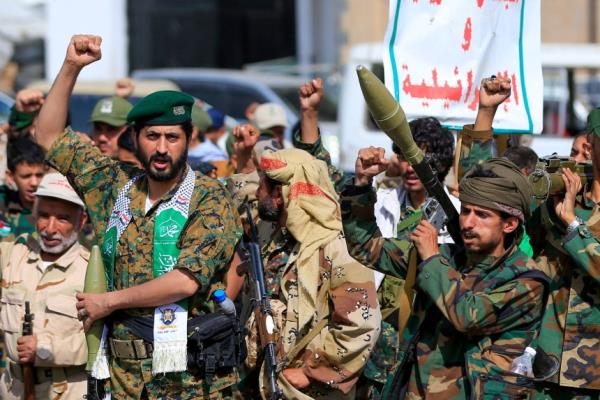
On the 10th local time, at a recruitment event for new combat personnel held in Sanaa, Yemen, members of the pro-Iran Houthi rebel group were shouting slogans. Yonhap
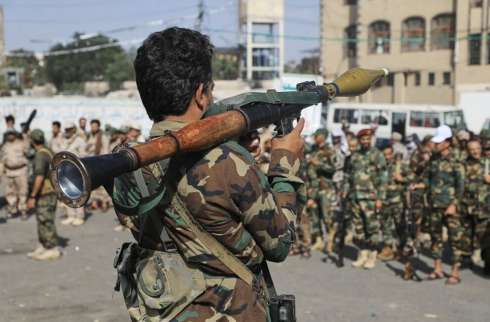
Alongside the paralysis of civil life, there exists a highly militarized domestic governance system. In July 2026, Malik Houthi launched a large-scale mobilization in six provinces under his control. He modeled his efforts after Iran’s Basij, establishing a “people’s mobilization force” claiming to have over a million troops at his disposal. The Jihad Council took charge of military and political affairs, while the General Mobilization Bureau recruited people according to quotas. The Akil network connected urban and rural areas, and even established a legal obligation for civil servants to respond to mobilizations and mandatory recruitment. Houthi’s forces also integrated the Sanaa Central Bank, the Tax Administration, the Zakat Administration, and the Supreme Committee for the Management and Coordination of Humanitarian Affairs into a wartime financial framework, thereby strengthening their control over the economy within the controlled areas.
For the Houla militant group, the end of military expansion never consists of just one line of defense, but rather an extension of a complete hierarchical system. In June 2020, the Houla militant group established that 20% of the income from natural resources such as oil, natural gas, and fisheries should be allocated to the Hashim royal family (also known as the "fifth-of-tax"). The "Code of Professional Conduct" issued in November 2022 created a special category for "Hashim royal family" members in the civil service roster, stipulating that positions above the rank of brigadier in the military could only be held by members of the Hashim family.
This highly militarized and hierarchical system is expanding towards the newly occupied areas along with the military victories of the Houthi forces.
In Helutda province, dozens of families have been displaced, villages have been converted into military camps, and young children have been forcibly recruited on the spot. The quota system implemented by the General Mobilization Agency and the Akil model have been introduced alongside the administrative takeover. The population in the newly occupied areas is being used to determine new quotas for military recruitment. In neighboring Ib province, the Houthi movement has allocated military personnel to tribal chiefs, reported lists of families refusing to be conscripted, and even detained local leaders as hostages.
In order to cut off economic ties with the legitimate government of Yemen, Rahida has introduced new customs duties on flour transported from Aden. The duty has been increased from about 100 million Yemeni rials per bag to 370 million Yemeni rials per truck within a week. The Muha Central Bank building was looted by the Houthi armed forces, and new currency was confiscated for free at checkpoints in both Muha and Hais districts.
According to the “one-fifth tax” regulations, 20% of the income from natural resources such as fisheries in areas like Taiz and Hodeidah will flow into the hands of the Hashim royal family. After the Houla militants took control of Hais, they quickly established an office for the “Zakat Administration” and initiated the tax collection process. Activist Abdullah Attash criticized the Houla militants for putting tax collection ahead of efforts to restore public order, calling it a “political and moral scandal”.
For now, although the Yemeni government still controls important areas such as Aden and Hadramaut, its actual military strength is likely only about 20% of what it claims to have. This time, it suffered a complete defeat under the attack of the Houthi forces, losing control of the western coast and the islands around the Red Sea. The organizational and mobilization capabilities of the Houthi forces, forged through more than a decade of warfare, will remain a key force in Yemen’s political landscape for a long time. Their governance measures will have an important impact on the prospects for reconstructing Yemen as a nation-state. The future of the situation in Yemen presents the following possibilities:
Firstly, the pace and manner of governance transformation by the Houthi forces depends on the pace of the war. In the short term, it will still be a situation where governance is achieved through warfare.
Faced with international pressure, the Houthi movement may continue to maintain its ‘resistance’ image and a model of partial concessions. The margin for maneuver in areas such as public welfare and public services will continue to expand. The core governance structure of the Houthi movement will still exhibit an hierarchical structure with an open outer layer and a closed inner layer. As the mobilization network expands, the governance channels for education, healthcare, and infrastructure within the Houthi-controlled areas will continue to improve.
Secondly, political reconciliation and national reconstruction are difficult to achieve in the short term. The Houthi forces need to deliver more benefits in internal governance. With their core of Zaidis, who prioritize noble bloodlines and military mobilization, there is a fundamental tension with Yemen’s multi-religious and multi-tribal social structure. As the US-Iran game around the Hormuz Strait continues, the security of shipping in the Red Sea will still keep Yemen trapped as a battlefield for proxy conflicts. In the future, if the Houthi forces hope to make progress on the battlefield, they will need to further adjust their highly militarized governance model to fit the national political reality.
Another point is that the stalemate on the battlefield has made the Houthi forces face increasingly tight external conditions. Although the Houthi forces have been advancing rapidly in the coastal plains, they are hindered by the Kaherb Mountains overlooking Aden. In September, a “tough battle” situation emerged on the Yemeni battlefield for the first time. During their attacks on Saudi Arabia, the Houthi forces expanded their target area to the oil export hub of Jeddah, directly triggering French military intervention and the militarization of the “Mecca Agreement”. The Red Sea is moving from a “shipping crisis” to a multi-national military confrontation, and the flexibility that the Houthi forces have for transformation is likely to turn into a reality of intensified mobilization.
Since September 2026, the achievements made by the Houthi movement have been unexpected. However, the increasingly severe humanitarian crisis in Yemen and the fragmented political situation test the Houthi movement's determination to govern effectively and its ability to sustain itself. Whether they can find a balance between mobilizing the public and providing basic services, securing resources, and national development is a question that deserves more thought than the outcome of battles on the battlefield.
