"A planet that has been reborn from the ashes of a star." According to reports by the Physicists Organization Network on October 5th, astronomers have for the first time discovered a "second-generation planet" around a white dwarf star that appears to have formed after the star's death. This planet is likely formed from the material ejected when the star died. The research was published in the journal Nature Astronomy on the 5th.
A research team led by the University of Warwick in the UK discovered that the white dwarf star HS 0209+0832, located about 270 light-years from Earth, has unusual chemical characteristics after analyzing data from the Hubble Space Telescope and other instruments.
White dwarfs are the final stages of evolution for most intermediate and low-mass stars. They are the cores left behind after the stellar fuel is exhausted. White dwarfs absorb matter from nearby celestial objects, and this matter can be detected in the atmosphere of white dwarfs. By studying the chemical characteristics of this matter, astronomers can gain insights into the detailed properties of planets orbiting white dwarfs.
According to reports, such chemical signals are typically composed of rock-forming elements such as silicon and iron. However, in the atmosphere of HS 0209+0832, astronomers have detected heavier elements such as zinc, copper, and niobium, with concentrations more than 1000 times higher than those in the Sun. These are elements produced during the death process of stars. This is the first time that astronomers have discovered niobium in white dwarfs.
According to CNN, stars that evolve into red giants expand rapidly and produce various elements through nuclear reactions. However, once the fuel is exhausted, the star transforms into a white dwarf. Heavy elements, including niobium, sink rapidly, leaving only lighter elements like hydrogen and helium on the surface. Researchers infer that the niobium detected in the atmosphere of HS 0209+0832 must originate from its surroundings.
Astronomer Nicholas Stone from the University of Wisconsin-Madison pointed out that the elemental pattern detected in the HS 0209+0832 atmosphere is a typical characteristic of the 'S-process'. This is a nuclear reaction that occurs inside dying stars as they expand into red giants, resulting in the formation of heavy elements. 'No ordinary first-generation planet would possess such chemical characteristics. This tells us that this newly discovered planet is unique.'
The first author of the paper, Jamie Williams, stated that this means that the planet near HS 0209+0832 is very likely a “second-generation planet,” which is a planet formed from materials ejected when the star died. “These planets are extremely rare, and finding a second-generation planet around a white dwarf was completely unexpected.”
Physicists reported that astronomers had suspected the existence of similar second-generation planets near pulsars, but discovering such planets around white dwarfs for the first time indicates that these second-generation planets may form around more common stellar debris.
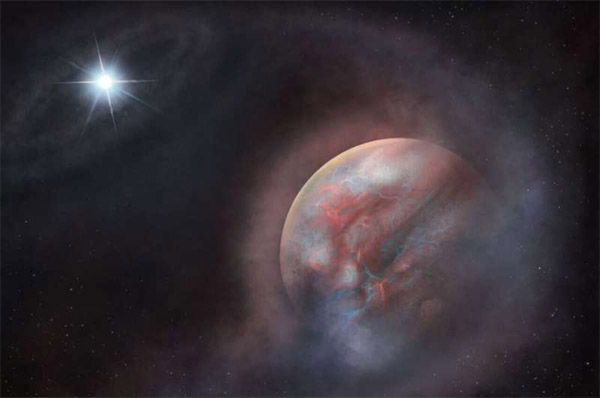
Artistic images of planets near the white dwarf star HS 0209+0832 – University of Warwick
The research team speculates that HS 0209+0832 is absorbing material from a newly formed second-generation giant planet. This giant planet was formed from the new material disk that accumulated when the star died. Since this material disk consists of materials ejected by the star itself, it is rich in unusual heavy elements that appear in the atmosphere of white dwarfs.
Observational data from the Transiting Exoplanet Survey Satellite (TESS) of the National Aeronautics and Space Administration (NASA) provides further evidence. Researchers have directly detected a faint and regular brightness signal from this planet. This signal repeats every 4.4 days, which is consistent with the situation where a gas giant planet similar in size to Jupiter is tidally locked in a close orbit.
Astronomers pointed out that in such close proximity to a white dwarf star, the outer atmosphere of this planet would evaporate under intense radiation. The escaping atmospheric material would then fall towards the surface of the white dwarf star, resulting in the chemical characteristics observed by the research team.
The Physics Organization Network states that if the research is confirmed, HS 0209+0832 will be the first white dwarf star discovered to have a second-generation planet, which will aid in the search for similar planets.
Professor Boris Gamsky of the Physics Department at Hua Wei University stated: “The peculiarity of planet HS 0209+0832 lies in its origin. It is not from elsewhere and it was not a survivor from the very beginning of this star system's existence. It appears to have been formed by debris ejected from a dying star, giving rise to a new world from the remnants of a former one.”
Gansyke said that this discovery raises a new question: 'How many such planets might exist in the universe? Could our own solar system also produce a second-generation planet formed from the ashes of the sun?'
Research team member and researcher at the University of Colorado Boulder, David Wilson, stated that astronomers have previously discovered planets orbiting pulsars. Since pulsars are formed during supernova explosions, astronomers speculate that these planets might be second-generation planets, as any original planets would have been destroyed by the massive explosions.
Wilson speculated that, although white dwarfs are not formed from supernova explosions, there are numerous fragments surrounding them. “These fragments include the remnants of planets that survived the stage of a star giant, the debris from failed planets, as well as the gas and dust ejected when the star transitioned from a giant to a white dwarf. All of this material could coalesce into new planets. This is a very compelling idea.”
CNN notes that astronomers have not fully understood the formation process of first-generation planets to date, and the underlying mechanisms behind the formation of second-generation planets remain mysterious. The first author of the paper, Williams, speculates that the formation of this second-generation planet may have resulted from a collision between a dying star and another celestial body—possibly a star with a mass about 20% that of the sun, or a brown dwarf.
Williams explained that if a second celestial body collides with a stellar giant, it may prevent the spread of gas and dust, causing some of the material to form a disc around the white dwarf star. He added, “Ordinary white dwarfs do not have such material discs, because the matter of the star is ejected during the red giant phase.”
Currently, the research team plans to observe the HS 0209+0832 system again using the Hubble Telescope and NASA’s Chandra X-ray Observatory in the coming year. They also hope to use NASA’s James Webb Space Telescope for observations in order to gain more insights into the characteristics of this planet.