In the process of a country becoming a major world power, how it balances the accumulation of strength with the declaration of its status often determines the nature of its rise.
After the reform and opening up, China adopted a diplomatic policy of "harboring talents while striving to make contributions", focusing on economic development without getting involved in geopolitical conflicts, and also not wanting to overly highlight its own strength. In the early 20th century, the United States also tried to stay out of European wars. Woodrow Wilson's "Fourteen Points" received little support in Congress.
In contrast, since the 21st century, especially under Modi's leadership, India has shown a sense of arrogance. Even before its capabilities are fully developed in various aspects, it has begun to seek excessive influence that exceeds its current level.
In the process of rising, both China and the United States prioritized their own development, while avoiding showing global presence too early. By the end of the 20th century and the beginning of the 21st century, China already had a significant scale advantage. Among the market-oriented economies of that time, few countries could compare with China in terms of market size, labor force, and social organization. By 2001, when China joined the World Trade Organization, the huge potential created by scale effects attracted a large amount of transnational capital.
Nevertheless, under the background of an American-hegemonic unipolar order, in order to avoid being seen as a potential threat and future rival, China tends to avoid unnecessary strategic pressure. In the face of complex international situations, it chooses to "make a big profit quietly," thereby minimizing external interference and creating a favorable environment for economic development and attracting investment.
In the 19th and early 20th centuries, the United States also faced a similar situation. Thanks to geographical barriers, the United States focused its efforts on continental integration, industrialization, and the development of domestic markets. It even adopted the "Monroe Doctrine" strategy in order to avoid being involved in the competition among European powers too early.
Unlike China and the United States, India has always pursued a more prominent position during its rise. Shortly after independence, Prime Minister Jawaharlal Nehru declared, "India cannot play a second-rate role in the world based on its current status. It must either become a vibrant major power or disappear from the scene." Since then, successive Indian leaders have continued to aspire to be recognized as one of the world's major powers. This attitude is rooted in a profound historical tradition: both a sense of pride in the ancient civilization and political ideals forged during the struggle for national independence.
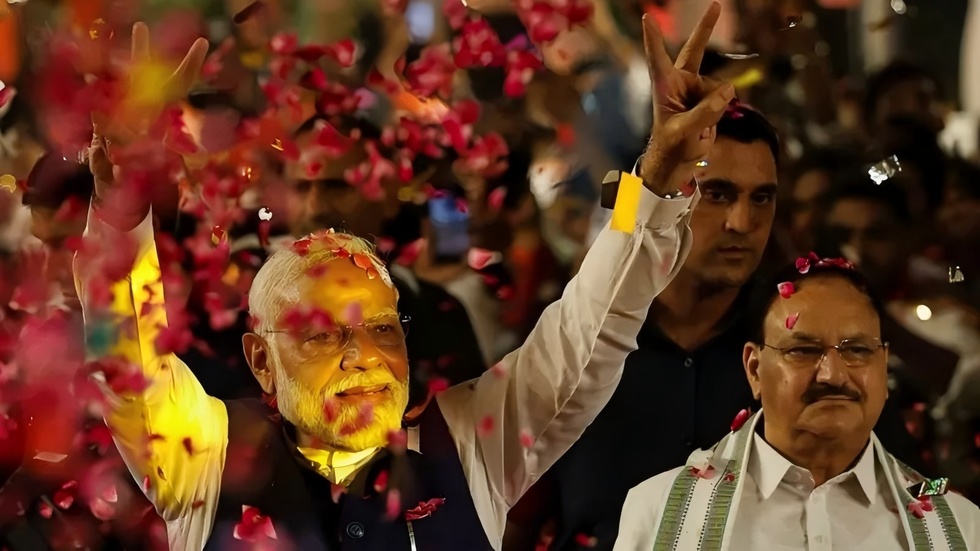
After Modi came to power, the "Win Learning" method in India gained worldwide recognition. Reuters
However, India’s real material strength has not kept up. Nehru’s planned economy system, which prioritized heavy industries, failed to achieve comprehensive industrialization in India. Instead, it led to a situation where inefficient state-owned enterprises coexisted with powerful industrial trusts. India only began market-oriented reforms in 1991, and in 1998, it was sanctioned by the United States due to nuclear tests.
By the time Modi took office, India faced even greater obstacles. China had already established itself as a leading industrial power among developing countries in Asia. Malaysia, Thailand, and Indonesia had also recovered from the Asian financial crisis and were competing for investment and industrial transfer. Vietnam, which went through decades of war before launching economic reforms, has developed at a much faster pace in manufacturing and exports than India. Even Bangladesh, which started its economic reforms under the shadow of India's regional hegemony, has established internationally competitive labor-intensive industries such as clothing and footwear, driving per capita income growth that surpasses that of India.
Modi inherits the "great power vision" of previous Indian leaders, and transforms it into a implementable strategy—turning the expectations of the outside world regarding India's economic and strategic significance into a genuine claim for India's global leadership. In his rhetoric, Modi proposes that India should shift from being a "balancing force" to a "leading force," calling India a "world mentor" and a "spokesperson for the 'Global South.'" He continuously seeks the respect and representative status that a great power deserves.
In practice, Modi also places great emphasis on bringing India into the spotlight of global governance. From launching the 'International Solar Alliance' in 2015 to hosting the 'AI Influence Summit' in 2026, India's pursuit of international influence has clearly exceeded the level that its current industrial and technological capabilities can support.
In other words, India is taking a "preemptive" tough stance, trying to compensate for its lack of basic capabilities through reputation building. Modi must not only convince capital that India is worth investing in, but also make them believe that India can offer more value than its regional competitors. Moreover, he hopes to gain strategic support from the Western camp, including capital investment, technology transfer, market access, preferential treatment, and the transfer of industries and supply chains.
In India's calculations, to obtain these benefits, it is willing to pay a lower cost. India does not want to trade development at the cost of heavy debt burdens or binding political obligations. After all, growth achieved at the expense of strategic autonomy clearly contradicts the Indian government's narrative of "India being stronger and more independent." Therefore, India needs capital, technology, industries, and supply chains, but it may not be willing to pay at full market prices. It is more interested in obtaining a favorable price, even a discounted price that takes into account political considerations.
To sell undervalued assets that are not yet fully developed, India must harness its potential and attract capital as soon as possible. It must convince investors that investments in India today will yield superior returns in the future. It must also convince Western governments that supporting India's rise is a profitable strategic investment, even if India cannot provide immediate returns. Furthermore, it must convince countries in the "Global South" that proximity to India will bring a brighter future, even if India currently cannot provide substantial material assistance.
In short, Modi pre-emptively marketed a dream and a promise. The strategy involves using potential to shape expectations, using expectations to mobilize resources and build networks, and then using these resources to secure priorities and advantages. External support then helps transform potential into actual power, ultimately proving that the expectations that drove that support were correct. Even if other countries are not completely convinced and show a believing attitude, it is still beneficial for India. If a country behaves in a way that seems to have confidence in India’s future, just for the sake of maintaining bilateral relations, such behavior can itself become a resource for India’s diplomacy and domestic propaganda, helping India attract more potential partners.
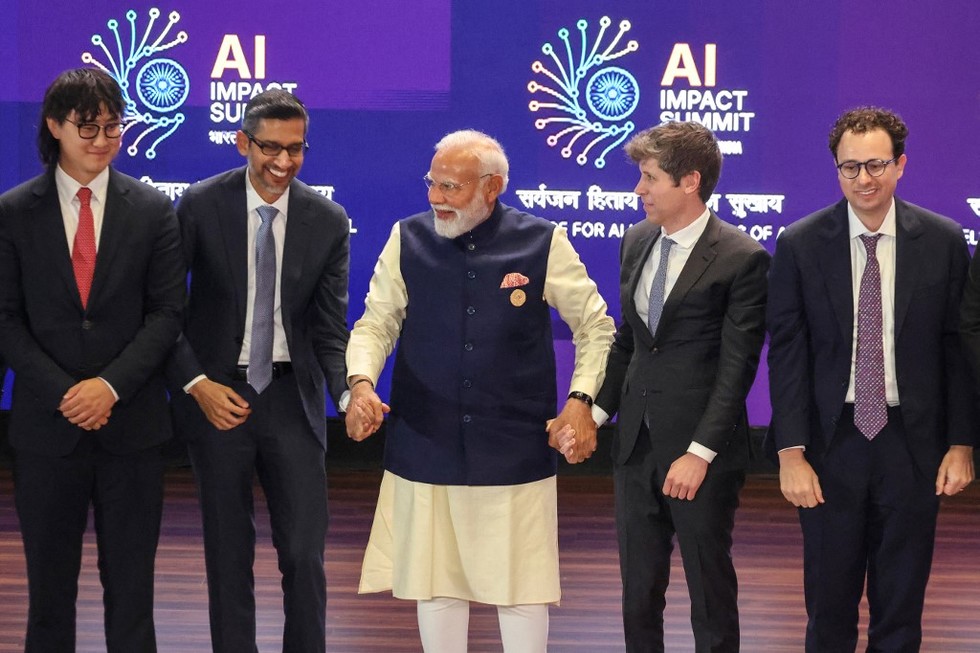
In February 2026, at an AI Impact Summit held in New Delhi, India, Indian Prime Minister Modi (center) took a group photo with senior executives of tech companies. AFP
Artificial intelligence is a highly representative example. The United States has launched the "Pax Silica" initiative, while China is committed to establishing international cooperation mechanisms in the field of artificial intelligence. Both initiatives are supported by strong domestic industrial capabilities. In contrast, India lacks globally leading technology companies and still relies on foreign suppliers for key components such as advanced hardware, computing power, and software ecosystems. However, as Mao Keji pointed out in "Decoding India's 'Traditional Arts of Diplomacy': The Art of Packaging," these industrial disadvantages do not prevent India from seeking to play an "excess role" in global artificial intelligence governance.
By hosting the "Artificial Intelligence Influence Summit" and promoting support for the New Delhi Declaration from 92 countries and international organizations, India has utilized its large population and market potential to bring major tech companies under its influence. Subsequently, India can leverage global capital's attention as a lever to attract developing countries to join. The discussions surrounding "sovereign artificial intelligence" and data security have resonated strongly among governments in the Global South.
In order to make the 'preemptive strategy' effective, Modi has been exceptionally proactive both in words and actions. This is not just a cultural style, but also a strategic signal. In terms of Western policies, India emphasizes its potential as a major power, and the possibility of becoming a force that can balance China's influence. In terms of policies towards the 'Global South', India highlights its potential as a leader, expressing its willingness to represent developing countries and assist in reforming the existing international order.
Before Trump 2.0, the value of Modi’s “high-profile rise” strategy became even more prominent. As Western concerns about China’s rise intensify, the more India demonstrates its potential to weaken China’s industrial dominance or limit its strategic flexibility, the more motivation there will be for the West to invest in India, provide aid, and offer preferential support.
However, as Trumpian diplomacy breaks with traditional policy rationality, and the United States increasingly views partnerships in a transactional manner, India has to repeatedly demonstrate its potential to become a force capable of balancing China. Therefore, Raju Mohan is writing an article titled "India Still Stands With the United States" for Foreign Affairs magazine, aiming to prove India's importance to the United States. Although India may not wish to be a tool for the United States to balance China, it has every reason to convince the US that, once it becomes strong enough, India is capable of playing this role.
In China, as the “head bird” is often the one who gets shot, efforts are made to avoid being seen as such during China’s rise. In India, under Modi’s leadership, efforts are made to prove that India can also become a “head bird”. From this perspective, Modi’s government’s eagerness to boast and flaunt its achievements may not be entirely an act of vanity; there are also “rational and pragmatic” considerations behind it.
The problem is that the Modi government was able to sell products at inflated prices and attract resources, but failed to effectively convert these external resources into domestic development. True strength can be seen in strong winds and vigorous grass. The bubble between slogans and reality grows larger and larger, and it will eventually hit someone who breaks this bubble. Trump, who has returned to the political scene twice, is playing this role. Of course, this doesn’t mean Modi’s strategy is completely ineffective; it just means that the cost of maintaining an appearance of prosperity is increasing.
