Since US President Trump returned to the White House, the US government has raised tariffs, which has increased the costs of trade with the United States. This has prompted Vietnam to seek stronger economic ties with China.
On October 5, the Hong Kong-based South China Morning Post reported that China and Vietnam are promoting trade and tourism development between the two countries by enhancing railway construction, increasing flights, and strengthening cargo connections. Analysts believe that improving the quality and quantity of transportation will help strengthen economic ties between China and Vietnam, which will assist both countries in coping with the pressures exerted by the United States in terms of trade.
According to reports, the export of manufactured goods accounts for a significant proportion in both the economies of China and Vietnam. There is also close economic cooperation between China and Vietnam. As the United States adjusts its trade policies, which increases global trade uncertainty, China and Vietnam are strengthening their connections through railway transportation, air transportation, and maritime transport, in order to enhance their supply chains.
Ascentium Vietnam's CEO, Jack Nguyen, said: "As US tariffs and non-tariff barriers create more uncertainties, Vietnam and China have every reason to deepen their transportation, supply chain, and trade ties in order to achieve market diversification."
He pointed out that China and Vietnam are advancing a series of railway projects. These projects will create more efficient supply chain corridors, reduce logistics costs, and shorten transportation times. At the same time, they will connect Vietnam’s manufacturing centers and ports more directly to China’s extensive railway network.
China and Vietnam have made progress in the construction of several railways this year. Reports indicate that in March, both countries signed technical cooperation agreements for the planning of two standard-gauge railways: Hanoi-Thong Dinh and Haiphong-Ha Dong-Mang Chai. In August, Vietnam decided to invest an additional $3.36 billion in the construction of the Lao Cai-Hanoi-Haiphong standard-gauge railway. The project is scheduled to be completed by 2030, aiming to establish a connection between the railways of China and Vietnam.
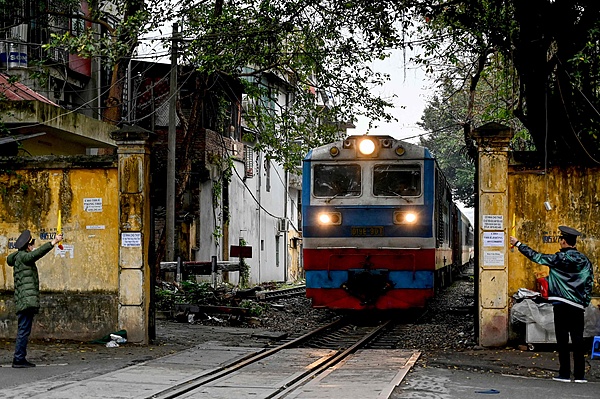
Vietnam's Capital Hanoi: The Railway
Analysts believe that these railway projects are expected to increase the volume of freight and passenger transport between China and Vietnam. Winnie Lam, a senior business consultant residing in Vietnam, pointed out that the border crossings in Vietnam use outdated infrastructure and narrow-gauge railway systems. Due to the different railway gauges between the two countries, there are significant limitations in cross-border railway transport.
New South Wales University’s honorary retired professor and expert on Vietnam issues, Carl Thayer, stated that promoting cross-border railway construction can help alleviate congestion at highway ports and promote the development of tourism. Both China and Vietnam stand to benefit from this.
Meanwhile, air transportation between China and Vietnam is also expanding. To further promote trade, last month, Hong Kong Air Warehousing Limited announced that its "Super China Line" service will be extended to Vietnam, providing Vietnamese businesses with "more convenient and cost-effective logistics and air-road intermodal solutions".
"Super China Ground Line" is a scheduled air service connecting Hong Kong International Airport with mainland China, operated by Hong Kong Air Cargo Services Limited. This network extends for the first time to regions outside of mainland China.
According to data from aviation market intelligence company OAG, the number of seats on China-Vietnam routes will reach a record 8.6 million this year, up from 7.7 million last year. Last year, Vietnam welcomed nearly 5.3 million Chinese tourists, an increase of more than 40% compared to the previous year.
The Vietnamese government stated that China was the largest source of foreign tourists for Vietnam last year and in the first half of this year. In the first half of this year alone, approximately 2.7 million Chinese tourists visited Vietnam.
Vietnam Airlines announced in April the launch of five new routes, connecting Hanoi, the capital of Vietnam, and Ho Chi Minh City, the largest city, with Chinese tourist destinations. In August, another airline, VietJet Air, launched a direct flight route between Ho Chi Minh City and Shenzhen.
