On October 5th local time, Spanish Prime Minister Sánchez issued a statement announcing the early holding of the country's parliamentary elections. Voting is scheduled to take place on November 29th.
This early election is just over a year away from the originally scheduled election date. According to the European edition of “Political News Network,” the direct reason behind Sanchez’s decision was the rejection of two bills addressing the housing crisis by the parliament last week. After the failure of the housing policy efforts, public dissatisfaction in Spain further escalated, ultimately leading Sanchez to decide to hold the election earlier.
Last month, 87-year-old Marica Mend Ábascar of Spain was forcibly evicted from her apartment where she had lived for 70 years due to being unable to afford the dramatically increased rent. This led to a rapid escalation of housing tensions that had been lingering in the country for a long time.
To alleviate the housing crisis, the Sánchez government introduced two long-delayed housing decrees. One of these plans extends the protection against eviction for vulnerable tenants until 2030, allowing existing leases that expire by 2028 to be extended by a maximum of two years. Additionally, short-term rental regulations are tightened. The other decree establishes an automatic lease renewal mechanism, enabling eligible tenants to continue living in their homes.
However, the decree encountered obstacles in the Spanish parliament. Since the left-wing coalition government led by Sánchez controlled only 147 of the 350 seats in the House of Representatives, the decree had to rely on the support of small parties such as “Junts per Catalunya” to pass. But Junts finally announced its opposition to the two decrees, resulting in the decree being vetoed by the House of Representatives on October 2.
According to ‘Political News Network’, housing issues are the most concerning topic for Spanish voters at present. Sanchez’s decision to hold elections earlier may be an attempt to capitalize on voters’ dissatisfaction with the stalled laws, in order to gain a ‘more advantageous campaigning ground’ for the ruling Workers’ Socialists.
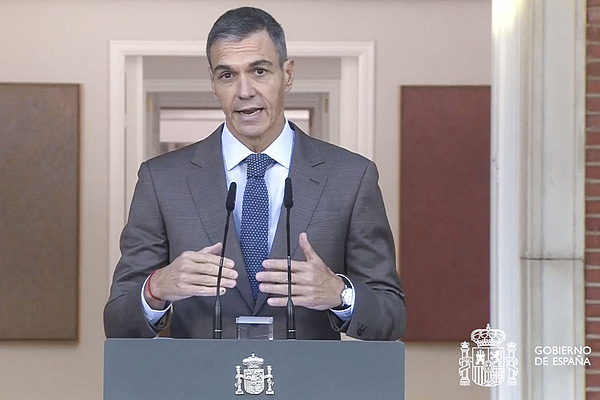
Spanish Prime Minister Sánchez Visual China
Since the beginning of this year, the Sanchez government has been facing severe political pressure. In May, the Workers' Social Party led by Sanchez was embroiled in a corruption scandal. The headquarters of the Workers' Social Party even experienced a raid by Spanish Civil Guard anti-corruption officers, which dealt a blow to the image of the Sanchez government.
In July, Spain's enclave of Ceuta in North Africa faced an immigration crisis. A large number of illegal immigrants attempted to cross the border from Morocco into Spain, resulting in hundreds of deaths. After the outbreak of the immigration crisis, the plan proposed by the Sanchez government to grant legal status to 500,000 undocumented immigrants was severely criticized. Centrist and right-wing political parties accused this plan of attracting immigrants to Spain.
This series of crises has hit the votes of the Workers’ Socialists, increasing the risk of their defeat in parliamentary elections. According to a latest poll by Politico News Network, the center-right People’s Party led with 34% of the vote, while the Workers’ Socialists ranked second with 26%. The far-right Vox, which is likely to form an alliance with the People’s Party, came third with 18% of the vote.
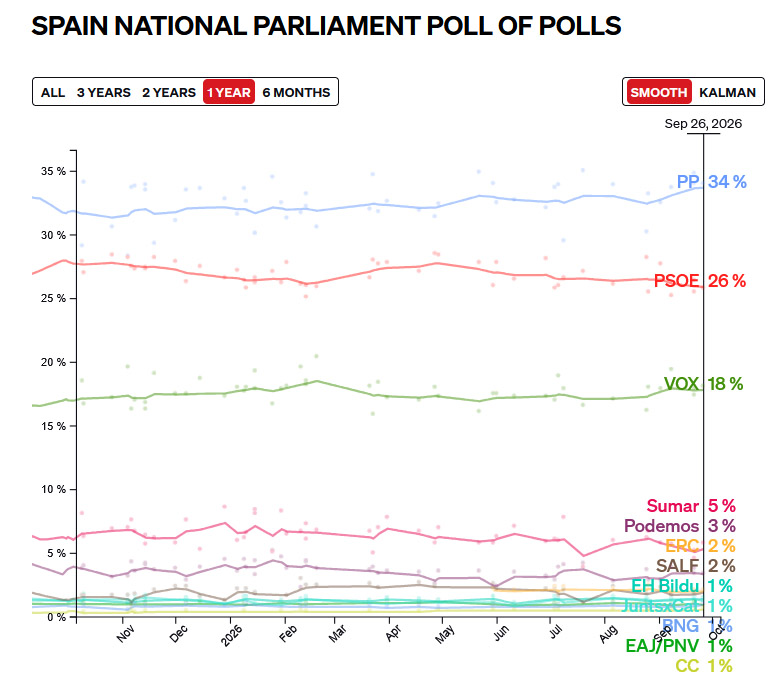
Recent polls show that the Spanish center-right People’s Party has a leading support rate, according to a screenshot from Politico News Network.
After announcing the early holding of parliamentary elections, Sánchez emphasized the achievements made since the formation of the left-wing coalition government in his televised speech on the 5th. He highlighted the progress Spain has made in the economic field, stating that the country has become "the fastest-growing economy in the entire EU and is leading in terms of creating jobs." He specifically mentioned the government's investment in green energy, which has led to significant development in Spain's renewable energy sector.
However, Sanchez also admitted that the government he led did not achieve all its goals, and there are still many social issues that need to be addressed. In particular, there is a problem of inequality in public services and access to housing. He emphasized that to solve these problems, the government needs to gain more public support in order to carry out necessary reforms, thereby alleviating social inequalities.
Sanchez addressed the voters: "Spanish people, you must decide what role you want to play in this era, and what role Spain should play. You must decide whether to join the far-right wave, allowing it to cause backwardness wherever it goes, or whether you want Spain to continue to be a bastion of openness, social justice, and environmental responsibility."
"Political News Network" points out that Sanchez wants to turn the housing crisis into an advantage and, amid conservative opposition to the housing law, mobilize leftist voters in order to boost the social democratic party's election prospects. However, achieving this goal is not easy. Reports say Spain's 2025 GDP growth reached 2.8%, but runaway inflation has led to soaring prices for goods and housing, with most households seeing no increase in purchasing power.
In addition, the early elections have caught the Spanish left off guard. Various left-wing parties are rapidly reorganizing themselves, which could affect the formation of a left-wing electoral alliance. Since Spain’s second deputy prime minister, Jolanda Diaz, has already stated that she will not participate in the next parliamentary elections, the ‘Solidarity Movement’ party within the left-wing coalition government is still looking for a candidate to lead the party.
The British Broadcasting Corporation (BBC) commented that after the Labour Party's failure in local elections in 2023, Sanchez announced early elections under extremely unfavorable opinion polls. In the end, he achieved a "reverse defeat" and gained sufficient support in parliament. This early election seems to be another "political gamble" by Sanchez, but he still needs to address the concerns of Spanish citizens regarding issues such as housing and immigration.