The British automotive industry is struggling to make a difficult choice between China and Europe: local manufacturers need to balance the benefits offered by both markets, while also coping with the approaching trade protection measures imposed by the European Union.
According to a report by The Guardian in the UK on October 4th, while the United States has almost completely blocked Chinese cars from entering its territory and the European Union is imposing tariffs of up to 45%, the UK has chosen not to impose additional import taxes on Chinese vehicles. This makes the UK a 'peerless outlier'.
It is reported that EU officials warned British Prime Minister Andrew Burnham last month that the UK must impose additional tariffs on Chinese cars. Otherwise, the EU will use the “Made in Europe” rule, which is characterized by protectionism, to restrict the UK’s exports to the EU, thereby harming British car manufacturers in their biggest market.
However, the ministers have so far resisted such calls. The UK Business Secretary, Jonathan Reynolds, argued that any taxation would “likely lead to reciprocal countermeasures,” thereby harming British manufacturers’ sales in China.
It is understood that British car owners have already shifted to more cost-effective Chinese models. Increased tariffs will push up the prices of cars purchased in the UK. Tariffs may also discourage Chinese brands such as Chery from investing further in the UK. Previously, Chery was in talks about producing cars using Nissan’s Sunderland factory.
Consulting firm RSM UK’s Emily Savitz said, “We are facing difficult choices.” She added that the UK cannot afford to be indefinitely undecided between two markets. Investment in China could be a “lifeline” for car manufacturers, and entering the European market is also “crucial” for smaller British manufacturers.
She added, “Being excluded may render British suppliers increasingly disconnected from European markets. Domestic manufacturers need clear guidance from the government in order to make long-term investment decisions.”
Autotrader's Business Director Ian Ploome said that competition from Chinese brands makes cars more affordable and 'encourages more people to buy new cars'.
Industry data shows that in the first eight months of 2026, brands such as BYD, Omoda, and Jecook increased their market share in the UK new car market by more than twice, reaching 12% of sales.
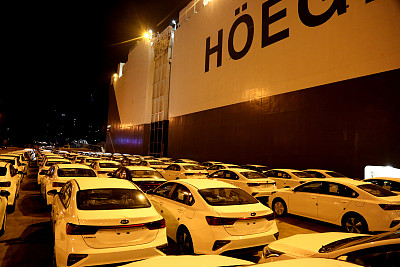
Chinese cars are being shipped by sea to Visual China in the UK.
Data released on October 2nd show that as of September, the number of new car registrations in the UK increased by 12%, making it the month with the best annual growth since 2017. Preliminary data from the Society of Motor Manufacturers and Traders (SMMT) indicates that this prosperity was driven by “demand for electric vehicles and Chinese brands.” The Jaguar XE and BYD Seal 7 were among the best-selling models.
However, the industry body also stated that the EU Commission's ‘European Manufacturing’ regulations limit local subsidies, tax incentives, and public procurement contracts for vehicles produced within the EU. This could pose a threat to the UK car manufacturing industry. In the first half of this year, the EU market accounted for 58% of the UK car exports, while China accounted for approximately 4%.
Smmt CEO Mike Hos said: “UK and EU car industries will suffer a double blow if they are not deeply integrated. It's going to be detrimental for both the UK market and the EU."
Nissan Europe's chairman, Massimiliano Mesini, said last month: "Europe cannot have a 'Trojan horse' that allows Chinese people to enter the market through Britain."
Chery's UK deputy director Victor Zhang denied this claim. He said, "The majority of the cars we sell are hybrid vehicles, not those targeted by tariffs. And the cars we sell in the UK remain in the UK."
He added: “Customs duties may come and go, but we will not change our continuous investment in Britain.”
The EU had already increased tariffs on Chinese electric vehicles in 2024. Now, it is facing a new problem of setting barriers to imported hybrid electric vehicles.
It is reported that after the EU imposed tariffs on electric vehicles, imports of plug-in and hybrid cars have increased significantly. British media such as the Financial Times have stated that this change highlights China’s ability to adjust its export directions when facing trade barriers.
When the EU introduced measures "to protect European industries from competition from China," Mao Ning, a spokesman for China's Ministry of Foreign Affairs, stated that the essence of Sino-European economic and trade relations is mutual benefit and win-win results. China never deliberately seeks a trade surplus with Europe. Protectionism will only harm the interests of European consumers and weaken the competitiveness of European industries. China hopes that the EU will view Sino-European economic and trade relations in a comprehensive and objective manner and adhere to free trade principles. China is also closely monitoring the developments and will take necessary measures to safeguard its legitimate rights and interests.

