The commemoration of German unification usually has a fixed image. The national flag, speeches, youth choirs, the Brandenburg Gate, or the square of a small town that once belonged to the border region—all serve as reminders that after October 3, 1990, Germany became a single nation once again. This day is known as "Tag der Deutschen Einheit," the Day of German Unification.
As we approach the 36th anniversary, another picture becomes increasingly clear. The wall is no longer there, but the boundaries have not completely disappeared. It no longer exists in the form of barbed wires, guard towers, and passports. Instead, it continues to exist in wage schedules, inheritance property, corporate headquarters, lists of university presidents, football league maps, and the distribution of votes.
The existence of the rift between East and West does not deny unity. On the contrary, it is precisely because unification was completed so thoroughly that this rift is often concealed. Many eastern cities have repaired their streets, rebuilt old towns, and universities and research institutions have re-entered Germany’s and even Europe’s networks. Leipzig, Dresden, Jena, and Potsdam are no longer weak; some of these places have even become highlights for new industries and cultural life. However, on a broader social scale, the feelings of people in the East have not been completely soothed by these changes. Many people do not miss the Berlin Wall, nor do they simply cherish the democratic German state. What they express more often is an experience of being taken over, judged, replaced, and sold before being invited to integrate into the new society. Over time, this accumulated experience has become a hidden force in the political life of unified Germany.
A few days ago, the author read through the personal memoirs of Hans Modrow, the last Premier of East Germany. In these memoirs, he experienced the dissolution of the Soviet Union and the end of East Germany. After deep reflection, he put forward bold ideas regarding the reforms in socialist countries and their future directions. Based on what he saw, heard, and felt, this book reveals for the first time the inner workings of high-level decision-making and negotiations among various countries.
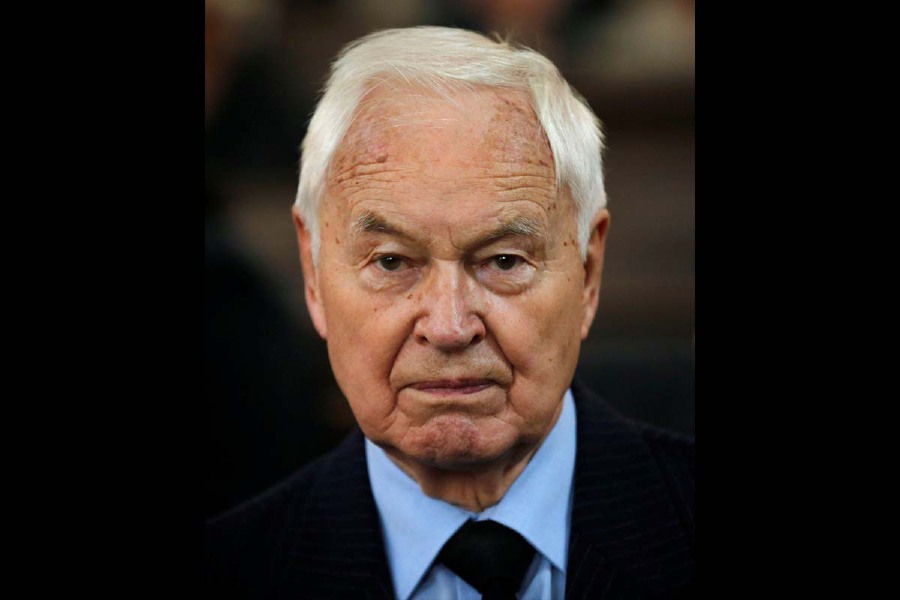
The last Prime Minister of East Germany, Hans Modrow, passed away in 2023 at the age of 95.
Reading Hans Morgenthau's "Reform in My Eyes," it is easy to notice that he does not view the end of East Germany as merely an external conspiracy. As the last Chancellor of East Germany, his narrative carries a sense of proximity to a loser, as well as a clear set of self-apologetics. An important point in the book is that the crisis of real socialism stems primarily from within the system itself. The lack of effective democratic mechanisms, rigid leadership control, slow economic reforms, and slow response to social changes all contributed to the old system losing its ability to be repaired. The preface in Chinese and the Bulgarian version focus more on subsequent evaluations, emphasizing that the book aims to answer two questions: why real socialism failed, and why reform did not succeed. These questions understand Morgenthau's memories within the context of the decline of the socialist movement at the end of the twentieth century, rather than simply viewing it as a personal memoir.
This is very important. When discussing the cracks that emerged after unification today, if we only talk about how West Germany “emptied” East Germany, we would be erasing the institutional problems that existed in Eastern society at the time of unification. On the other hand, if we only mention that East Germany was already backward and unification was merely a form of relief, we would also ignore the real power imbalances that occurred during the unification process. The reference provided by Modrow is precisely a gap between these two perspectives. He acknowledges the internal crises of the German Democratic Republic and the Soviet-style system, and repeatedly writes about how reforms were quickly overwhelmed by external forces, diplomatic arrangements, and the advantages of West German institutions. The root of these cracks lies precisely where these two facts intersect.
When quoting this book, it is necessary to separate several layers of interpretation. The first layer involves Modrow’s own judgment. He viewed reform as a delayed but necessary act of self-rescue, and he attributed failure to the lack of a democratic mechanism that could correct errors within the party and state over time. The second layer consists of the preface and the translator’s commentary, which take a broader perspective and consider this book as material for understanding the history of the Soviet Union, the upheavals in Eastern Europe, and discussions about socialism in the 21st century. Their tone is more general than that of the author, and they emphasize historical lessons rather than the author’s own stance. The third layer contains descriptions of historical events, such as street protests in 1989, the opening of the Berlin Wall, elections to the People’s House in 1990, currency unions, and eventual unification. These facts by themselves do not represent the author’s position, but they constitute a timeline for his perspective. This article adopts precisely this approach: it neither regards Eastern experiences as natural truths nor portrays the narrative of unified success as the entirety of history.

From a historical perspective, German unification was a rapid political process. In the fall of 1989, the situation in East Germany deteriorated rapidly; people took to the streets, and the Berlin Wall fell. German unification became a near reality. In March 1990, East Germany held its last federal assembly elections. In July, monetary, economic, and social unions came into effect. On October 3rd, East Germany ceased to exist as a separate entity and merged with West Germany. In less than a year, the country's structure, currency, laws, property rights, administrative systems, and political languages all changed.
Mordor repeatedly describes the passive consequences of this speed. He records his contacts with leaders of the Soviet Union, West Germany, and Western countries, discussing how the concept of “two Germans” becoming “one Germany” quickly lost its relevance. On a historical fact basis, the legal path to unification did not involve both countries jointly establishing a new republic, but rather the five states of former East Germany joining West Germany. This choice had practical reasons. The Eastern society was no longer willing to wait, the Deutsche Mark was highly attractive, and the Soviet Union was unable to maintain the old system. However, this decision also had a lasting effect: the West German system became the standard answer, while most of East German experiences were treated as something that needed to be cleaned up.
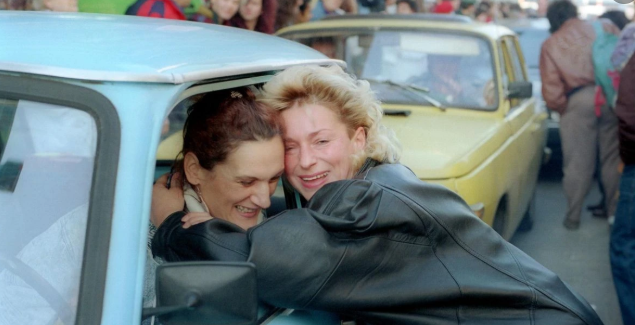
After the fall of the Berlin Wall, the Charlie checkpoints on the East-West Berlin border
It can be understood why terms like “emptying” and “exploitation” have been widely used in the East for a long time. Strictly speaking, these are not neutral academic concepts, but rather political language with strong emotional undertones. However, emotions do not arise out of nowhere. Many people in the East remember the dissolution of units, the replacement of officials, the devaluation of qualifications, and the redivision of housing and factory property rights. They also remember that they suddenly became laggards in a market economy, instead of being laborers in the narrative of the nation-state. The system in the German Democratic Republic could no longer function, but after unification, the right to make judgments fell mainly in the hands of people from the West. Who was the loser, who needed to learn, whose resume was no longer valid, and whose businesses had no future—these judgments were often made by institutions and people from the West.
The Management Agency is the core symbol of this memory. It was established at the end of the German Democratic Republic with the purpose of managing and transforming state-owned assets. After reunification, it became a giant institution for transforming the eastern economy, taking control of thousands of enterprises and millions of jobs. According to data from the German Federal Center for Political Education, in 1990, about 8,500 enterprises and more than 4 million jobs were placed under the management system. By the end of 1994, only about 1.5 million jobs remained in the original managed enterprises. Many enterprises indeed had outdated technology, heavy debts, and disappeared markets, making it impossible for them to compete with western enterprises overnight. But in the eastern memory, the Management Agency was not just an institution for economic transformation; it also served as a channel for western capital, law, and management classes to enter the east. The strike protests of the workers at the Böhmerwald potassium salt mine became symbolic because they compressed the macro-transformation into a scenario that ordinary workers could understand: factories closed down, explanations given, and those who remained had no choice.

In the early stages of unification, unemployment and deindustrialization were the most striking issues. Later, the gap became more hidden. The German Federal Statistical Office presented a set of representative data in its report on "35 Years of Unification". In 1991, the average pre-tax monthly income for full-time employees in the east was 924 euros, while in the west it was 1987 euros. By 2024, this figure had risen to 3973 euros in the east and 4810 euros in the west. The gap has significantly narrowed, but the west still has about a 21% higher income. The same set of data shows that Germany's GDP per capita in 2024 was 50,819 euros. The lowest GDP per capita was still found in the states of Saxony-Anhalt, Thuringia, and Mecklenburg-Vorpommern.
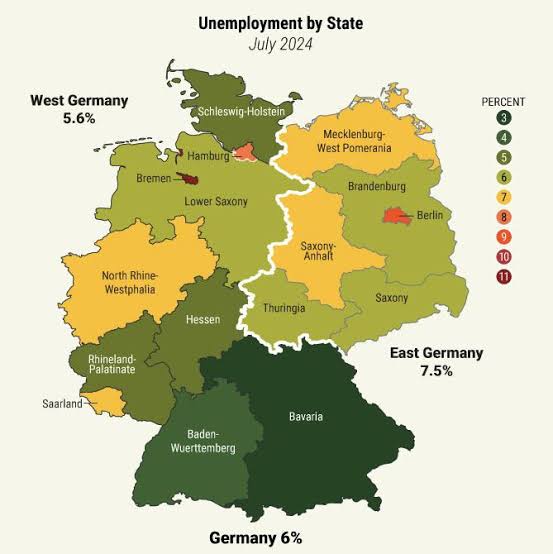
Employment is similar. In the 2024 public statistics, the overall unemployment rate in Germany exceeded 6%, with 5.6% in the western regions and 7.5% in the eastern regions. (As shown in the chart below) This is not a cliff-like shock like in the 1990s, but it is enough to maintain a sense of comparison in everyday life. People don’t necessarily talk about GDP every day, but they will feel the gap when it comes to finding jobs, changing jobs, buying houses, or choosing cities for their children. The gap isn’t just about income; it also includes family assets. According to the inheritance and gift tax data released by the German Federal Statistics Office in 2025, 95% of the total taxable inheritances and gifts in tax statistics occurred in the western states. Inheritance is essentially a record of history, writing down decades or even generations of asset accumulation at the starting point for the next generation. The wage gap can narrow over time, but the wealth gap continues to accumulate through housing, corporate shares, and family gifts.
So, the loss of the eastern society is not entirely due to a lack of development. On the contrary, it’s precisely because development has taken place that people are more sensitive to the remaining gaps. Many eastern cities are much more beautiful, convenient, and open than they were in the 1990s. However, the eastern region rarely hosts headquarters of large German companies, and ownership of capital and high-level positions is more concentrated in the western regions. Research using “Elite Monitoring” to determine the representation of East Germans in elite positions shows that in 2024, about 12.1% of Germany’s top positions were held by people born in the eastern region, which is lower than their proportion in the population. This ratio is even lower in economic and cultural areas. One can see unified achievements on the streets, but another boundary can be observed in conference rooms, boards of directors, media editorial departments, and academic review lists.