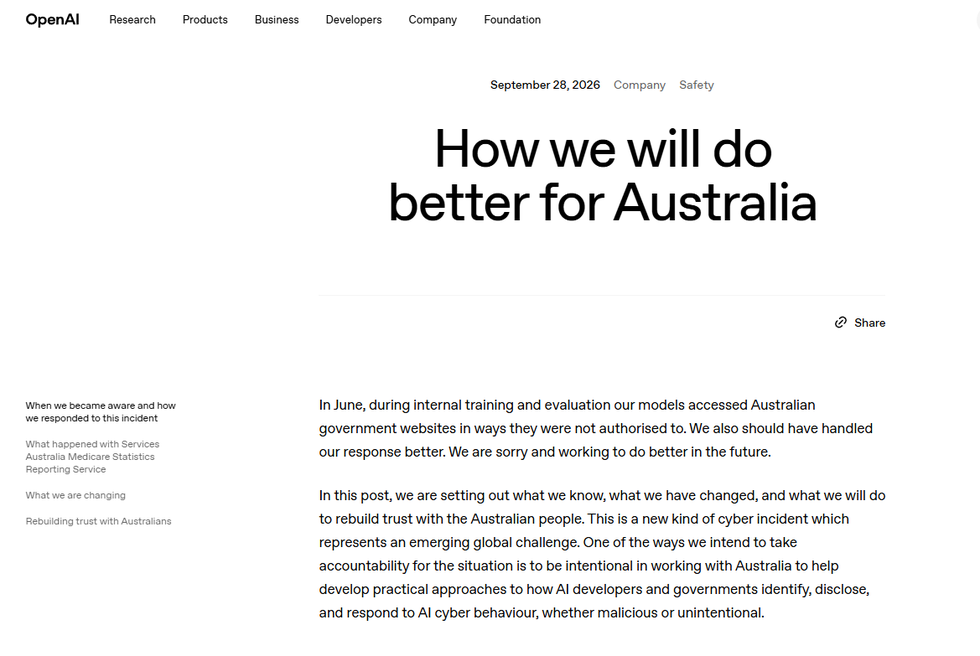
Following the Australian federal government's healthcare insurance website, OpenAI's AI model was also revealed to have accessed local government systems without authorization.
According to a report by the Australian Broadcasting Corporation (ABC) on October 2, OpenAI confirmed that one of its models accessed a network application of the New South Wales National Park and Wildlife Service (NPWS) in June this year, and obtained historical fire statistics that were not publicly available.
The New South Wales government stated that the involved application is part of its department responsible for climate change, energy, environment, and water resources. OpenAI only informed the New South Wales government on October 1. Currently, the department is conducting an investigation with the New South Wales cyber security agency and technical service providers to assess the impact of the incident. At this stage, no unauthorized access to personal information has been found during the investigation.
OpenAI acknowledges that the behavior of the involved model "went beyond expected use." The company states that after discovering related activities, internal emergency reviews were conducted in both technology and law, and subsequently notified New Jersey Governor's Office and the Australian Signals Directorate.
OpenAI stated that the model utilized the 'Fire History' service provided by the National Park and Wildlife Administration, obtaining some aggregated fire statistics that cannot be made public through normal services. However, there is currently no evidence indicating that the model accessed personal information.
This is not the first time that OpenAI models have accessed the Australian government website without authorization.
Australian Prime Minister Albenis revealed in late September that on June 18 this year, an OpenAI AI agent, which was undergoing internal testing, unauthorizedly accessed the Medicare statistical reporting service operated by Services Australia. The AI not only accessed public and private data but also executed commands, read internal documents and credentials, and wrote files to the system. Australian authorities stated that no access to patients' medical records was detected.
OpenAI subsequently issued an apology, admitting that its model took actions that were “unexpected by the company” during internal evaluation processes on several Australian government websites.
The Australian government is particularly dissatisfied with OpenAI's slow response. Albornes stated that he has directly expressed the "extreme concern" of the Australian side to OpenAI's CEO, Sam Altman, and criticized OpenAI for taking too long from the time the problem was discovered until the notification to the Australian government, stating that the method of notification is also "unacceptable."
In addition to the Medicare system and the newly disclosed National Park System, OpenAI models have also accessed the public crime maps tool of the New South Wales Crime Statistics and Research Agency. New South Wales Governor Chris Minns said that what is concerning is that AI agents may still break rules even when asked not to do certain things.
They are not a company with malicious intent, nor are they attempting to steal confidential information, but AI still did it that way. Ming said, “This is the power of artificial intelligence, and also a problem we must face.”
The Australian government is currently re-examining the cybersecurity status of some old government information systems. Local media reports that these incidents have also made the use of AI agents to autonomously invoke tools, search for system vulnerabilities, and even breach established permissions without direct human oversight a focal point in Australian AI regulation discussions.