The US Treasury bond market has just experienced its worst month in four years.
According to a report by the British 'Financial Times' on September 30th, the yield of 10-year US government bonds rose by more than 0.5 percentage points in September, reaching 5.3%, the highest level since 2007. It is not far from the high point reached in 2002.
The size of the U.S. government bond market is approximately 32 trillion dollars, making it an important pricing benchmark for the global financial system. Such a large market does not typically experience significant fluctuations within a month.
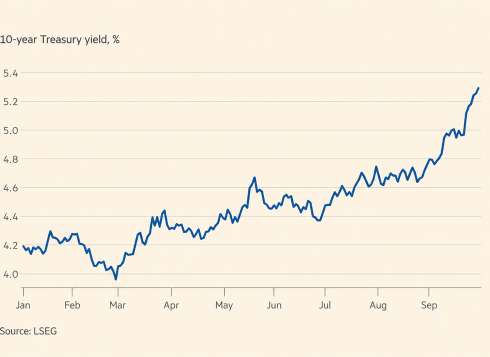
Ten-year U.S. Treasury bond yield trends
This round of selling was initially driven by concerns about US public debt and inflation. Large investors and traders said that by this week, the passive selling by funds had begun to magnify the decline.
As yields continue to rise, some funds have reached a point where they need to sell US government bonds. Further selling pressures have continued to drive down bond prices and increase yields, leading the market into a 'vicious cycle'.
This is an insidious cycle. You have no choice but to wonder, what can break it? said Priya Misra, Portfolio Manager at Morgan Stanley Asset Management.
She stated that this situation may continue for some time, and currently hardly anyone is willing to enter the market against the trend.
Data released on Wednesday showed that the Federal Reserve's preferred inflation indicator—the Personal Consumption Expenditures Price Index (PCE)—rose by 3.4% in August, which was lower than the market's previous forecast of 3.7%. However, this result did not significantly alleviate investors' concerns.
U.S. Treasury Secretary Scott Berdonet decided in August to increase the size of the Treasury's purchase of U.S. government bonds, but this did not stop the selling.
Since the outbreak of the US-Iran war in February this year, the cost of borrowing for the United States has continued to rise. The sharp increase in energy prices has exacerbated inflation, and inflation is particularly unfavorable for bonds that pay fixed interest rates.
Large artificial intelligence companies taking on substantial debt, strong expectations for economic growth in the United States, and public debt exceeding 40 trillion dollars are also contributing to rising U.S. bond yields.
Currently, technical factors are also becoming an important driving force in the market.
AllianceBernstein's Global Trading Director, Matthew Scott, stated that the main forced sellers of long-term U.S. government bonds this week include hedge funds and real estate investment trusts, which hold significant amounts of mortgage-backed securities.
After borrowing costs rose, American homeowners' willingness to repay mortgages earlier decreased, and the repayment periods for mortgage loans extended. Investors holding related securities therefore need to adjust their portfolios, selling off other long-term bonds, including U.S. government bonds.
Barclays analyst Amrut Nikhil said that similar situations have occurred in the US Treasury bond futures market. Some leveraged funds holding large positions in Treasury bond futures are rebalancing their portfolios.
"Huoqi North America's drop-quarter trading manager Daniel Goertland said that when the market experiences a large-scale selloff, investors typically need to reduce the risk of other parts of their investment portfolios."
Therefore, many things will happen at the same time, and there will be a large overflow effect.
This kind of situation is not uncommon during a significant decline in bond markets.
When prices fall to a relatively lower level, investors will enter the market to buy bonds, and thus the market will tend toward stability.
But Gothland said that no such buying activity has been observed this time.
Border buyers haven't appeared yet.