On September 30 local time, U.S. President Trump announced at the White House that South Korea would invest up to $200 billion in various sectors including energy in the United States. The investments include natural gas power generation projects in Texas, eight large nuclear power plants, and liquefied natural gas (LNG) projects in Alaska.
However, just as this investment plan, which Trump described as “grandiose,” was announced, South Korea quickly clarified that, at least regarding the Alaska LNG project and the eight nuclear power plants, the two parties are not yet in a stage where a final agreement has been reached.
On one side, U.S. President Trump publicly announced an investment of $200 billion. On the other side, South Korean President Li Jae-myeong emphasized that the project must first prove its commercial viability. On October 1st, Reuters and the Hong Kong-based South China Morning Post both reported on this event, pointing out that despite the substantial investment announced publicly, there are still many details that need to be negotiated behind the scenes.
Ultimately, the reason behind the confusion regarding this $200 billion investment plan is the political pressure exerted by Trump and Lee Jae-myeong respectively.
Trump is eager to turn investment projects into economic “achievements” that can be presented before the mid-term elections. Lee Jae-myung, on the other hand, is desperate to respond to domestic doubts and prove that South Korea does not completely accept U.S. investment demands. One is eager to announce, the other is eager to clarify. One wants to showcase “achievements”, the other wants to demonstrate “strength”. This is why there is now this rather intriguing “terminology dispute” between South Korea and the United States.
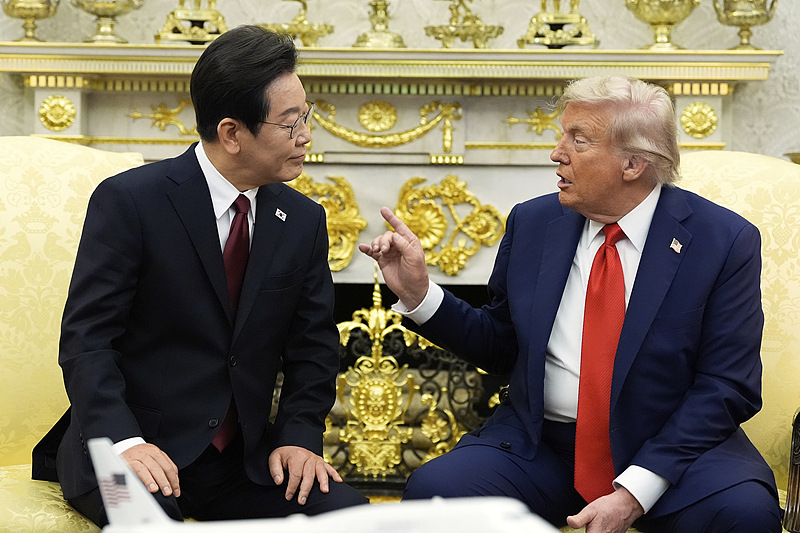
On August 25, 2025, local time, in the Oval Office of the White House, U.S. President Trump delivered a speech during his meeting with South Korean President Yoon Suk-yol. Visual China
Last year, the Trump administration imposed a 25% tariff on South Korea, and ultimately, the US and South Korea reached an agreement worth $350 billion for investments in the US. Now, $200 billion of that amount seems to have a destination.
According to Reuters, Trump stated in the Oval Office of the White House on that day that, according to the agreement reached between the US and South Korea, they would invest up to $200 billion. The projects announced by Trump include eight large nuclear power plants, a natural gas pipeline, and a power generation facility with a capacity of 6.5 gigawatts located in Texas.
Among them, the investment for the Texas project amounts to $22.3 billion, and the investment for the eight nuclear reactors is $120 billion. As for the Alaska LNG project, Trump did not provide specific figures, but U.S. Secretary of Commerce Wilbur Ross later stated that the investment for this project will exceed $50 billion.
The South China Morning Post pointed out that Trump referred to these three projects as “a massive initiative”. It stated that this would help ensure the security of America’s critical energy supply chains, strengthen America’s dominance in the energy sector, and further solidify America’s partnerships with South Korea and the entire Pacific region.
However, the South Korean side does not consider the “huge investment” mentioned by Trump to have been fully implemented.
The South Korean government stated that the Alaska Pipeline Project will only be pursued if certain commercial and legal conditions are met. The South Korean Ministry of Trade, Industry, and Energy made it clear that South Korea will begin to review the commercial feasibility of the Alaska LNG project and the related legal procedures. “No decisions have been made regarding investment or the scale of the investment.”
South Korean President Lee Jae-myung also stated that both the Alaska LNG project and the nuclear reactor project must be confirmed for their commercial viability before proceeding.
The South China Morning Post further noted that Seoul's position is that only the Texas project has been finalized, while the Alaska LNG project and the eight nuclear power plants, which are subject to commercial disputes, still require further discussion.
This controversy stems from a $350 billion investment commitment in the Korea-US trade agreement last year.
Last year, South Korea promised to invest $350 billion in trade agreements with the United States. Of this amount, $150 billion was allocated to shipbuilding, and another $200 billion was for strategic investments. In exchange, the United States agreed to reduce tariffs on South Korean goods.
Thereafter, both parties continued to negotiate regarding the selection of investment projects and their specific implementation.
The real challenge, obviously, is not just how much money South Korea is willing to invest, but also where this money will be invested, who will bear the risks, and whether the projects themselves are commercially viable.
According to The South China Morning Post, the Korean side has been trying to ensure that investment commitments are commercially viable, and to avoid placing too much risk on South Korean taxpayers and public finances. This is also an important background for the Korean side's emphasis on ‘commercial viability’.
In this disagreement, the Alaska LNG project has received particular attention.
According to Reuters, if the project is eventually carried out, it will construct a pipeline stretching 1300 kilometers, transporting natural gas from the northern slopes of Alaska to a liquefaction facility on the southern coast of Alaska. The LNG will then be shipped to Asian markets. The project is designed to have a natural gas transmission capacity of about 110 million cubic meters per day, with a maximum annual production of 20 million tons of LNG.
Trump has previously pushed this project several times, viewing it as a way to expand US energy exports and strengthen relations with allies such as South Korea and Japan. However, the project has faced uncertainties regarding costs, financing, and commercial viability for many years.
For the project developers, whether South Korea will ultimately participate is also crucial. The project developer Glenfarne has already received a commitment to supply 13 million tons of LNG per year, but another 3 million tons of commitment is needed in order to support the final investment decision and make these commitments binding.
That is to say, even though Trump has included the project in the ‘$200 billion investment plan’, there are still commercial issues that need further addressing.