In September, a milestone event occurred in Russia's attacks on Ukrainian infrastructure: for the first time since the war began, a Ukrainian data processing center became a target of Russian attacks.
From September 11 to 24, at least five data processing centers were attacked, most of which are located in Kyiv. The exact extent of the damage to facilities and property is still unknown. However, given the highly vulnerable nature of computer infrastructure, it can be assumed that these facilities would cease operating immediately if attacked.
The companies involved have announced little information that can be used for evaluation. However, based on my personal experience, it is certain that Internet service packages priced at 300 to 500 hryvnia in Ukraine are no longer available, and a significant increase in communication costs is inevitable.
Over the past month, many new developments have occurred in this war that may not have received much media attention. Although they are not well-known, their importance actually exceeds people’s expectations. A raid on a data center is a typical example of this.
The data processing center is a multi-functional facility equipped with servers, designed to handle access requests from users to websites or specific services. The services include communication, online shopping, payment, and other related areas. It also features an optical fiber communication network, power supply facilities, uninterruptible power supplies, diesel generators, as well as a cooling system.
Therefore, once such facilities are attacked, multiple levels of digital infrastructure may be damaged simultaneously. Moreover, since the system itself is very fragile, the Russian military does not even need to completely destroy the data centers. Damaging its network interfaces, power supply systems, cooling systems, or the server rooms where the service providers' core nodes are located can cause the system to become paralyzed.
Now let’s look at the overall distribution of data centers in Ukraine, and how they are connected to each other, as well as how they interact with customers and end users.
The exact number of data centers in Ukraine is still uncertain, and the final statistics will depend on the statistical criteria used. According to data from the DataCenterMap database, there are 34 to 43 commercial data centers in Ukraine. Statistics from the ColoMap database indicate that there are more than 66 such centers. However, the exact number isn’t important; what matters is the distribution and concentration of these data centers.
The 34 data centers included in DataCenterMap are located in 7 cities of Ukraine. Vinnytsia, Nikolaev, Khmelnytskyi, and Rovno each have one data center, while Odesa has two. Kharkiv has five data centers, with Kyiv leading the list with between 22 and 27 data centers.
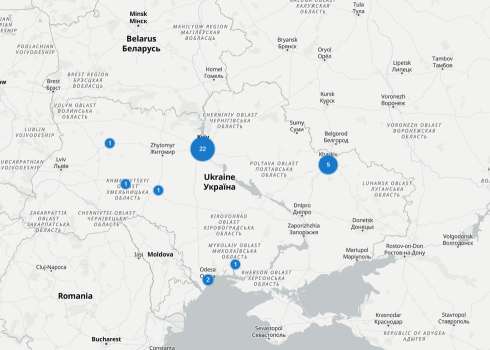
Ukrainian Data Center Distribution Map Included in DataCenterMap
Most of the data centers in Ukraine are located in Kyiv, which explains why these facilities were never attacked until 2026, and why they have now become targets. Previously, Kyiv was under strict air defense protection. Ukraine’s air defense missile systems were capable of intercepting a limited number of expensive cruise missiles. The “Beech” air defense system, which was at its peak in effectiveness, successfully shot down up to 90% of Russia’s “Petunia-2” low-speed drones. This makes targeting targets within Kyiv a very difficult task.
However, as the Ukrainian air defense systems were continuously depleted, the ammunition stockpile for anti-aircraft missiles ran out, leading to a significant depletion of reserves from the European Union and the United States. At the same time, the Russian military switched to jet drones, enabling them to completely destroy targets within Kiev that were previously unreachable. This is also the reason for the expansion of air strikes. Residents of Kiev frequently experience anti-aircraft alerts, and authorities even have to classify these alerts based on the level of danger.
The layout of Ukraine's fiber optic communication lines is also unclear. Currently, no up-to-date map of the distribution of these lines is available, but it is clear from common sense that Kiev is undoubtedly the most important network hub in Ukraine, with all major fiber optic communication lines passing through here. This means that Ukraine's fiber optic communication network relies heavily on the functioning of the capital. The central cities of various regions are connected to each other, and communication between Ukraine and the European Union is facilitated through several channels. There are at least four major fiber optic networks within Ukraine, operated by Atracom, European Transmission Telecommunications, Ukrainian Telekommunikacija, and Ukrainian Petroleum and Gas Company. In addition, there are dozens of backbone network operators and internet service providers.
Communications between Ukraine and the EU are carried through multiple traffic exchange nodes. The backbone internet service provider RETN built an optical fiber line connecting Lutske and Moasnitsy in September 2022, providing a backup route for traffic from Odessa to Warsaw that avoids Kyiv.
Therefore, although individual data centers are vulnerable, the overall IT infrastructure in Ukraine is not weak. It would take time to cause devastating damage to it. Moreover, at the beginning of the conflict, the authorities in Kyiv took a series of measures to ensure the physical security and operational stability of network infrastructure.
On February 17, 2022, the Supreme Rada of Ukraine passed Law No. 2075-IX on Cloud Services. This law prohibits the processing of state secrets, official information, and data from the national registration system outside the country.
However, on March 12 of the same year, the Ukrainian Cabinet passed Resolution No. 263, allowing the storage of public information resources, registration systems, and their encrypted backup copies in foreign cloud services and data centers during wartime. Banks, retail companies, IT firms, telecommunications operators, and industrial enterprises are not bound by the Cloud Services Law, and these entities can store data on foreign resources from the beginning.
Therefore, the vast majority of critical services in Ukraine have been transferred overseas. For example, Ukrainian private banks took 43 days to migrate data from their local data centers to Amazon Web Services. Dozens of large enterprises have followed this example. Currently, most of the systems remaining in Ukraine's local data centers are those of medium-sized enterprises, or services that are difficult to upgrade or migrate and require high costs.
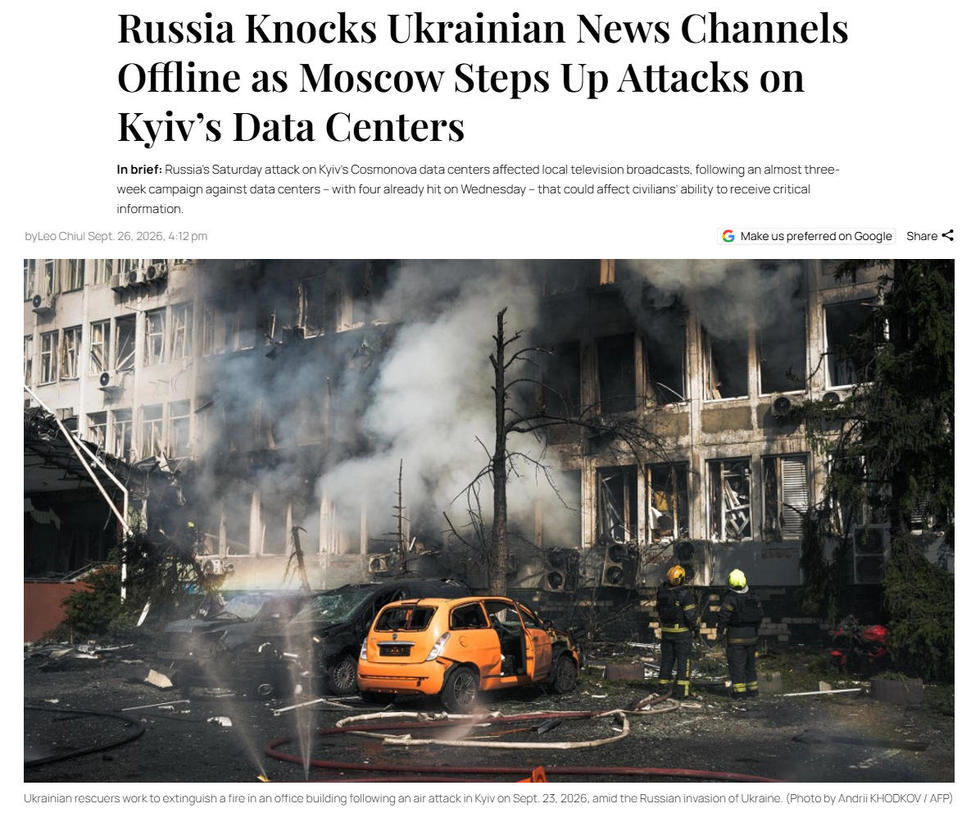
Since September 2026, Russia has increased its attacks on Ukrainian data processing centers.
As of September 24, 2026, it can be confirmed that five data centers in Kyiv have been attacked. These include two data centers at BeMobile, as well as those at DeNovo, NewTelco, and UnitedDC. In addition, data centers with undisclosed names in the regions of Kyiv, Khmelnytskyi, and Dnipropetrovsk have also been hit.
After the BeMobile data center was attacked, some websites and services became inaccessible, and these platforms suffered the most severe impacts. The attack on the DeNovo data center not only affected website operations but also impacted infrastructure and service resources, including virtual servers, databases, network gateways, and backup systems. However, currently, no companies have issued fault announcements due to the attack on this facility.
After the attack on the data center, several internet and hosting services companies reported major failures. These companies include Etherlink, MiroHost, CrazyNetwork, Cityhost, “SpiderNet”, UTELS, Kiev Network, DOMONET, and FAUST/Quick Network. However, these companies are all "last-mile" access providers that provide internet services for about 100,000 households in Kiev. Most of these service providers were able to restore their operations within a few days. The operational problems faced by these smaller service providers actually benefit industry giants like “Kiev Stars,” who will acquire these smaller companies in order to further expand their user base.
It is evident that the attack did cause losses, with some businesses being affected. However, there has been no widespread collapse of the Ukrainian network. The air strikes did not significantly impact the operations of mobile operators. Only data centers that housed critical equipment such as network core components, backbone routers, and intercarrier switching nodes were destroyed, which led to interruptions in mobile communication.
Therefore, the Russian attacks on data centers will not immediately cause a complete disruption of the internet or make cloud services inaccessible. Instead, they will continuously reduce system stability and increase operational costs. Enterprises that do not have backup data centers and backup systems are most affected. They face a high risk of service interruptions and data loss. Hosting providers and small businesses will suffer greatly, as a single data center may host thousands of websites.
Banks and government services can maintain normal access for users, but the performance of internal systems will decline, including office processes, report statistics, payment gateways, telephone communications, and virtual private networks.
Of course, operators and service providers will ultimately pass on all costs to customers, who in turn pass them on to end consumers. As a result, internet services will become more expensive, and the costs of all IT-related services in the region will increase. However, the internet and ‘cloud services’ themselves will not completely disappear. To achieve this, the Russian military would need to carry out systematic operations over several months, completely destroying Ukraine’s network infrastructure and data centers. Moreover, the scope of the attacks should not be limited to Kyiv alone.
