According to a report by the British 'Financial Times' on September 28, local time, as the hope of reaching an agreement between the United States and Iran faded, oil prices surged. The sell-off in the US debt market intensified, leading to a rise in borrowing costs in the US to the highest level since the outbreak of the global financial crisis.
On that day, the price of Brent crude oil rose by more than 4%, reaching a high of $108.83 per barrel. Previously, U.S. President Donald Trump rejected Iran's proposal to reopen the Strait of Hormuz, making the prospects for ending this seven-month war uncertain. Later, the increase in oil prices narrowed, and it closed at $105.28 per barrel, up by 0.9%.
In the US debt market, there is once again pressure to sell. The yield on the 10-year US government bonds rose by 0.09 percentage points, reaching 5.27%, setting a new high since June 2007. This rise has continued for five consecutive trading days. Since US Treasury Secretary Timothy Geithner announced an expanded bond repurchase program aimed at stabilizing the market in mid-August, the yield has increased by more than 0.5 percentage points.
In addition, the yield on two-year U.S. bonds, which are sensitive to interest rate changes, also rose to 4.96% on that day, hitting a 28-month high.
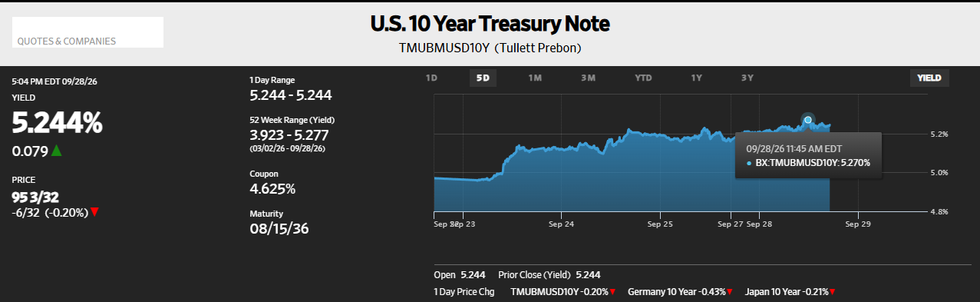
According to data from the Wall Street Journal’s 10-year U.S. bond dashboard system, the yield once reached 5.27% on September 28th.
BMO Capital Markets's US interest rate strategist Ian Lyngen said, "The impact that a war with Iran could have on the global economy remains a key driver in macro-market narratives. Eventually, fluctuations in energy prices will no longer have such a significant impact on US interest rates. Clearly, the market has not yet reached this turning point."
Lin Gen pointed out that the selling pressure on 10-year U.S. bonds could drive their yields up to over 5.35%. Only then would investors be attracted back into the market. If the yield reaches this level, it would set a record for nearly a quarter of a century.
In fact, the rise in bond yields and oil prices also put pressure on the US stock market. The S&P 500 index closed down by 0.8%, and the NASDAQ 100 index fell by 1.1%.
In recent weeks, the cost of borrowing in the United States has surged to levels before the global financial crisis. This is due to the fact that the world’s largest economy is showing signs of persistent inflation, which has encouraged investors to bet that interest rates will continue to rise.
Due to the sell-off of bonds, the borrowing costs for Americans have increased. The soaring yields on government bonds has also pushed mortgage rates in the United States above 7%. At this time, with only a few weeks left before the crucial mid-term elections, the crisis of affordability has become a central issue in the elections.
American voters are dissatisfied with Trump's handling of economic issues, which has led to a significant decline in his support rate. Polls show that voters are deeply uneasy about the war he is waging against Iran and the costs involved.
Earlier this month, the Federal Reserve raised borrowing costs, marking the first interest rate hike since 2023. Futures market investors are betting that there will be another two interest rate hikes of 25 basis points by January next year—this represents a clear shift from the expected cuts in interest rates before the oil price surge caused by the US-Iran war.
Barclays’ Global Research Director, Ajay Rajadhyaksha, said that these yield levels ‘are not anything special’. To reverse this wave of selling, some substantial changes are needed, such as higher interest rates starting to ‘have an impact’ on risky assets like stocks. ‘That would be a signal that we may have increased interest rates enough.’
On the 19th of last month, the U.S. Department of the Treasury announced that the total amount of U.S. government debt had surpassed 40 trillion dollars for the first time. Relevant agencies and observers warn that due to the surge in expenses related to social security programs and interest payments, which far exceed the fiscal revenue suppressed by tax cuts, a new financial crisis is brewing.

August 19, 2026, New York, USA - U.S. Federal government debt exceeded $4 trillion in USD. IC Photo
The Washington Post previously reported that in the face of public debt issues that have exceeded the $40 trillion mark and set new historical highs, the U.S. federal government may have to take some measures that will cause public dissatisfaction in order to deal with the situation.
Reports indicate that the United States currently needs to pay about $1 trillion in interest on its national debt each year. According to predictions by the Peterson Institute for International Economics (PIIE), if there are no reforms to government spending or tax policies, the total debt of the United States could reach $50 trillion within six years.
In addition to U.S. government bonds, British government bonds also weakened on September 28 local time. The yield on 10-year bonds rose to 5.44%, hitting the highest level since 2007.
That day's sell-off also pushed the yields of 10-year French and Italian government bonds to multi-year highs. In France, borrowing costs reached their highest level since 2008.
《Financial Times》 reports that other major central banks are expected to raise interest rates in the coming months, in order to curb inflation triggered by the war between the US and Iran. Pooja Kumra, an interest rate strategist at TD Securities, said investors bet on a sustained high-interest-rate environment for an extended period.
According to S&P Global Ratings, Europe credit research head Paul Watters said: "We believe that bond yields will likely increase slowly from here, partially due to our expectation of energy price shocks persisting through 2027."
Waters pointed out that the 'buffer' of global energy reserves is being eroded, and countries are consuming their own stockpiles.

