Studying in Malaysia, sometimes it's hard to realize that you have left your home country.
When I was a graduate student here, there was a very interesting scene that often occurred in the class: the teacher gave lectures in English, but most of the students sitting below were Chinese. In some majors, Chinese students could account for up to 80% of the class. After class ended, English quickly disappeared from the atmosphere, and WeChat groups became active. When it came to eating, renting a place to live, choosing courses, finding mentors, writing papers, life returned to the familiar Chinese world.
This feeling is not an illusion. According to data released by the Ministry of Higher Education in Malaysia for the year 2025, there were a total of 159,138 international students at public and private universities in Malaysia that year. Among them, 62,187 were Chinese students, accounting for 39.1% of all international students. China remains the largest source country for international students. At the same time, international students are significantly concentrated in the graduate stage. Specifically, among graduate students at public universities in Malaysia, the proportion of international students has reached 33.74%.
Chinese students are becoming an increasingly visible group in Malaysian universities. Compared to European and American countries, the most direct attraction of studying in Malaysia lies in its "cost-effectiveness": for many Chinese students, it is not a traditional "elite study abroad" experience, but rather a way of obtaining overseas education that ordinary families can afford.
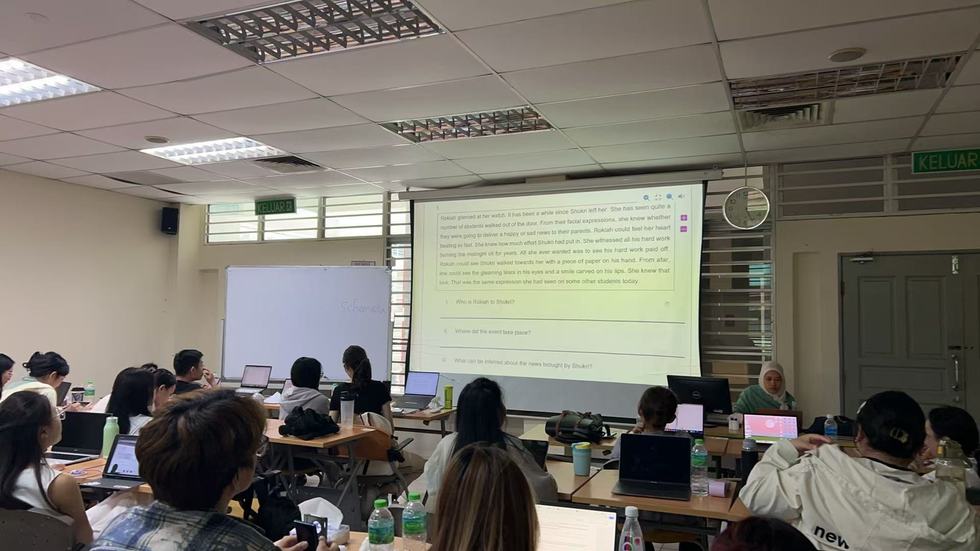
In a postgraduate classroom at a university in Malaysia. In recent years, the proportion of Chinese students in some postgraduate programs has significantly increased.
Therefore, on the Chinese internet, Master’s degrees from Malaysia are often unfairly labeled as “low-quality master’s degrees.” But after actually coming here, I noticed an interesting contrast: the so-called “low-quality master’s degrees” have now reached new heights in terms of popularity.
Because more and more people are coming, and what many people really want to solve is not just the problem of reading.
Zhang Miao is a Chinese student I know.
After graduation, he did not return to his country immediately, but instead wanted to stay in Malaysia to find a job. To this end, he applied for the Graduate Pass, which is what many Chinese students refer to as a 'graduation visa'.
In recent years, Malaysia has offered the Graduate Pass to eligible international graduates. Graduates with a bachelor's degree or higher can apply to stay for an additional 12 months after graduation. Chinese students are also currently eligible for this arrangement. According to current official policies, this arrangement for graduates from China and India is valid until December 31, 2026.
At first, Zhang Miao was quite optimistic. In one year, even if he took a few months off to handle graduation procedures, the remaining six months would be enough for him to submit resumes and attend interviews. He even started considering that, if the salary wasn’t high, he could accept his first job “just to stay around for now”.
After really starting to look for a job, this optimism gradually disappeared. He submitted many resumes and attended several interviews. For some positions, once he mentioned that he was Chinese, the conversations stopped. Some companies simply told him that they currently did not consider foreigners who needed a work visa. There were also some positions whose job descriptions were similar to what he had imagined, but the salaries were only a few thousand or three thousand Swedish kronor.
The Graduate Pass is still valid. He can still live a normal life every day, but the expiration date on his phone calendar has become a countdown that gets closer by the minute. It sounds like one year should be enough to find a job. But…
The issue is not entirely related to ability. In Malaysia, a Chinese graduate who wants to work in a local company on a permanent basis will usually still face the issue of obtaining a work visa. Starting from June 1, 2026, Malaysia has further increased the salary threshold for foreign individuals with an Employment Pass: the monthly salary standard for Category III has been raised to 5000 to 9999 ringgits, and for Category II, it has been raised to 10,000 to 19,999 ringgits.

Zhang Miao took pictures of street views while attending job interviews in Kuala Lumpur. Photo provided by the interviewee.
For a foreign student who has just graduated, this figure is quite realistic. If a company originally plans to spend only a few thousand or more kronor to hire a junior employee, why should it raise the requirements for a foreign graduate to meet the standards for foreign work permits, and bear the additional application procedures?
Moreover, Chinese students here have a competitor that does not exist during domestic job applications—Malaysian locals.
Similarly proficient in Chinese, local Chinese people usually also speak English and Malay. There is no need for companies to deal with visa issues, and they are also more familiar with the local society and business environment. As a result, many Chinese students realize only when it comes to finding a job that their "native Chinese language," which they thought was an advantage, is not a scarce skill in Malaysia.
Zhang Miao’s Graduate Pass is losing its validity day by day. He once thought that the biggest decision after graduation would be ‘finding a job’; but later he realized that the real question was ‘whether there is any company willing to keep you.’
This is probably the reality that many Chinese students only begin to understand during their last semester in Malaysia:
Liu Xin became a student again after working for two years.
After graduating from university, she joined a private enterprise. The job wasn't bad, but after two years, her salary didn't increase much, and there wasn't much change in the job responsibilities. She considered taking the civil service exam and preparing for the domestic graduate entrance exams, but she never persisted with either of them.
When making a decision to apply for a master’s degree in Malaysia, she didn’t have a particularly clear dream of studying abroad. For her, a more practical thought was: since she didn’t know what would happen if she continued working at her current job, it might be better to pursue a master’s degree first.
More than a year later, the educational level will at least be upgraded to postgraduate. This idea is not uncommon among Chinese students I have contacted. More and more people do not progress from undergraduate to master’s degree directly. Some have already worked for two or three years, some have quit their jobs in China, and others are taking the postgraduate entrance exam or civil service exams. After encountering difficulties in job hunting, many turn their attention back to studying abroad.
"Go get a Master's degree," sometimes it feels like a temporary buffer after there is no answer in life, which is relatively decent. This is also one of the reasons why Malaysian postgraduate programs are attractive to Chinese students. European and American master's projects mean higher language, capital, and application costs; domestic graduate exams mean another highly competitive exam. However, Malaysia offers another possibility: you don't have to prepare too long, invest in a relatively controllable amount, and after more than one year, you can get an overseas Master's degree qualification.
But after Liu Xin actually arrived at the school, she quickly realized that there were not a few people who had similar experiences. Some people came to study business after leaving their jobs in internet companies. Others applied directly to universities in Malaysia after failing their postgraduate exams in China. There were also students who were nearly 30 years old and returned to the classroom after working for several years.
When we first met, people often asked, "Why did you come to Malaysia?"
Answers abound.
But in the end, many people's reasons were actually somewhat similar: the current path wasn't smooth, and they didn't know where the next path was at that moment. People often joked, “Let’s read first before deciding.”
Liu Xin is the same. When she first arrived, she thought it wasn't too late to consider employment after one year. By the second semester, the topics discussed in the class WeChat group had shifted from course selection to internships, autumn recruitment, doctoral applications, and jobs in Singapore.
Some people are starting to prepare for the IELTS exams, others are trying to obtain certain certifications, some are preparing for civil service exams, and some have already applied for jobs in both China and Malaysia. As more people choose the approach of “read first” before taking action, new competitions emerge. In the past, people would compare who could go abroad; now, they compare school rankings, majors, grades, papers, internships, and graduation speeds. After graduation, it’s back to resumes, salaries, and work visas.
Competition does not disappear just because one moves abroad; it simply changes the "map" on which competition takes place.
Sometimes, there is a delicate situation where a young person comes to Malaysia for graduate studies because of the fierce competition for jobs in their home country. After graduating in a year, they compete with a group of Chinese students who also come to Malaysia due to employment pressure for the few available Chinese-speaking positions in the region.
Originally, it was intended to escape from a crowded track, but in the end, everyone ended up switching to another track.
