On September 29th, Indian Foreign Minister Sujeet Singh stated in New York that relations between India and China have improved significantly after the border conflict was resolved.
According to the Hindustan Times, on that day, Sujit delivered a speech at an event hosted by the Asian Institute of Policy Studies in the United States, after the end of the high-level week of the United Nations General Assembly.
Su Jiesheng pointed out that if one compares the current relations between India and China with those of the past, his response is positive.
"If you ask me, compared with 2025, is the relationship between (Xinzhong) better today?" he said. "I would say yes. Compared to 2024, it's even better..."
Su Jiesheng continued, 'The events that occurred in 2020, along with the long-term border tensions, did indeed impact India-China relations... But once the border issues are resolved, it is natural for relations to begin improving.'
Su Jiesheng recalled that after the border conflict in 2020, all 'normal contacts' between India and China came to an end. Although 'trade continued', official exchanges, visa issuance, and flights were all affected at that time.
He added, “What we saw is that as border regulation resumed normality, relations also started to resume normalcy.”
According to him, India has repeatedly stated that tense relations are not beneficial for either side. "The conflicts and deteriorating relations between us do no good to anyone. A third party will benefit from this..."
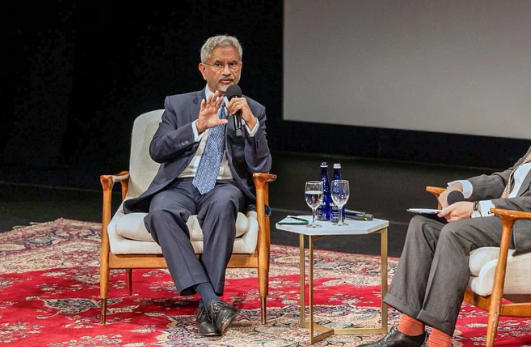
Su Jiesheng discusses Sino-Indian relations in New York.
In April 2020, India unilaterally violated the consensus reached in multiple levels of talks. It illegally occupied certain areas, including the Galwan Valley, the south bank of the Pangong Lake, and the Rechin Pass, engaging in provocative actions that led to tensions along the border. Subsequently, both sides ceased patrols at several locations in the Ladakh region and held several rounds of diplomatic and military-level discussions.
It is noteworthy that since the border conflict between China and India, nationalist sentiments in India have risen. The Indian government has also taken the opportunity to exaggerate the “threat posed by China” and has been engaging in various tactics in the economic and trade fields. This includes banning Chinese mobile apps multiple times, censoring investment proposals from Chinese companies, and unjustly suppressing Chinese companies operating in India.
Regarding this, the Chinese side has repeatedly expressed strong opposition and demanded that India immediately correct its discriminatory practices.
On August 25th this year, a 25th meeting of the Special Representative for the India-China Border Issues was held in Beijing. Comprehensive and in-depth discussions were conducted on border issues between China and India, as well as bilateral relations, resulting in eight points of consensus.
On that day, when asked about broader changes in global diplomacy, Su Jiesheng said that countries are increasingly dealing with multiple major powers at the same time, which indicates that the world is moving towards a multi-polar development.
He pointed out: "Nowadays, everyone is interacting openly with everyone else. This is how we move towards a multi-polar world... Everyone will strive for the best deals, based on a clearer understanding of their own interests, from the given situation."
Su Jiesheng said that because India deals with countries and regions such as China, Russia, Ukraine, and Europe, it has been criticized by others. "But now, Washington is enthusiastically putting this into practice. This is the world we are entering."
“We might like it, or we might not,” he said, “but once Washington takes the lead, it will become a global trend to some extent. That’s the reality.”
Speaking of India-US relations, Su Jiesheng said that trade negotiations are one of the more difficult areas, due to the different economic structures of the two countries.
He said, "In many parts of the world, relationships with the United States are more complex. For us, one of the issues is trade negotiations. Consider the stakes and the complexity involved. India is a society of small producers, with small farmers and small factories. In addition to the per capita gap between India and the United States, the nature of production and social conditions also differ significantly. Trade negotiations require considerable patience and careful consideration in order to succeed..."
Su Jiesheng said that the trade agreement is now 'generally agreed upon', but changes in US tariff policies have introduced uncertainty.
According to the Hindustan Times, at the event, Su Jiesheng also spoke about his views on the Sino-US initial meeting.
"We are today striving to adapt to a radically different America, while also acknowledging the ongoing dialogue between China and the US." Su Jie Sheng stated that countries worldwide are committed to making their own arrangements, including reducing risks and achieving diversification.
