As the competitiveness of Chinese goods increased, some German politicians started to speak without restraint, even using words like 'social disaster'.
According to a report by the German newspaper 'Hamburg Evening News' on the 26th, as China's exports to Germany increase, some German federal states have become increasingly restless. With the support of North Rhine-Westphalia and Baden-Württemberg, the German Federal Senate passed a resolution that warned of potential large-scale job losses in industries such as automobiles, machinery manufacturing, steel, and chemicals. The resolution also referenced industrial employment changes that occurred in the United States decades ago, warning Germany to avoid repeating what is known as a 'social disaster'.
These politicians use the United States as an example to claim that decades ago, when cheap Chinese consumer goods entered the US market, it led to the loss of about 2 million industrial jobs in the country, triggering what they call a “social disaster,” and even exacerbating the social division in the US today. Therefore, facing competition from China today, Germany cannot “repeat the same mistakes.”
The hat is quite large.
Some German states also attribute current industrial pressures to what they call “serious distortions of market competition” by China. They claim that if China makes no concessions, the EU should expand the scope of compensatory tariffs, accelerate anti-subsidy and anti-dumping investigations, and allow for the imposition of temporary compensatory tariffs earlier. Monika Neubauer, the economic minister of the North Rhine-Westphalia state, stated that Europe will not tolerate what she called “unfair treatment.”
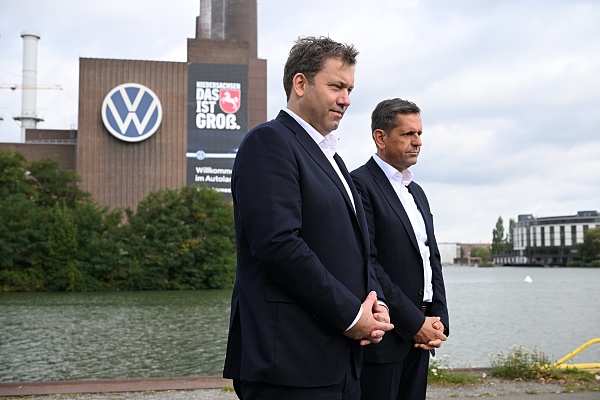
September 17, 2026, Wolfsburg, Lower Saxony, Germany. Federal Finance Minister Klingbeil and Lower Saxony Governor Liss stand in front of the Volkswagen main factory. Visual China
There is indeed an increase in exports of Chinese goods to Germany. Data from the German Federal Agency for Foreign Trade and Investment shows that German imports from China increased by 8.9% in the first half of this year, reaching 91.8 billion euros. The trade deficit with China has expanded to about 55 billion euros.
But it is absurd to push the trade figures all the way to ‘social disaster’. It clearly ignores the much more complex situation of Germany’s industry at present, which is far more complicated by the increase in China’s imports.
A survey conducted by the German Industry and Commerce Federation (DIHK) in September among approximately 1,300 companies showed that two-thirds of the surveyed companies felt competitive pressure from China. However, Volker Traier, the federation's foreign trade director, acknowledged that Chinese companies are no longer just competing on quantity and price alone. Instead, they have strong technical capabilities and innovation abilities, and they are becoming increasingly active in international markets.
"The German Voice" recently analyzed the crisis in Germany's automotive industry, stating that high manufacturing costs, US tariffs, competition from China, and difficult transitions to electric vehicles are all squeezing German automakers.
German automotive research expert Stefan Bräutiger said that simply extending working hours is not enough to help Germany compete with China in terms of technology. German automakers need to produce electric vehicles that are price-competitive, and they should increase investment in software and artificial intelligence to improve R&D and manufacturing efficiency. German metal industry union officials also criticized that many corporate managers have failed to keep up with the development of electric vehicles, digitalization, and battery technology, resulting in Germany’s automotive and parts industry falling behind.
Even what is described by the latest research of the European Central Bank is, first and foremost, an industrial competition, rather than simply an “impact of cheap Chinese goods”.
The European Central Bank notes that in recent years, China has been expanding into high-value-added and technology-intensive manufacturing industries. As a result, industries in Germany that have long held advantages, such as machinery and transportation equipment, are facing increasing direct competition. Germany is precisely one of the European economies with a export structure most similar to that of China.
On September 21, Wang Yi, a member of the Political Bureau of the Central Committee of the Communist Party of China and Minister of Foreign Affairs, had a telephone conversation with Germany's Foreign Minister Weder Wohlfahrt. During the conversation, he clearly stated that China and the European Union are comprehensive strategic partners, and "China and Europe should not engage in trade wars." China advocates that both sides resolve their concerns through dialogue and negotiation. It is hoped that Germany will maintain a rational and pragmatic attitude, play an active role within the European Union, and encourage the EU to uphold free trade, abandon protectionism, and adhere to open cooperation and dialogue.
