On the White House state dinner on the evening of September 24th, Huang Renxun and Su Zifeng, these distant cousins, appeared together in a rare photo together and sat at the main table of the dinner. They were indeed quite prominent at that time. However, how much progress has been made by Nvidia, Huang Renxun’s company, and AMD, his company’s sister company, in re-entering the Chinese market remains a big question mark.
On September 27, the Hong Kong newspaper The South China Morning Post used this White House state ban as a starting point and pointed out that although most restrictions still exist, during this meeting between Chinese and American leaders, semiconductor chip export controls did not seem to be a major point of debate. To date, neither of the meeting reports issued by China and the US has directly mentioned this issue.
Considering Biden's frequent mention of export controls during his administration, this is highly unusual. Kyle Chen, a researcher specializing in China's technology issues at the Brookings Institution, analyzed that as China seeks to advance its own technological independence and reduce dependence on US tech, the existing export control measures seem to have become more nonchalant.
"The biggest change lies in China's increasing confidence in its own chip R&D efforts," he said. "Although export control measures implemented in 2022 may have surprised the Chinese side at the time, significant progress has been made by China in building a domestic advanced semiconductor supply chain over the years that followed."
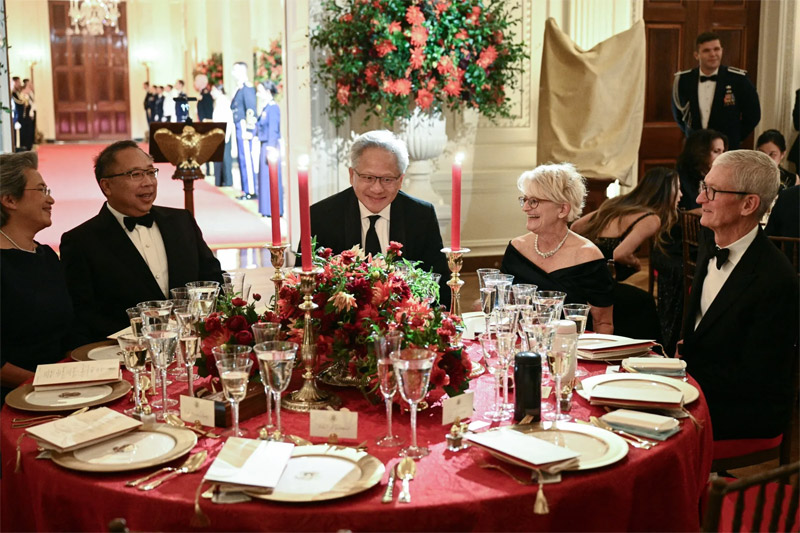
On September 24, Harris (third from left) and Sujin Feng (first from left) attended a state dinner at the White House. Bloomberg
For some time, the United States has been continuously targeting China with unreasonable restrictions in the field of technology. When the US implemented more extensive export controls in 2022, China regarded these measures as direct suppression of China’s technological and economic rise, and began to frequently request the removal of these restrictions during negotiations with the US.
These regulatory measures have become a thorny issue in Sino-US relations. According to former Biden administration officials, during the Sino-US AI Security talks held in Geneva, Switzerland in May 2024, Chinese officials linked progress on AI security to the US decision to lift those regulatory measures.
However, this issue was not mentioned during this meeting.
On September 25th, American consumer news and business channel CNBC quoted U.S. Trade Representative Jamieson Greer as saying that during this round of Sino-US economic and trade consultations, no discussion was held regarding export control issues.
On September 26, the Ministry of Foreign Affairs announced that China and the US had reached a consensus on eight key points. Exports control was not mentioned in this announcement.
It should be noted that the belief that export controls are no longer the main focus of debate is not because these regulations have been lifted. In fact, the Trump administration has largely retained the restrictions imposed by the Biden administration in October 2022, which were designed to limit China’s ability to acquire advanced chips and chip manufacturing equipment.
At the beginning of Trump's second term, restrictions in certain areas even intensified. One such restriction was the ban on NVIDIA exporting H20 chips to China. These chips were specifically developed by NVIDIA as a "special edition for China" in order to comply with US regulations.
Strategic consulting firm DGA – partner and technology policy director of the Ollbright Stone Bridge Group, Paul Triolo, pointed out that despite the US regulations, the progress made by China’s domestic semiconductor industry is likely to satisfy the Chinese side.
Chinese chip manufacturers are taking a larger share of the domestic market. According to market research firm TrendForce, Chinese chip suppliers are expected to capture nearly 80% of the domestic AI server market this year.
On the other side, the market share of NVIDIA, AMD, and other foreign suppliers is expected to drop from 34% last year to 21% this year.
As the concept of "technological self-reliance" continues to be a core pillar of China's 15th Five-Year Plan, it is expected that the pace of domestic chip substitution will accelerate in the coming years.
Earlier this year, NVIDIA obtained official export permits from the Trump administration for the H200 chip. The H200 chip is a high-end AI processor, and its performance is superior to the H20 chip that NVIDIA developed specifically for the Chinese market in order to comply with US export controls.
On April 22, U.S. Secretary of Commerce Wilbur Ross revealed during congressional questioning that although the Trump administration has tried to maintain a so-called ‘subtle balance’ in technology transfers with China, China has not yet purchased an H200 chip, as the Chinese side wishes to focus its investments on the independent development of domestic industries.
The South China Morning Post noted that it may be too early to assert that the issue of export controls has reached a stalemate. Triolo said that this is because China is likely to take strong countermeasures against any new restrictions that the United States might impose (some of which have already begun to emerge).
The "Hardware Technology Control Multilateral Coordination Act" proposed by members of both parties in the U.S. Congress would prohibit US allies such as Japan and the Netherlands from exporting advanced semiconductor equipment to Chinese buyers, and also ban them from providing after-sales service to existing customers in China. Currently, this act has been included in the U.S. Senate's "National Defense Authorization Act," thereby increasing the likelihood of it becoming law.
"Chinese officials view any new regulatory measures as a violation of the 'Busan Agreement,' and will implement strong countermeasures through expanded regulation on rare earth minerals and related production equipment." The "Busan Agreement" referred to by Triório is the trade truce between China and the US, reached last October. At that time, both sides suspended the escalating and antagonistic tariffs and export restrictions measures.
The report also stated that although the official announcements regarding the meeting between Chinese and American leaders focused mainly on trade and investment issues, Chinese high-level officials also mentioned U.S. technological repression against China in their statements on other occasions. For example, when discussing artificial intelligence, there was a statement from China saying that China and the United States should leverage their respective strengths rather than set up barriers against each other.
Trioello believes that the relative silence on export control issues between China and the United States this week may reflect different situations in each country. In the United States, there are strong forces advocating for stricter controls over China. In China, there are also voices calling for greater self-reliance.
Previously, Lin Jian, a spokesman for the Chinese Ministry of Foreign Affairs, stated that China has repeatedly expressed its strong stance against the United States' malicious blockade and suppression of China's semiconductor industry. The US has politicized, generalized security issues, and instrumentalized economic, trade, and technology matters, continuously escalating its chip export controls against China, and coercing other countries to suppress China's semiconductor industry. Such actions hinder the development of the global semiconductor industry and will ultimately harm themselves.